Monday, July 22, 2013

Dressing for Men: The Tailor Mottel Kamzoil

Finding a good seamstress is not easy. 
http://upload.wikimedia.org/wikipedia/commons/7/76/Renoir_Seamstress.jpg
Renoir's Seamstress
I've had one who would take things in by virtual millimeters since her Korean sensibilities were, apparently, more modest than mine.

Alternatively, I brought a dress to another tailoress to hem up, only she chopped off too much fabric, blatantly exposing my knee. I ended up giving the dress to my sister-in-law, and I have a sneaking suspicion she sold it on Ebay.

Finally, I found someone nearby, who does exactly what I need, all for a great price. A good seamstress will also tell the customer whether it is worthwhile or not to alter a garment, or if she cannot do what is requested, rather than bumbling along and destroying the skirt or jacket. 

But then she failed me, butchering, quite unnecessarily, at least ten skirts. I was frantic, begging everyone for suggestions, until I tentatively handed my precious garments to the Korean needlewoman (yes, another) at my cleaners. A master of her craft! A thousand blessings on her head! 

Females, understandably, require a regular seamstress. We've got all those hems-elbows-collar issues, and off-the-rack items rarely fit perfectly. I need many skirts taken in/out, or let down/hemmed up. 

Men may think they can go without a tailor. Non, non, non, mais amis

It is incredibly disturbing to see a man in pants that make him look as though he has child-bearing hips.  

Fellas, once upon a time all clothing was custom. Off-the-rack changed that, meaning that only once in a while will a garment fit perfectly.
 

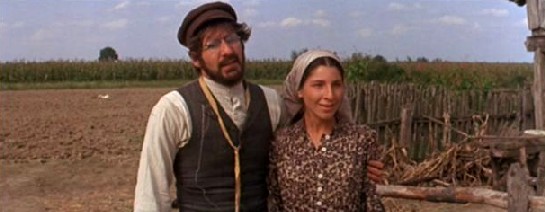
My father's tailor is an artist who charges through the nose, but he is so worth it. Especially in the business world, looking sharp means having Mottel Kamzoil on speed-dial. 
 http://dustedoff.files.wordpress.com/2009/06/pic67.jpg?w=560
Ask around—do not pick a name from the Yellow Pages! Go by recommendation only

Although, Luke had a bad experience. He took a magnificent suit to the same amazing tailor, who made it fit like perfection, only he was then caught in a torrential downpour and the suit shrank. 

After going to the tailor . . . invest in a good raincoat and bookmark Weather.com. 
http://s3.thisnext.com/media/largest_dimension/648A4222.jpg

Sunday, July 21, 2013

Battle of the Bulge: Learn from a Cartoon Character

Animaniacs was one of my favorite shows as a kid; therefore I was giggling when FrumGeek forwarded me this video as a suggestion for my "Battle of the Bulge" series: 
Note what the Warner siblings are doing; going up and down the aisles and chucking boxes and bags and cartons of food into their cart. That's a no-no. 

Stick to the outer perimeter, specifically the produce section. 

Friday, July 19, 2013

Courtesy is NOT Dead!

Joel Stein did observe in his article about Millennials that they are nice. No, really. 

As technology explodes, people are not sure how to behave in the digital realm, and are losing the ability to interact in person. Apparently, a swarm of young and hip etiquette gurus have filled the void, as Alex Williams reports. 
Young people “are getting sick of the irony, rudeness and snark that is so prevalent in their online lives,” said Jane Pratt, the editor in chief of xoJane, a women’s lifestyle site where etiquette posts are a popular feature. “The return of etiquette is in part a response to the harshness of the interactions they are having in the digital sphere.”
“Nice is very cool right now,” she added. 
Why is nice cool? That can be explained as this generation channels vintage mannerisms: 
There’s this idea in sociology that every generation rebels against its parents and makes friends with its grandparents’ generation,” Mr. McKay said. “You see that with Generation Y dressing like ‘Mad Men,’ and you see that with etiquette. The baby boomers were about ‘let loose, be who you are.’ The ‘greatest generation’ was more formal, and people want to embody some of those grandpa values.”  
The hippie generation let it all hang out; the previous was dapper with suits and hats on a daily basis. Watch any film on TCM; the streets of New York are filled with men and women suited, hatted, and gloved. 
  
As I keep on saying, appearance means a lot. When I'm groomed and dressed and well shod, I stand straighter, I think more before I speak, I'm freakin' polite. Can't be helped. 

Wednesday, July 17, 2013

Apple Cider Vinegar: Not Just for Salads

I had come across the concept of using an apple cider vinegar (ACV) solution as conditioner, so I decided to give it a try with the bottle of Heinz already in my kitchen.

Since my current method of hair cleansing is shampooing only the roots then conditioning only the ends, the roots of my hair needed a little more consideration. But applying any conditioner up there would lead to greasy hair in no time. 

ACV conditions without residue, plus it is beneficial to the scalp, treating issues like dandruff and oiliness. Something to do with balancing pH. 

Current procedure: 

1) Shampoo roots, rinse; 

2) Condition ends, rinse; 

3) Pour an ACV solution all over, rinse. 

The results? 

Despite my deep conditioning treatments, including a weekly coconut oil hair mask, when I rinse the ends of my hair (where most of the damage happens) with ACV, the ends are distinctly softer than with conditioning alone. (I have tried using the ACV without conditioning but the results weren't as nice as when using both.) 

Additionally, my hair, usually thick and heavy, feels lighter. According to one theory, the ACV removes residue that can weigh down hair. Because it supposedly "seals" the hair, I believe I am getting less split ends. 

There are differing opinions as to water to ACV ratios; some say 1 tablespoon in a cup of water, others 1 part to 1 part. I just eyeball it, pouring it into a squeeze bottle. Obviously, avoid getting it into eyes. 

I don't apply any additional product afterwards, and my hair now dries beautifully on its own, or if I style with my trusty Infiniti Pro by Conair Spin Air Rotating Styler, the waves stay even after being slept on for more than one night, when previously the additional oils in my hair would refuse to hold the look.

As for skin, it has been hailed as an acne cure, banisher of scars, etc, etc. When my bottle of toner was used up, I reused the container to make for myself some ACV toner, which is working out quite well. 
https://blogger.googleusercontent.com/img/b/R29vZ2xl/AVvXsEhY_c5Y-0weOTGlarEMMsYTiURKmUxEpW_0OPE7T7VFNcPPdiEw4RUYps4jQLF1ze-aOFtc3Po8Lq4oWmeNmIGnQ0Y7w0MR5pWaAongSGsBQLKEvyEIIi9bEc2hyphenhyphentKqLAIlcNuvlZyRMDQ/s1600/apple-cider-vinegar1.jpg
Via www.luluandsweetpea.com
This article on Huffington Post by Kirsten Hudson provides more info; many beauty blogs are singing ACV's praises. It is recommended to purchase organic, so that item is ready and waiting in my shopping cart. 

And before you ask, no, the stink does not stay. 

Next challenge: Baking Soda Shampoo! 

Tuesday, July 16, 2013

Tehillim

I always had a bland relationship with Tehillim. I blame it, perhaps a bit cop-out-ish-ly, on a practice from my Bais Yaakov days; periodically, the morahs would grimly circulate laminated booklets of Psalms, which altogether would be the entirety of the sefer, meaning it was said in completion when disseminated amongst a classroom of twenty. But I mumbled and stumbled over the ancient meaningless words, often rushing as I did not have sufficient time. I certainly did not avail of it voluntarily outside of school hours.

Recently, a family member was diagnosed. A few days later, when the news of her illness finally sank in, topped with specific dating aggravation, then layered with bureaucratic red tape that prevented finalizing necessary documents, I felt low. I felt off-balance, my insides gibbering with unresolved chaos. I yearned for a divine blankie, a snuggle from Above, simply put, comfort. 

I scanned the available multitude of Tehillims on the seforim shrank, selecting one with an interlinear translation, and began to slowly enunciate the text (mostly) penned by Dovid HaMelech, one of the few granted the title, "Servant of God." At times his eloquence made my eyes well up. 
http://www.jerusalemtempleprayers.com/uploads/images/david.jpg
Then I felt His presence, His warm and fuzzy security enveloping my overwrought thoughts in soothing consolation. I was at peace, tossed onto level equilibrium from my previously shaky perch. How is it that 3,000 years old compositions can speak to my soul? Dovid didn't pussy-foot about his difficulties; he describes his agonies all-too poetically. But then he concludes on the love of God, the magnitude of God, the salvation of God.   

I have now made my way back to Tehillim. I do not necessarily say it in request, but simply as a means, like telephone or email, to commune with the Almighty, knowing, that in the midst of heartache, succor can be found.

In her articles regarding evangelical Christains, T.H. Luhrman considers the therapeutic benefits of faith in "When God Is Your Therapist." I am not familiar with the methods practiced by flesh-and-blood psychologists beyond humorous scenes in sitcoms, but the basic premise is that one voices their problems to a sympathetic ear.   
A young man — a kind man with two adorable children and a loving wife — died unexpectedly in one of the churches where I spent time. When the pastor spoke in church the following Sunday, he did not try to explain the death. Instead, he told the church to experience God as present. “This is a difficult philosophical issue for Christians,” he said. “We who believe in a loving, personal God who created the earth and can intervene at any time — we have this problem.” His answer? “Creation is beautiful but it is not safe.” He called our everyday reality “broken.” What should you do? Get to know God. “Learn to hang out with him now.”
I saw the same thing at another church, where a young couple lost a child in a late miscarriage. Some months later I spent several hours with them. Clearly numbed, they told me they did not understand why God had allowed the child to die. But they never gave a theological explanation for what happened. They blamed neither their own wickedness nor demons. Instead, they talked about how important it was to know that God had stood by their side
Reaction to difficulty should be like Dovid's, it would seem, whose Psalms provide the same premise: Hashem, I am in pain. I do not know why You have sent me these tests, but I know that they come from love, and that You are with me.

Viewing God as a loving deity as opposed to a fearsome one is good for one's health, as Luhrmann explains in "Why Going to Church is Good for You." 
What I saw in church as an anthropological observer was that people were encouraged to listen to God in their minds, but only to pay attention to mental experiences that were in accord with what they took to be God’s character, which they took to be good. I saw that people were able to learn to experience God in this way, and that those who were able to experience a loving God vividly were healthier — at least, as judged by a standardized psychiatric scale. Increasingly, other studies bear out this observation that the capacity to imagine a loving God vividly leads to better health. 
However, that is only if one sees God as being close and kind, not far and uncaring. 
. . . in one study, when God was experienced as remote or not loving, the more someone prayed, the more psychiatric distress she seemed to have; when God was experienced as close and intimate, the more someone prayed, the less ill he was. In another study, at a private Christian college in Southern California, the positive quality of an attachment to God significantly decreased stress and did so more effectively than the quality of the person’s relationships with other people.   
It all comes down to: 
. . . God is a relationship, not an explanation. 
As I now cling to this random Tehillim found in my den, I idly flip the first few pages. Apparently, this was given to each student by my Bais Yaakov graduation. That which I have blamed, has provided. 

Monday, July 15, 2013

The Seven Blessings

http://25.media.tumblr.com/tumblr_mdto02OZET1qzsuffo1_500.png
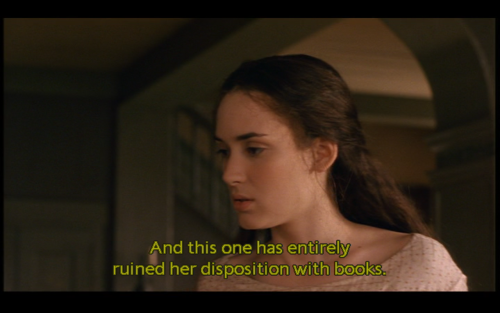
Via Little Women, 1994
As per Bad4's recommendation, I took out Ruchama King's The Seven Blessings from the library
http://jacketupload.macmillanusa.com/jackets/high_res/jpgs/9780312309169.jpg
What I liked about it is that it didn't try to white-wash the petty, nasty side of human nature, especially when it comes to dating. The narcissistic single man, who belittles his dates and spends the evening checking out the hotter woman at the next table, while it isn't pretty, it's real

The characters have their moments of questioning, of doubt, but there is a discussion that takes place that provides a new way of looking at Hashem that I hadn't considered before. It's not only about lonely souls, it's about lonely religious souls, and how they choose to react to the situations they find themselves in. 

Everyone, and I mean everyone, are shown as all too human, and in need of progress, which is certainly refreshing. Even the thick bachelor who is on the search for the "perfect" woman finally comprehends the error of his ways. 

The married individuals in the tale provide a realistic view of wedded "bliss"; marriage does require effort and work to keep it healthy and fulfilling. King's shadchanim, married but not necessarily happily, reflect that true contentment and satisfaction begins from within, not through another.  

I had read other books by non-Jewish publishing houses that really got our world wrong, and this is certainly more familiar than anything else I had come across, like The Outside World by Tova Mirvis (which I ended up skimming since I didn't find it ringing true). A baalas teshuva took her to task in the NY Times for her inaccuracies, while Mirvis defended herself on the basis that since it is fiction, it doesn't have to be accurate. Yeah, lady, it does. When I read a book about Mongolian shepherds, I go around quoting it because I expected the author to have enough respect for other cultures that he would make a point to do his research and represent the society accurately. 

King managed to describe our practices without over-explaining. Sometimes I fantasize about writing a novel about the frum world but three words in see footnotes in my mind's eye. She gives me hope that that won't be necessary.  

Until the last page, I was unable to put this book down, an amazing feat in itself as I usually need a break, even with novels that I like. 

I had loaned my purchased copy to a middle-aged man who claims to be quite discerning, and he adored it as well, calling it "charming." Having received his blessing, I heartily recommend this tale of not only love, but of faith, and the human desire to change for the better. 

Friday, July 12, 2013

Roasted Veggies

Need a simple, gorgeous, nutritious side-dish?

My guest for Shabbos had a food allergy that made pretty much all standard fare verboten. I scoured the internet, and decided roasted vegetables would be the safest. 

My trusty fruit store provided all the variety of vegetables I sought; sweet potato, zucchini (green, yellow, gray), peppers (red, orange, yellow), parsnip (I really love parsnip), carrots, eggplant.

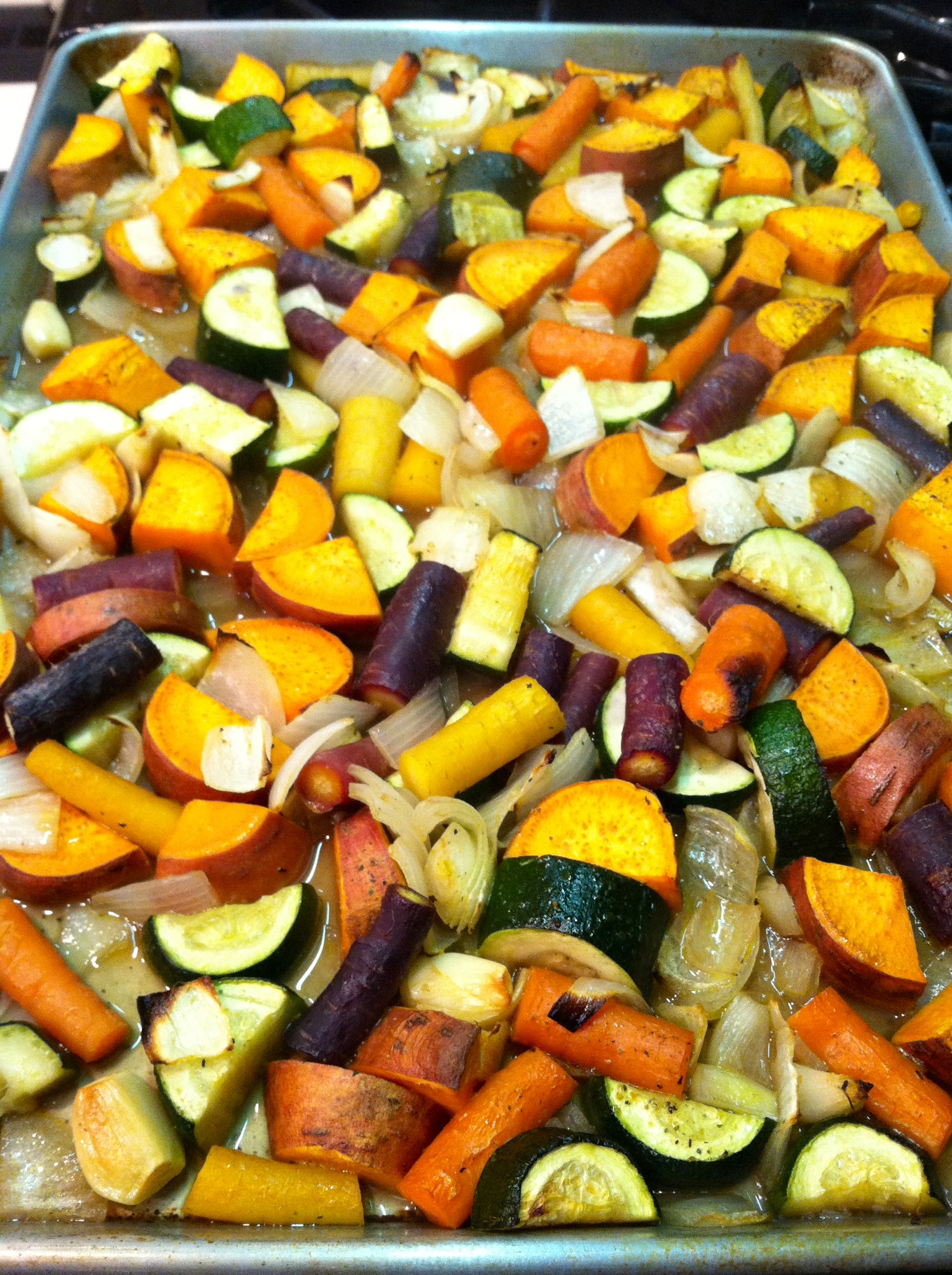
I chopped them all up into bite-sized chunks, tossed them in light olive oil with black pepper and salt, spread them out on a parchment-papered cookie sheet and threw it in a 400 degree oven for an hour or so. 

The results: Boom, baby! 
http://thehungryhusky.files.wordpress.com/2012/11/oven-roasted-vegetables.jpg
Via thehungryhusky.files.wordpress.com
I couldn't stop eating them. The colors are so vibrant they look more like decoration than food, and those same hues testify to the healthy stuff that keeps one healthy, as well as make excess poundage fall off. I kid you not, these have become my primary food group.

Now, want that awesome roasted flavor in a fraction of the time? 

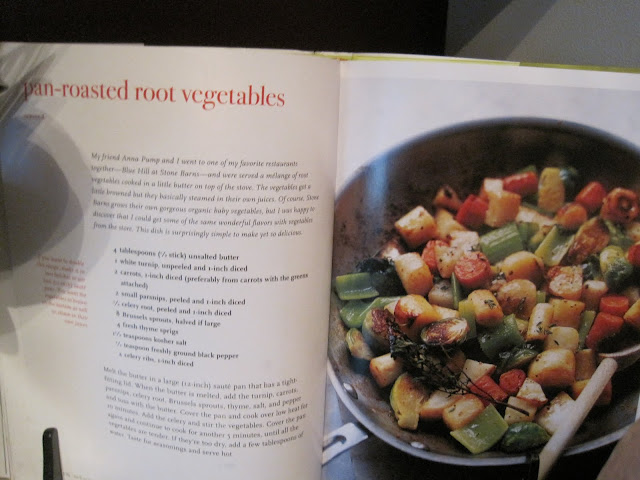
Simply chuck chopped veggies into an oiled pan with a well-fitting lid, dust with salt and pepper, place the flame on low-medium, cover, shake occasionally over 10-15 minutes, adding dashes of water if necessary, and voilà! As much as it hurts me, I must give the credit to the Barefoot Contessa. Blurgle. 

I never used to eat Brussels sprouts before, but guess what? They're like mini-cabbages, and when they caramelize, the heavens sing.
https://blogger.googleusercontent.com/img/b/R29vZ2xl/AVvXsEiFRuSjZP_gPlo2ohKEB1FFvbrtrMjlLgyyUkcnM6WUswJwOgKoxJKaSrsOKoe1BgfhM9xOJqpE4oycHIsWbf5ZATKYgzydFUsmYEHVTevYiGWpav2gDX1QRZESLk7AwDKikQV61dcqwSxh/s1600/IMG_0921.JPG
Via heartstransformed.blogspot.com
I personally prefer bite-sized chunks of everything, even though sweet potato and parsnip fries are trending at the moment. Then I don't have to bother grating my knife on my plate, or getting my fingers greasy, thank you. 

It is just ridiculously easy to make, to keep warm, and to reheat. Even if it is not directly on the blech or hot plate it is still very tasty. 

Thursday, July 11, 2013

Nature Will Win Out

I really like Frank Bruni. Down to his article on his loathing of summer, he seems to hit the nail on the head. 

Accordingly, his head-scratching regarding the modern state of so-called parenting, entitled "A Childless Bystander's Baffled Hymn," has made me purr with satisfaction. It won't do it justice for me to splice in excerpts, since I think the whole thing should be quoted. 
http://graphics8.nytimes.com/images/2011/05/27/timestopics/Frank-Bruni/Frank-Bruni-articleInline-v3.jpg
One point of his I find to be a constant: Many parents seem to fear their children won't like them. This worry leads to inconsistency. For example, when parents are particularly frazzled, and emotionally lash out; we've all been there. But the problem is when they come whimpering back with a bribe in hand. 

As an aunt, I've gone berserk plenty of times (I definitely had sufficient reason); parents, in their time, will lose it. But the biggest mistake is to act overly sorry for it. Yes, parents are human, blah blah blah, but here's the thing: Kids don't think parents are human. They think parents are Super-human. 

Starting a lengthy conversation how even mommies and daddies make mistakes is a slippery slope. If someone's little tyke is sharper than most, just consider what comes next: "Well, if mommies and daddies can make mistakes, who says they are right about that whole healthy foods thing? Or that riding in cars with strangers bit? Or that stay in school message?" 

If one loses it, simply work it to one's advantage. Layer it in meaning and purpose. One can compensate with a loving caress, a sweeter tone, but never try to buy the rascals off. Like dogs, they will simply sniff out the motivation of insecurity, and lunge for the throat.

Allow me to illustrate with a small tale of my own: 

At my 12-year-old niece's birthday party, present were the ubiquitous party horns. The 5-year-old was happily bouncing about the house, tooting away. But then the men began to bentch, and I casually flung over my shoulder, "Boo-ba, not now." 

You see, I hadn't been a constant presence in her life as I had been beforehand, so I was surprised when I came back into the room and she was still at it. Toot! Tooooooooot! A little more sharply, I ordered as I walked by, "Not now." 

When I made my next pass, it was still in her mouth. Oh, right, she forgot how I operate. 

I plucked it out from between her lips, my force perhaps aggravated by angry annoyance at being previously ignored. "I said, 'Not now.'" She was rather stunned, and did not protest. Did I feel bad? No. But I have seen other caregivers feel a burning need to apologize for far less.

Right before I left she flung her arms about my waist, squeezing the stuffing out of me. No, she didn't "hold it against me." Because she's a child, and no matter how much she blithers on about being a princess, she wants to be treated like a child. Boundaries means someone cares about her, and is taking care of her, and she is free to be a kid, with no heavy decisions to make. 

Bruni's end point is that genetics win in the end. He's right. I have seen it all too often.
Some of them were held to early bedtimes and some weren’t. Some had their own computers and some shared. Some had nannies and some didn’t. Some of their parents were yellers, and some of their parents were brooders. All of them ate too many chicken fingers. 
And while they were indeed coaxed toward better or worse etiquette and cleaner or sloppier rooms, they weren’t, generally speaking, transformed. At age 8 they were essentially larger, more articulate versions of who they’d been at age 4, and at age 13 they were larger and more articulate versions still, with iPhones affixed to their palms. What had always been wonderful about them remained so. What was difficult did, too. 
One has to raise their children (with consistency and firmness so one day that can socially interact with the world at large), but when they leave the parents' roof, their internal voice has a chance to get a word in edgewise. Sometimes a parents' influence will have made a difference, but that kid for the most part is on his own. His nature, as DNA has given him, will have free reign.
http://www.baltimorecityschools.org/cms/lib/MD01001351/Centricity/Domain/6596/Our%20DNA.jpg
But at least, as a parent, one will know one has done what one should. 

Wednesday, July 10, 2013

This Is Hard?

I wanted to die. 

I can assure my audience that there are few things more unpleasant than being clenched in a fetal position on the floor of JFK, writhing in the agony that is a stomach virus.  

"Never . . . babysit . . . again . . . " I groaned, apportioning the blame to a niece who, whilst staying beneath the same roof, had arrived puking. 

As I lay twitching in the thankfully relatively clean public bathroom, moaning and wheezing like a dying animal, I was, oddly enough, suffering from major guilt as well. 

Earlier that week, I had been doing some research on my grandparents' experiences in the war.  

And that's all I kept thinking about: This is just some stupid stomach bug that'll be gone in 24 hours. They went through HELL. Actual hell, not just an inconvenient illness during an El Al flight.

I crawled on the plane and attempted to dope myself up with Dramamine, but I had insufficient water; it disintegrated and stung the back of my throat. I was surrounded by crying children. 

"They . . . went . . . through . . . worse . . ." I gritted my teeth. I knew that all I had to do was hold out for a day, and then I'd be fine, complete with a glowing, freshly detoxed complexion. 

Rabbi Yisroel Reisman made me feel a little better. He told over this story: His wife, a morah, asked her class to write down their ancestors' mesiras nefesh. Whether they quit their job every Friday, or were survivors, the girls were scribbling away.  

Then she asked the class to flip over the paper, and relate their own mesiras nefesh. The girls stared at the white expanse of paper, unable to fill it in. 

The Eibishter knows that we are in, bless Him, a wonderful time where we are not so tested. But even in our times, however, we can have mesiras nefesh, even if it can't remotely equate with that of our Babis and Zeidies. 

"Ooooooh . . . kill . . . me . . ." I groan into my stale-smelling airline pillow. Nope, still a wuss.

Tuesday, July 9, 2013

They Break Bones

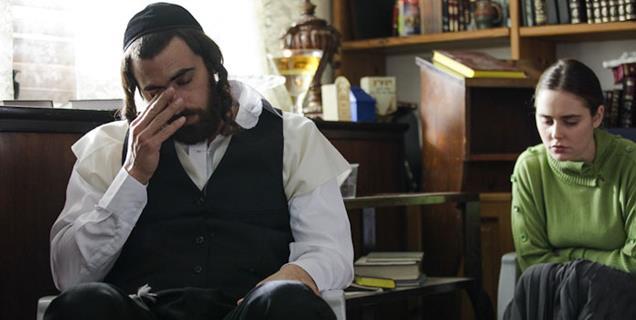
There was a scene in "Fill the Void" that has wedged itself in my mind. Shira, the 18-year-old protagonist who has recently lost her sister, is back at work, playing the accordion for the local gan. Watching the little girls bounce cheerfully to a joyous tune, she is infected by their enthusiasm and smiles. 

Another teacher comes over, placing her hand on her shoulder, saying she was so sorry to hear the news, she was out of town. How do you feel? How is your mother? 

Shira, now reminded of her pain, droops distinctly. The woman walks away, but Shira can no longer continue with the dancing melody. Instead, drowning in her refreshed sorrow, her fingers and hands contort her instrument into a mournful lament.

This image clashes with the previous scene of the family sitting shiva, remaining steadfastly silent as Shira's mother leans heavily on her. After a few moments, the visitors gets up, saying "HaMakom yinacheim eskem . . ." May God comfort you.
http://www.screendaily.com/pictures/636xAny/5/8/1/1158581_fillthevoid_01.jpg
The laws of shiva are that a comforter cannot speak unless the grieving instigate conversation. Unbidden, visitors cannot pry as to details, or feelings (which, I would think, are obvious); they are merely to come and show their support, taking their cue from the mourners. 

Why should these laws be suspended after a mere week? Suddenly, one can ask impertinent questions, stabbing another who is already in agony? It happens all to often, as also seen when the spinster, Freida, is told constantly the Hebrew equivalent of "Im yertz Hashem by you." The audience can see the flicker cross her face, even as she smiles politely, every time it is uttered. What kindness is there reminding someone constantly of the fact that she is single?

In a segment of Social Qs, a woman writes in: 
I heard through the grapevine that a woman I used to work with for over five years is going through chemotherapy. We were never personal friends. This morning, I ran into her on the street. She was clearly wearing a wig (albeit a very nice one that many people might not have noticed). I didn’t comment on her appearance and wasn’t sure exactly what to say. So I asked how she was, and we chit-chatted about work. She never mentioned her cancer. But I couldn’t help feeling uncaring for not asking about her struggle with chemo. What was the appropriate thing to do?
Anonymous, Brooklyn
I (finally) watched the first season of “Breaking Bad” over our rainy Memorial Day weekend. (Don’t worry; my pulse should be back to normal any day now.) And as I watched Bryan Cranston turn from unassuming high-school chemistry teacher to brutal meth-cooker (thanks, in part, to his character’s diagnosis with Stage 3 lung cancer), I realized that taking “vacations” from serious illness is probably crucial, whether that involves gunning down your local drug lord or putting on a good wig and walking along Main Street as if you were as healthy as a horse.
No one wants to be a cancer patient all the time or talk about it with everyone she meets. I think you did just the right thing. Let other folks decide when they want to share their bad news, especially those with whom we’re not close. And if they choose not to mention it, don’t take it as a slight, or let your silence feel like a mark of coldness. Quite the opposite: you let your former colleague enjoy a brief respite from her illness. I’d call that very kind, indeed.
Words can wound. We have to think a moment, perhaps many moments, before speaking. How many times do I cringe in memory of that which I spoke without sufficient aforethought? If I accidentally step on another's toe, while I have hurt them, it will be forgotten in five minutes, tops. If I say the wrong thing? I am guilty of hurting someone for years to come.