But on her
face, as she trudged along, hugging the pole of the great pennant that
flapped in the breeze, was stamped a look! . . . It wasn't merely a
look. It was a story. It was a tragedy. It was the story of a people . .
. It spoke eloquently of pogroms, of massacres, of Kiev and its
sister-horror, Kishineff. You saw mean and narrow streets, and carefully
darkened windows, and, on the other side of those windows the warm
yellow glow of the seven-branched Shabbos light. Above this there shone
the courage of a race serene in the knowledge that it cannot die.
—Edna Ferber, Fanny Herself
Friday, December 30, 2016


Thursday, December 29, 2016
Altogether Now
On Rosh Chodesh and Chanukah, I cannot help but remember my schoolgirl days when reaching Hallel. The institution's policy was that for Hallel, all the girls would gather in the auditorium, and would sing it altogether.
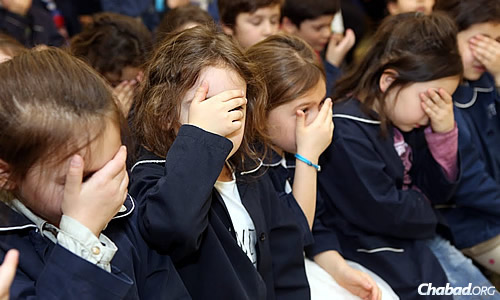
I have been told my singing ability is questionable, yet when hundreds of children belt the tunes out, it doesn't matter. Singing together was an uplifting experience. No matter what was contributed, a softer voice, a jarring bellow, a mellifluous harmony, a discordant squawk, the end result was the same: Beautiful unity.
I feel an additional pleasure, though, greater than flow, when I sing in a choir. It’s a mode of singing that strikes a balance between feeling necessary — each voice must participate to achieve the grand unified sound — and feeling invisible, absorbed into the choir, your voice no longer yours. I can work hard, listen hard and disappear, let the ocean of sound close over me. It is comforting to disappear into all that sound and to know that no one else will hear me, either. The performance feels like a secret.
So writes Sarah Manguso, in Letter of Recommendation: Choir. Whilst Jewish (I think), she joined a church choir in college for the above experience.
That transcendence stays with me for the rest of the year following Rosh HaShana and Yom Kippur. I dare to presume that everyone's favorite piyut is "Ki Anu Amecha." There is an increased surge in the room's energy when it is reached. The words are simple for such eloquent yearning—where we all join together, on various levels and beliefs, as one.
Wednesday, December 28, 2016
Stuffed Pepper
I'm a sauce lover. Anything that involves a sauce, I'm there. I often ignore the ikkur (i.e. meatballs). Just sauce me.
Stuffed cabbage is the stereotypical dish of my people, but Ma has always preferred preparing its close sibling, stuffed pepper. Not much difference between the two, except that stuffing pepper is an easier task than pre-wilting cabbage leaves and carefully folding the contents therein.
My household has now entered an age of new and improved eating, which usually means that old-timey favorites may require . . . reinvention.
How does the classic stuffed pepper go? (1) canned tomato sauce = copious sodium. (2) white rice = unnecessary carbs/little nutritional value (3) red meat = obvious reasons, as well as the fact that I'm not crazy about beef. I like birds. (4) green peppers = aesthetically lacking.
Research commenced. Recipes were summoned. Grated vegetables appeared in many, replacing the rice. Others used red, orange, and yellow peppers, turkey and chicken instead of cow.
Although, none that I could find used tomato sauce. Philistines. I don't need you. I would note, however, that at least one pepper should be green, since that adds an extra dimension to tomato.
The results of the first attempt were quite tasty, minor tweaks required. The joy of stovetop cooking is that rarely are exact recipes needed, more of a general guideline.
Various recipes used various quantities of various vegetables; I used some of each, to palatable delight. So one doesn't need to use specifically what I used below; mixing, matching, and omitting is fine.
Stuffed Pepper—Vague Guideline (please alter/improvise)


4-5 bell peppers, one green (try to select peppers that will stand in a pot)
1 lb ground meat (I like chicken)
2 carrots, grated*
2 zucchinis, grated*
1 onion, grated (or shallots, or scallions, or leeks)*
2 stalks celery, grated*
2-3 fresh mushrooms, grated*
4 cloves garlic, grated/minced
hefty gratings of black pepper
squirt of mustard
squirt of sriracha
squirt of sriracha
1 spoonful tomato paste (from the below jar)
Sauce:
(one can also sauté an onion for the base)
1 15 oz. jar diced/crushed tomatoes
1 6 oz. jar tomato paste
1 tablespoon honey/sugar
1 tablespoon to ¼ cup vinegar/wine
generous sprinkle of Italian seasoning (oregano and/or basil will do)
shake of red pepper flakes
1. Buzz vegetables of choice through the grating blade in the food processor. Heat oil in bottom of pot, pouring in these vegetables to sweat down a little, along with the spoonful of paste. Initially cover, then remove lid as the heat builds. The intent is not to caramelize, but to shoo out some liquid. Stir from time to time. When they are at the desired limp state, remove from heat.
2. While the above is shvitzing, prepare the peppers. Carefully cut off the tops, trying to keep them whole, if possible (if not, no biggie). Remove seeds with knife, fingers, serrated spoon. For steadier standing, slightly slice the bottom bumps to make them more level.
3. Being careful not to overwork the meat, mix in, along with the seasonings, about half the vegetables.
4. Stuff the peppers, and place them aside.
5. Heat a little more oil (if sautéing an onion, this is your moment) and add all sauce ingredients and remaining buzzed veggies. Tomato sauce can burn easily, so keep an eye on the flame once it reaches a vigorous simmering point.
6. Once tomato sauce is good and hot, carefully add the peppers. (I miscalculated the roominess of my pot, and had to move some peppers and sauce into another.)
7. Cook for about an hour, checking to make sure nothing "sticks."
8. I was very, very happy.
*Vegetable quantities is based on preference. No hard rules here. Leave them out; add more of others. Your call. (A recipe I recently discovered for stuffed cabbage uses cauliflower to replace the rice. That's also an option.)
3. Being careful not to overwork the meat, mix in, along with the seasonings, about half the vegetables.
4. Stuff the peppers, and place them aside.
5. Heat a little more oil (if sautéing an onion, this is your moment) and add all sauce ingredients and remaining buzzed veggies. Tomato sauce can burn easily, so keep an eye on the flame once it reaches a vigorous simmering point.
6. Once tomato sauce is good and hot, carefully add the peppers. (I miscalculated the roominess of my pot, and had to move some peppers and sauce into another.)
7. Cook for about an hour, checking to make sure nothing "sticks."
8. I was very, very happy.
*Vegetable quantities is based on preference. No hard rules here. Leave them out; add more of others. Your call. (A recipe I recently discovered for stuffed cabbage uses cauliflower to replace the rice. That's also an option.)
Tuesday, December 27, 2016
Go Low to Go High
It happened many, many years ago. Yet I still shudder in memory.
I had volunteered (or had been volunteered) to watch the kinfauna while the parents went on a trip. Nearly as soon as they left, I felt the pangs of a stomach bug.
My nephew was not happy with his parents being away. On top of that, he was overtired and cranky. Until he merrily adjusted to my consistent yet benevolent regime, he was a demon.

A berserk three-year-old isn't a picnic in general. Add the fact that I was folded up in nauseous, agonizing pain, I was beyond miserable. His older siblings, of course, were rays of sunshine, but still required basic maintenance, which took effort. At one point he broke away from my grasp and took off down the sidewalk, wailing, while I, terrified he would run into traffic, high-tailed after him on wobbly legs. Hauling him back was almost as much work.
Did I ever forgive him? Well . . .
What I do remember clearly is how I fought to keep it together that day. I plastered a grin on my green face as I tucked the good children into bed. I then scurried out, confirmed the hellion was safely asleep, closed my door behind me—and lost it.
I wept out the gallons of salt water that I had been holding back for hours. Because I knew that there is nothing more frightening for small children to see the adults, upon whom they rely, break down. Their sense of stability in the universe would be compromised.
I recalled that heinous day as I read Daniel D'Addario's interview with Natalie Portman in Time Magazine regarding her depiction of Jackie Kennedy following the assassination.
DD: Did being a parent add to the role for you?
NP: It makes you understand the ability to be calm and collected under that kind of emotional and psychological pressure. When you have kids, you can't afford to be a mess. There's moments when you are, but you need to pull it together. You see how that impacted her ability to gather herself under such awful circumstances.
The mere presence of those kids gave me the strength to do what I didn't think was possible. If I had been at home, leaning on my parents as opposed to toddlers leaning on me, whatever self-discipline I would have summoned then, I would have thought was my max.
I have very, very few excuses at hand. I can push myself to go farther.
Monday, December 26, 2016
A Fetik Holiday to All
I can't believe it took me until now to find latkes historically inaccurate. After being unnerved by a Jeopardy! clue that stated that the latke is a knock-off from—get this—a Greek sidedish, I gave it a google, leading to "What's a Latke, Really?" by Yoni Appelbaum.
Yet I had known that potatoes were indigenous to South America, making their European debut after the explorers lugged them back in the mid-1500s.

As for frying in oil, Eastern European Jewry did not have canola. They had schmaltz, animal fat. If shooting for miraculous similarities, that ain't exactly from an olive.
"Ma, did you have latkes in Hungary?"
Snort. "Nope."
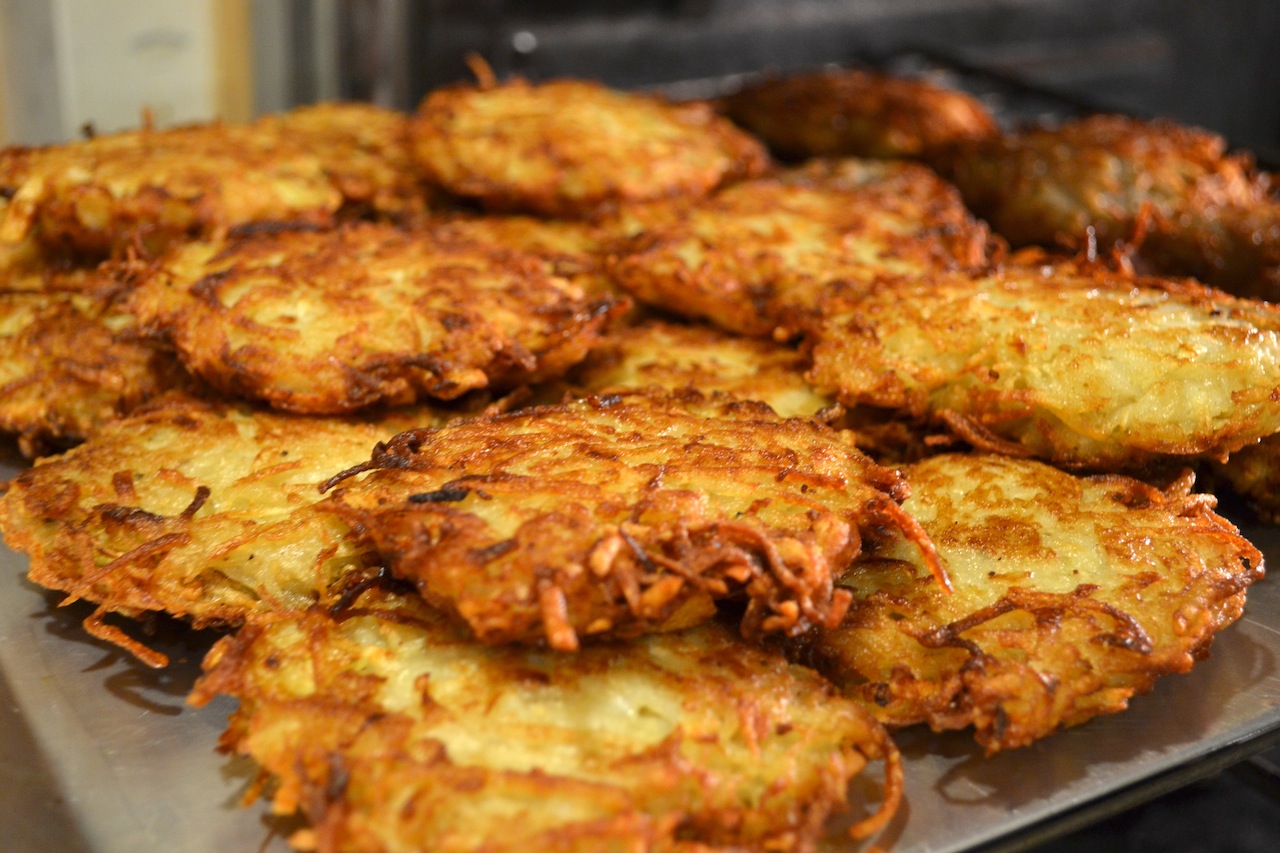 |
| Via Dinner With Rachel |
Ah. Chremslach for Pesach, at least. I always liked those better than latkes. Babi did make donuts, though, for Chanuka—fánk.
But both latkes and donuts have limited appeal. Latkes are only good while still warm, and keeping them that way without drying them out is tiresome. Donuts are great fresh. Not longer than that.

Baruch Hashem for our lives of prosperity; every home is equipped, year-round, with extra-virgin olive oil—shemen zayis zuch. However, it has a low-smoke point, meaning it is not ideal for frying. So instead of using the oil of the neis, we use the oil of . . . dubious origin to celebrate the holiday and consume needless calories.
I think this year, I shall commemorate Chanuka with salad dressing. How authentic!

Friday, December 23, 2016
TGIF
"Stop Talking About the Shidduch Crisis" by Rochel Spangenthal; and
Chanukah: Patterns of Life by Rabbi Daniel Glatstein.
Chanukah: Patterns of Life by Rabbi Daniel Glatstein.
Thursday, December 22, 2016
I Really, Really Don't Want To Know
I've become a Facebook cynic. When people post photos of their families being oh-so-happy, I'm the Scrooge that eye rolls. "My husband is the best! #breakfastinbed Love you sooo much." That translates to me as, "I'm insecure so I must let everyone know that I am totally enviable!"
Am I just being jealous? Perhaps. Yet my reactions are the same when it comes to vacation shots, and I'm a terrible traveler who dreams of her own bed. Seriously. The last time I went to Miami I packed so reluctantly I wondered if I was getting sick.
Henry Alford's "Wish You Weren't There" researches yet-another oversharing situation.
While it’s fairly easy to categorize the photographically incontinent under the headlines Narcissistic and Insecure, or some combination thereof, the photo-posting folks may not have the same clarity about themselves. “People often don’t know that they’re the culprit,” said Marla Vannucci, a clinical psychologist who is an associate professor at Adler University.
In my tolerant moments I cringingly recall my early relationship with Facebook, where I felt obligated to post photos of my life. There wasn't really any thought behind it. FB is constantly begging and wheedling for me to share so they can blast me with targeted advertising, and my giddy young self succumbed.
Yet the people posting aren't giddy young things anymore. I passed a mother and child on the street the other day; the mother had her phone up to snap a picture; the child threw her hands up to shield her face, wailing "NO!" The mother, flat-eyed with intent, grimly tapped away; she's taking the (unnecessary) picture. It was a mindless, and so thoughtless and inconsiderate, action.
The Jabba in me was cheered by the news that the IRS now prowls through social media for proof of expensive lifestyles. "Can't pay your taxes? But you could pay for Disney World?"
Hee hee.
Wednesday, December 21, 2016
Tevye!
After recently seeing Fiddler on Broadway (thank you, sis), and finding their inaccuracies tolerable, along with the affirmation that the only true Tevye is Topol, I decided to take out the original text to compare.

Wow. "If I Was a Rich Man" is so loyal to the source material that the lyrics are practically copied from the book—down to Goldeh's double chin. Yet, in others . . .
The one movie scene that always irritated me is when Tsaytl begs Tevye not to force her to marry Layzer Wolf, to which he initially, coldly replies, "If I say you will, you will."
Sholom Aleichem puts it quite differently. After getting the mix-up vis-a-vis the cow cleared up, Tevye specifically says that the engagement is only on if Tsaytl is willing, and Layzer pours liquor down Tevye's throat to guarantee an understanding. Then, he cockily tells everyone in town before getting her okay.
When Tsaytl runs up to Tevye, weeping, he immediately tells her that she doesn't have to marry Layzer. Shortly thereafter, a confident (yes, I know, confident) Mottel Kamzoyl appears and boldly asks for her hand (they did have an understanding).
Oh, and there's no Yente. Shocking, right? There is Efrayim the Matchmaker, and his lines are pretty good. Goldeh comes off as a simple woman with no wit or wisdom, contrary to her sharp stage tongue (a constant refrain of Tevye's is that he "is no woman"; meaning, he can keep it together unlike some people). As for the name of the movie itself, Fiddler on the Roof, that imagery was ripped from Chagall; it ain't in the text at all.
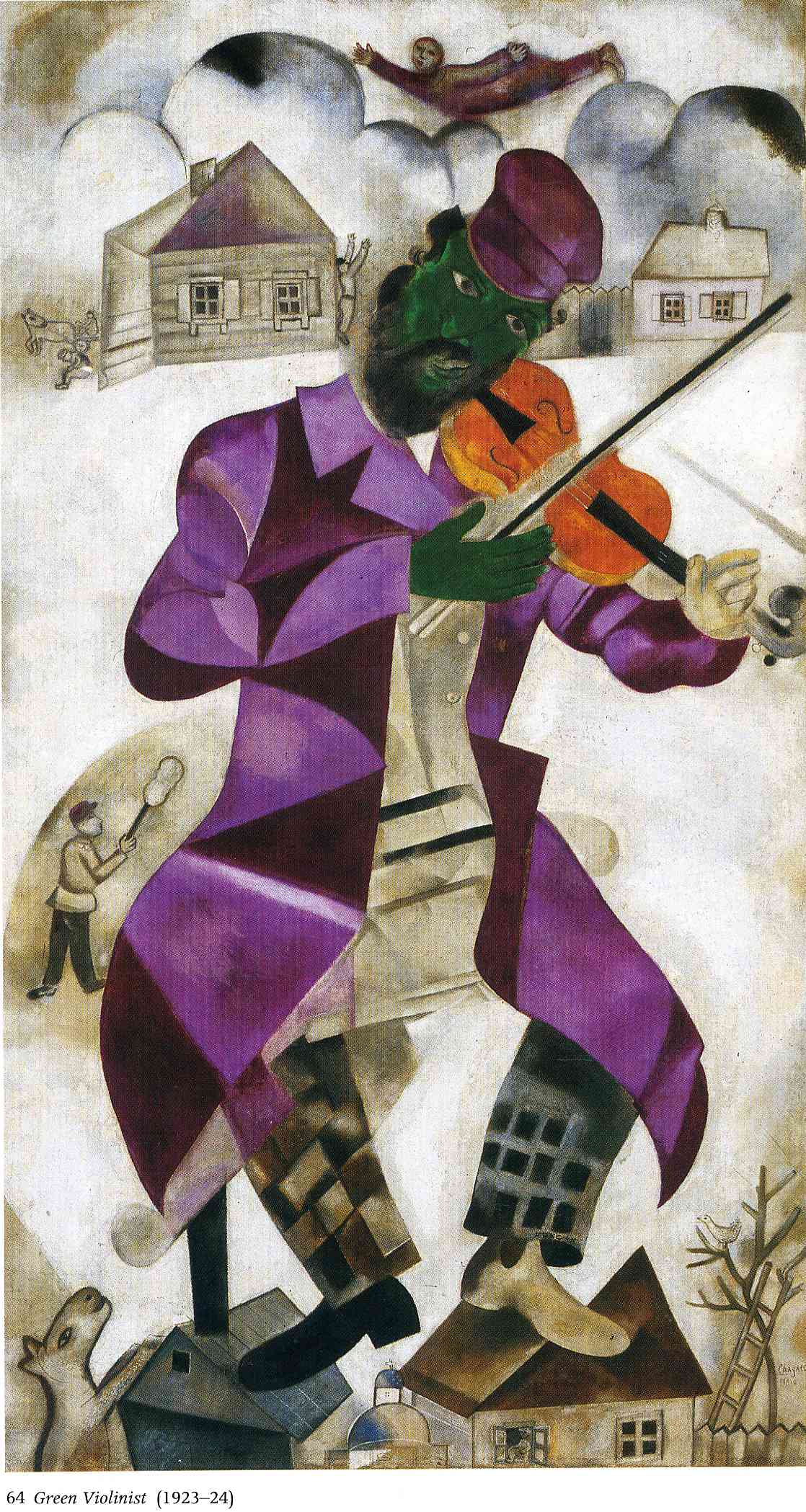 By the way, if anyone dares to say that it's harder to raise kids nowadays then ever before, read about Tevye's headaches (based on the happenings of the time). In Russia at the turn of the century, some stupid book came out which glamorized suicide, and teenagers were doing themselves in all over the place—including Jewish ones.
At least the wedding doesn't coincide with the pogrom. . .
The translator, Hillel Halkin, writes in the (lengthy) introduction:
Oh, and there's no Yente. Shocking, right? There is Efrayim the Matchmaker, and his lines are pretty good. Goldeh comes off as a simple woman with no wit or wisdom, contrary to her sharp stage tongue (a constant refrain of Tevye's is that he "is no woman"; meaning, he can keep it together unlike some people). As for the name of the movie itself, Fiddler on the Roof, that imagery was ripped from Chagall; it ain't in the text at all.
At least the wedding doesn't coincide with the pogrom. . .
The translator, Hillel Halkin, writes in the (lengthy) introduction:
Halkin presents Tevye as the "God-arguer," like Job. Once, as Halkin gave a talk on the subject, a member of the audience said that Tevye was a fool; he should have denied God after all his suffering (not all the misery made it to the musical. That guy caught one break, then it was downhill after that). Halkin notes that was the reaction of Iyov's wife as well: "Curse God, and die!"
For Job—and for Tevye—to curse God is to die, because neither can live in a world without Him. Even if God never answers, even if He never will, Tevye must go on debating with Him, for the minute he stops, his life has lost its meaning. And besides, who is to say when God answers and when He does not? In Job's case, you say, it was obvious: "And then the Lord answered Job out of the whirlwind." Yes: but has you or I been present in that whirlwind, would we have heard anything but wind?
Tuesday, December 20, 2016
By Any Other Name?
My personal definition of "friendship" aspires to a threshold few can achieve. It involves qualities like "loyalty," "caring," "devotion," stuff like that.

Then I observe a supposed friendship, and I witness back-stabbing, jealousy, and indifference. Head scratching ensues.
When I hear, "I can't believe my friend said/did that," then I must respond: Sweetie, she wasn't a friend in the first place. Then the sentence makes sense.
My befuddlement with the modern perception regarding "friendship" is shared by many, I was relieved to read ("Do Your Friends Actually Like You?" by Kate Murphy). When asked, study subjects couldn't say what "friend" means.
We can say what it isn't: It is not a symbiotic relationship. Take the SJF; she has time on her hands, and would like someone to hang with. Other SJFs oblige. Then one of them gets engaged. Despite their generous gifts and showers, following her marriage she disappears. Not a text, email, or gushing voicemail.
Time for the grand reveal: She wasn't a friend in the first place. It was a mutually beneficial arrangement. If any of the others had married instead, it would be the same.
By [Ronald Sharp's] definition, friends are people you take the time to understand and allow to understand you.
Friendship involves depth, vulnerability, a meeting of minds and souls. Just because you do stuff with someone doesn't automatically make you friends. Ask yourself this: If a better offer came around, would you leave them in the dust?
This is not a matter of quantity, says the article. Schoolyard pride in "a million friends" is kinda sad in adulthood.
Such boasting implies they have soul mates to spare in a culture where we are taught that leaning on someone is a sign of weakness and power is not letting others affect you. But friendship requires the vulnerability of caring as well as revealing things about yourself that don’t match the polished image in your Facebook profile or Instagram feed, said Mr. Nehamas at Princeton. Trusting that your bond will continue, and might even be strengthened, despite your shortcomings and inevitable misfortunes, he said, is a risk many aren’t willing to take.
One can stand in a crowded room of so-called "friends" and still be very, very much alone. I would much rather be seen by one or two.
Monday, December 19, 2016
Down with the Borg
Generalizations complicate matters. They encourage conspiracy theories and dwindling faith in humanity. In single women's case, in mankind.
Take the potentially broiling topic: women and careers. In my case, I have received many a puzzled look as to why I do not have a career ("What a waste!"), along with the ubiquitous "Well, boys nowadays want ______."
A few girls I know, following some such comments, reluctantly went back to school; they didn't pursue those higher degrees because they felt a burning desire to experiment in other employment. They ended up marrying men who didn't care either way.
Yet, I have come across quite a number of articles opining how "all men want" a trophy wife who'll stay home with the kids, and also won't have an opinion.
There you go, folks: All men want a women with a career. All men want brainless bimbos.
That's quite a trick.
That's quite a trick.
I don't appreciate it that as a female, there will be guys out there complaining, "Well, girls nowadays want ______." I'm me. An individual. The men I've gone out with were individuals too, with their own versions of what they seek in a life partner.
We aren't the Borg ("Self-determination is irrelevant"; "You will become one with the Borg"), who have a warped concept of perfection (which is, if clarification is needed, that "perfection" is no identity, no individuals). There is no right. There is no wrong. There is no good. There is no bad. There is no "all they want."
There is "What works for me." Which won't be the same as "What works for you." And that's fine.
Subscribe to:
Posts (Atom)