Sunday, August 11, 2013

Stupid Technology

As it would seem, constant phone use turns one into Forrest Gump, as shown in an article called "Brain, Interrupted" by Bob Sullivan and Hugh Thompson.
http://img8.joyreactor.com/pics/post/funny-pictures-auto-life-era-387298.jpeg
It's not just enough to be distracted; the expectation of an incoming call, text, or email was sufficient to dumb down the test participants. The brain cannot focus on many things at once. 
Clifford Nass, a Stanford sociologist who conducted some of the first tests on multitasking, has said that those who can’t resist the lure of doing two things at once are “suckers for irrelevancy.” There is some evidence that we’re not just suckers for that new text message, or addicted to it; it’s actually robbing us of brain power, too. Tweet about this at your own risk. 

Friday, August 9, 2013

Flailing Fists

"What is he doing?" 

Beneath the chuppah, the chosson was in the throes of something between an epileptic fit and an improvised attempt at boxing; face streaked with tears, nose unattractively red, he back-breakingly flung himself back and forth, his fists brandished to the skies above. 

I was terrified that he would head-butt his bride. 

"He's going to do himself an injury!" 

Unable to watch anymore, I kept my eyes on the pattern of the jacket in front of me, memorizing the silver threads against the navy satin background. To think I had been annoyed that I didn't get a good seat.

I wasn't the only woman to find his histrionics embarrassing. "That is very immature," said the lady next to me of the feverish floundering taking place.

He wasn't that bummed ten minutes earlier by the badeken, when he came in with a cartoonishly goofy grin and chattered away to the kallah, taking his sweet time before veiling her. 

I peeked to see if he had slowed down at all, but he was still at it. His kallah stood a good distance away, probably trying to avoid a black eye. I quickly focused my eyes on the fabric before me again, wondering if he would pass out from sheer exhaustion.

"I bet he took notes by his friends' weddings," I noted dryly. "'You call that crying? I'll show you crying!'" 

Not soon enough, the chuppah blessedly concluded. There's going to be a lot of video editing tomorrow.

Just in case it has to be said, one can never go wrong with a little dignity.  

Thursday, August 8, 2013

Unhappy Much?

In an episode of The King of Queens called "Shrink Wrap," the insanity of her father, Arthur, escalates to the point that Carrie decides to take him to a therapist, in the hope he'll prescribe some calming "medication." However, after Arthur shares his childhood memories, Dr. Taber advises that Arthur should be validated in all of his hare-brained schemes. 


Eventually, after Arthur indulges in every idea that takes his whimsy, he collapses in oddly unfulfilled fatigue. Doug is dancing in bliss that his father-in-law has finally exhausted himself, but Carrie goes back to Dr. Taber claiming she has never been so miserable. 

Following a look at her childhood, Carrie comes home all excited at her discovery. You are a happy person by nature, Carrie tells Doug, but I'm not. So you are usually up there, while I was down here. While my father was making you unhappy, you came down to my level, so I had some company. Now you are happy, and I am back down here alone. 

Carrie: You are happy, I am not, and I hate that. 

Doug: So when I am unhappy, that makes you happy? 

Carrie: Well, not happy, happier

Doug: I'm not gonna lie to you, I'm a little shaken by that.

That is, according to Dr. Sonja Lyubomirsky, the basic premise of unhappy people: 
In one experiment, documented in “The Myths of Happiness,” Dr. Lyubomirsky asked two volunteers at a time to use hand puppets to teach a lesson about friendship to an imaginary audience of children. Afterward the puppeteers were evaluated against each other: you did great but your partner did better, or you did badly but your partner was even worse.
The volunteers who were happy before the puppeteering review cared a bit about hearing that they had performed worse than their colleagues but largely shrugged it off. The unhappy volunteers were devastated. Dr. Lyubomirsky writes: “It appears that unhappy individuals have bought into the sardonic maxim attributed to Gore Vidal: ‘For true happiness, it is not enough to be successful oneself. ... One’s friends must fail.’ ” This, she says, is probably why a great number of people know the German word schadenfreude (describing happiness at another’s misfortune) and almost nobody knows the Yiddish shep naches (happiness at another’s success).
Sometimes I can't understand it when people make nasty remarks about another's rather innocent behavior, and then I realize they must be true malcontents. A happy person doesn't feel the need to tear others down in their pursuit of happiness. The unhappy will take out whoever is in their way, and their joy is but fleeting, since there will always be another bursting with glee to highlight their misery. 

Before I get too smug, of course, I find myself making kinda b****y comments in my head about another. Oh, shoot, that means I'm unhappy. Smile! Smile! I'm happy, dammit!

Wednesday, August 7, 2013

What a Beautiful Morning!

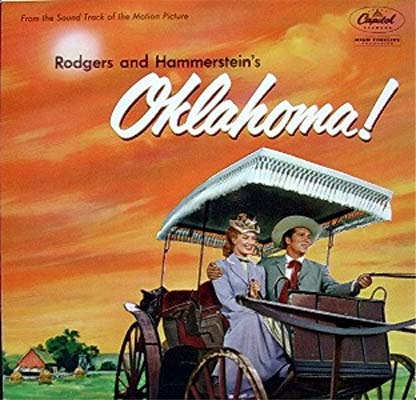
PBS featured once the Broadway revival of Oklahoma!, starring Hugh Jackman (a.k.a. Wolverine). While the performances are very good (Wolverine can really sing), what I was immediately turned off by was the blandness of the set, the depressing "dust bowl"-ness of the hues.

Everything was brown. Not a hint or touch of thriving greenery anywhere. Laury was stuck in mud-colored overalls, and Aunt Eller was rather grim. 

Maybe this was more accurate to the tough farming life of the past, but I infinitely preferred the 1955 movie version. 
http://www.onlygoodmovies.com/blog/wp-content/uploads/2010/03/oklahoma-soundtrack.jpg
The screen is vibrant with color—the cerulean blue of the skies, the lush greenery of the crop, the neon hues of Laury's skirts, the gleaming white of Curley's teeth, and the twinkle in Aunt Eller's eye. 

The Broadway show depicts the villain, Jud, as a slow and painfully lonely individual, while Rod Steiger's version was easier to dislike as a sexist who couldn't take no for an answer. 

Below is "Surrey with a Fringe on Top." 


While this may not be on topic, I couldn't resist adding Billy Crystal's belting it out in When Harry Met Sally.

 
 At the 40 second mark.
To understand how a couple is supposed to compromise, Ado Annie and Will explain it rather well:  

Tuesday, August 6, 2013

She's a Lady

"Well, if I had been on a date with such a _________, I would have said _________, then I would have _________, and marched out of there!" 

Gesinteheit

I have had a number of dates with cads in my time (as I have detailed beforehand, and shall continue after-hand). Besides for my genetic terror of confrontation, which is further enhanced by a need for a ride home, I have other motivations for rarely taking the bait and snapping my fingers in a jerk's face. 

It was as Ma always told me: Don't lower yourself to their level. 
 
To illustrate: A while back, Jon Stewart got into a tiff with Chris Wallace. Now, no matter how poor Chris tried, he was never able to yank the rug beneath Jon. He threw line after line but Jon breazily lifted a hand and froze every dart that came his way in midair.

Because Jon doesn't take himself seriously, and is always ready and willing to flagellate himself, Chris didn't have a chance. He tried doing what Jon does for a living, except he flailed for snappy retorts, something obviously missing that prevented each and every point from driving home. He just ain't Jon Stewart. 
Chris would have been able to get at least one zinger in if he stayed on his own turf and played to his own strengths. As political analyst David Corn said regarding this "debate": "Never try to outwit a true wit . . . it was like two worlds colliding, and Chris didn't have a foot in either one." Chris was trying to be something he's not, and late night talk show host he ain't. Then he lost on more than one front.

Nigel Lithgow, inventor of and judge on So You Think You Can Dance, once advised the competitors that when they frantically free-style for votes, stick to their own genre. If you can't pop-and-lock, he said, don't do it. Stick to what you can do.

I like to think of myself as a nice person, and I try to get nicer every day. If I want a guy to realize how badly he's behaving, wouldn't it make more sense for me to take the high road, and then he can have an "Ooooooh" moment by comparison? It doesn't mean I am a sucker. It just means I respect myself too much, and frankly don't care that much about him, that I should lose it. 

Even if I made much more of an effort than him, well, bud, I'll sleep the sleep of the just tonight. I was the bigger person. 

Like that episode of Everybody Loves Raymond. You know that episode, "Baggage"? No? I'll fill in quick: 

Ray and Debra take a trip, and when they come home a suitcase is left on the stairwell landing. Each refuses to move it, since each insist that it is the other's job. It stays there for weeks. Ray even puts a piece of stinky cheese in there to blackmail Debra into action. 

Finally, matters come to a head.

Debra: Okay, Ray, you know what? I'm getting it.
Ray: What's that supposed to mean? 
Debra: It means I'll get it. I'll be the one who got it.
Ray: Oh no no no no no! (lunges and grabs hold of the suitcase)
Debra: Let the record show that I got it. Let go of the suitcase. 
Ray: You let go! 

They wrestle over the right to "get it." Look, look, I'm the one who moved it! No, I'm still holding it. You aren't going to hold that over me! Eventually Ray is trying to pry Debra off the bag by picking her up bodily and shaking her, at which point Robert walks in.

No one can stand being outshown by the better person. 

A woman wrote into Social Qs, asking what would be the best retort to ill-mannered remarks regarding her wardrobe. 
Now, as for the compliments you want, the best way to get ’em is to give ’em. Tell her she looks great the next time you see her. I bet she returns the favor. Happily, this is also the best revenge . . . your sweetest payback is on the high road, complimenting her even in the face of subtle (and not so subtle) digs. It will make you look and feel generous. 
I have a fond memory from one date, many many years ago. 

Firmus Piett did not treat me well. I waited on a street corner for twenty minutes after rendezvous time until he showed up. He couldn't make up his mind where he was willing to feed me. He made back-patting remarks about going to shul late; apparently I was supposed to be impressed by his unique skill of sleeping in. 

I maintained a dignified appearance. I did not twitch or protest volubly at each impolite remark; I coolly neutralized them, with decency, not crudity. I refused to become as petty and childish as he. 

As the evening progressed, he sat a little straighter. His tone became more respectful. He was even chivalrous. When I left him two hours later, he was obviously chastened and shame-faced. I brought attention to his bad behavior not by matching it, but by bringing myself above it. 

As I recall, he wed soon after. I decided to take credit for that. I like to think I reminded him how to be a mensch, by staying a mensch/lady myself.  


Monday, August 5, 2013

Butternut Squash Soup

A member of my family suffers from acid reflux; when onions are avoided (along with mint, coffee, and dark chocolate) it is best for the esophagus. Since I wanted to make this soup stomach-acid friendly, I decided to try it sans onion, and it came out oh-so-good.  

The secret is in the celery. It blends with the squash flavors perfectly, adding a pleasant zing.

Additionally, roasting the squash whole or halved is much easier than slicing it when raw

The ingredients are not set in stone; just add whatever is liked, ergo the somewhat vague recipe list below.  

Even Luke, who is a tad averse to anything with nutritional value, said, and I quote, "I would eat this." My niece? I kid you not, she said, "This tastes like ice cream." (It does depend on the sweetness of the butternut squash, mind you.) High praise indeed.

When I have eaten "sinfully," I live on this for a few days. My body absolutely hums with joy—oh, the health benefits!

For those whose tummies are free of overactive acid, definitely sauté an onion first. 

Acid-Reflux Free Butternut Squash Soup 

2-3 small butternut squash 
3-6 stalks celery
2-4 carrots
2-3 sweet potato 
2-3 parsnip 
bulb of garlic 
oil 
course sea salt 
pepper

1. Prepare the squash and garlic for roasting. Either (a) stab the squash all over with a knife or (b) slice in half, scoop out the seeds, and place face down on the parchment paper. Slice off the top of the garlic bulb, put it in foil, and drizzle with oil. Place into 375°/400° oven for an hour.

2. Boil a kettle of water. The thickness of the soup is based on preference, so I don't have a specified amount. Some like a thick soup, others thin. Adding boiling water to the vegetables as opposed to room temp keeps the cooking at a steady pace (but one can always add room-temp water whenever). 

3. As the squash roasts, drizzle some oil in the bottom of the pot over a low-ish flame and add the chopped celery. I like to sauté the celery for a few minutes
4. Add the chopped carrots, parsnip, and sweet potato. A hefty shake of salt will help bring out the liquid (and provide flavor); add the boiling water. Let it simmer until the vegetables are tender; 15-20 minutes.
5. After the hour is up, remove the squash and garlic. (If one is being smart and patient, they will wait until both are cool enough to handle, but I can't seem to stop myself from partially singing my fingers.) Pry out the squash from the peel, and squeeze out the roasted garlic. 

6. Since I like to have some consistency in my soups, I blend the squash and garlic with some water separately with an immersion blender, then add it to the rest of the cooking mixture. For those who like a completely smooth soup, one doesn't have to bother with making the other vegetables so prettily chopped, add the roasted squash and pulverize it.  

7. Mix additional water to the soup until desired thickness is achieved. Season with pepper, and if needed, more salt.
 

Sunday, August 4, 2013

Replay

I saw Fill the Void a second time. It's playing now in more obscure locales, and the second viewing really hammered home the brilliance of the talented actors. I was able to see the character motivations more clearly, even though they are transmitted subtly through facial expression.

All the way to the car my two movie companions and I argued the nuances and the wardrobe. One said, "How did all these chassidish people agree to be in a movie?" She was stunned when I told her they aren't Chareidi. Then she just wanted to know what Yiftach Klein looks like without the beard. 

What, you haven't seen it yet? 

Friday, August 2, 2013

Mountains from Molehills

Rabbi Yisroel Reisman once mentioned the current age of over-analyzation. For an example, he brought a personal story which would have rather explosive consequences nowadays.

When he was engaged, his father-in-law bought him a tallis. Looking about the house, he came upon an empty box to send it over to his son-in-law.

The box, regrettably . . . originally contained underwear. The logo said as much.

What would occur, Rabbi Reisman asked the chuckling audience, if such a thing happened today?

I am a self-confessed ruminator. 

After a date? Oh ho. What did he mean by that? Does it mean he has bodies in his basement? Did I say the right thing? Will he want to see me again after I said that?

I simply read too much into every situation, and I have to be able to move on. 

Rabbi Reisman was advocating the ability to put certain matters and taavos behind us and stepping forward. In Hungarian there is a saying called "show-let" (sólet is actually the term used for cholent, but it has more than one connotation).

It translates as, "To become salt," Ã  la the wife of Lot. Meaning, don't look back.   
http://unmitigatedword.files.wordpress.com/2010/06/pillar_of_salt.jpg

Thursday, August 1, 2013

Then and Now

Along the lines of a previous post, I came across two articles on the subject of outdoing others in tragedy, one by Joyce Wadler entitled "Who Suffered Most" (rather witty, I must add) and the other, Frank Bruni's "Show Us Your Woe."
Robert Grossman
When it comes to suffering, whether it be relatively piddling or of great magnitude, sometimes the idea of . . . worthiness? creeps into our thinking. To clarify, pain can only be valid if greater than another's pain. 

Even if it wasn't one's own agony, we can assume it for ourselves. My grandparents are/were Hungarian in origin, meaning their experiences of the war, that of incomprehensible suffering, is incomparable to that of Polish Jewry. According to this table, there were over three million and 825,000 Jews in pre-war Poland and Hungary, respectively. The same amount, around 300,000, survived from both countries. Six years of ghettos and deportations and murders, as opposed to one. 

I feel oddly defensive, or perhaps meek?, in the presence of a survivor from Poland. 

Wadler's observation is merely social, as friends (or do they just claim to be friends?) compete for worst heartache, worst dog-death, worst day at the office, and she provides some tips on how to fake sympathy. 

Bruni notes that any competition nowadays, whether it be singing competition or politicians for office all possess under "qualifications" some sort of anguish. 

We seem to believe that with great suffering comes great quality, like gold in a roaring furnace. But that is not so, concludes Bruni: 
But I know strong, empathetic people who haven’t weathered anything much more distressing than a hangnail, and I know jerks who are graduates of garish travails. Hardship isn’t necessarily the crucible in which virtue is formed. Sometimes it’s just hardship, sad and unenviable, and the man or woman on the far side of it is exactly who he or she was before: kindly or cruel, brave or timid. 
In the end, what makes a good candidate or good singer is how they can perform now, not how miserable their childhood was.

My connecting validity to misery is yet another contemporary concept absorbed from my current surroundings. At least, when we once had to spend our days and nights tilling the land, who had time to compare notes?    

Wednesday, July 31, 2013

I Pity the Fool

After going out with Boba, I had been furious. I hate being made to look stupid, and to be treated like a disposable nonentity before I had an honest chance to make an idiot of myself was a real punch to the gut. 

I was commiserating with a single friend about the inept state of mankind (us single girls like to refer you all as "morons" every once in a while, sorry). She said, "Someone has to teach them manners." But I realized it's not about that. 

Boba was a highly placed, successful professional. No one can get to such a position without knowledge of manners. He has a boss he has to kiss up to, clients he has to charm, workmates he has to stay on the good side of. He knows his manners. 

Yet Boba believes that manners are only when one needs something. The shadchan who set us up believed him to be decorous and chivalrous, because he found it to his benefit to be mannerly to her. But being decent to me, a girl he already decided he had no interest in, is not worthy of any effort on his part. Because if he "tries," and will "get nothing" out of it, then he thinks he looks stupid. 

How sad

He is one of those sad, sad people who perceive decorum as the equivalent of "sucker" scribbled in marker across a forehead. That the world will laugh if he exerts himself for someone he may never see again. Therefore, he will reject me before I can possibly reject him.
http://images.zap2it.com/tvbanners/h3/AllPhotos/185268/p185268_b_h3_aa/i-pity-the-fool.jpg
Boba, I just want to say: I pity you. Because I have never regretted being kind, even if it was thrown back in my face. Decency and consideration are more for me than the other person, the same way Moshe Rabbeinu displayed gratitude to inanimate water and sand. It's not about the water and sand. It was Moshe's way of sensitizing himself.  I want to be the best I can be, and that means smiling and swallowing deserved retorts when I am on a date with someone who keeps on looking at his phone and complaining how the office cannot function without his presence (which I find highly unlikely, but if so, the obvious solution would be to schedule the date for Sunday).

Here we part ways, Boba. You may not believe it, but I pity you. Yes, you.