Monday, September 2, 2013

Wait For It

One year, it was a sweltering September. 

I arrived to shul for Rosh HaShana, shvitzing under my lightest possible in-between (neither summer nor winter) getup and nearly burst out laughing. 

Many of the women were wearing their brand-new knobby wool suits; some even teetered in knee-high boots. No way were they going to wait until it was actually cold
http://cdn.someecards.com/someecards/filestorage/summer-heat-fur-complain-cute-therapy-ecards-someecards.png
Then, in the dead of winter, these same women can be seen on a Shabbos day of 35 degrees under a mink coat, but with pumps on their feet, rather than the now-appropriate boots. 

Last year, on the first chilly day in September (all of 65 degrees), women walked the streets of Manhattan in suede footwear, wool skirts, and opaque tights. One that I saw even donned a rabbit-fur cape.

Then they'll be the first ones to whine in February how they can't wait to wear flip-flops.

I know how it is. After spending months in seasonal attire, one gets bored. One wants to whip out the newly purchased for the next weather pattern already.

Wait. It'll just be a few weeks. Wait, until the weather actually reflects the ensemble. It won't be long. Then you won't be bored of your boots by November 1.

Sunday, September 1, 2013

Mom, Taskmaster

For the parent out there: "When Helping Hurts," by Eli Finkel and Grainne Fitzsimmons.

In a nutshell, as Douglas Horton said: "If you love something let it go free. If it doesn't come back, you never had it. If it comes back, love it forever." 
http://www.wealthysinglemommy.com/wp-content/uploads/2012/09/Mean-moms-rule-denise-schipani.jpg
Oh, and your kids will be whiny dependents their whole lives if they don't do anything for themselves.

Friday, August 30, 2013

Only One

The 1994 version of Little Women is probably one of my most beloved films. I never get tired of it, always happy to pop in the DVD. (The 1949 movie doesn't quite do it for me; too many inconsistencies and too much makeup to be historically accurate.)

There is the well-known scene when Jo accidentally singes off a lock of Meg's hair in a clumsy attempt to curl it for a party that evening. Meg is freaking, "I'll never have any suitors. I'll just be a dried-up old spinster." 
https://blogger.googleusercontent.com/img/b/R29vZ2xl/AVvXsEi2lnlGYJA5PxPVeSOGc2ppy8f1MFzuc88AzG5_phl09EdHaC_XoCEp5yPWFOxcJF2JfJn5FFhlzfZZHpFKSMPWgCaWQe1DWdey9pWFn246Mi7ZczeGaH6e-zJh7HvYLjlcBGhaePs7LQMZ/s400/Jo_Burning_Meg__s_Hair_by_Himmapaan.jpg
Amy, still a youngster, flatly states in a rare streak of maturity, "You don't need scores of suitors. You only need one, if he's the right one."

During my dating saga, it has become apparent that quantity does not mean quality. Many of my dates I know immediately, if not beforehand, that it won't fly. Not that I don't make an effort, more like a premonition of futility. 

When the phone stays silent for an unnerving amount of time, or if suffering a string of one-date wonders, recall the words of a tiny Kirsten Dunst. 

http://content6.flixster.com/photo/74/69/85/7469856_gal.jpg

Thursday, August 29, 2013

To Be There, Both in Mind and Body

I love email. I really do. I love how I can use it to leisurely compose a letter, edit it repeatedly, eventually send it, then wait for a response, to which I can pretend I didn't get for enough time to brainstorm an acceptable reply. 

I love it most when I use it as a tool to blunt blows, like emailing a refusal after a painful date. Even an intimation of conflict leaves me gibbering in a closet, and avoiding uncomfortable situations is my modus operandi. Bless you, email, for allowing me to type rather than voice my objections, as I can be firmer via textual communication as opposed to in person. 

As a self-professed hater of smartphones, I suppose that I must concede that my arbitrarily drawn line (email OK, texts must die) cannot apply to the world at large; I still attempt to broadcast the importance of safe texting as much as I can. 

For added eloquence, we have Jonathan Safran Foer, "How Not to Be Alone." His prose is so beautiful that the article should be read in its entirety, but I shall slice and dice as usual. 

He echoes my earlier source that the distraction that technology offers dulls our sense of meaningfulness, as everything is experienced on the surface. The brain doesn't register deep emotion immediately the way it does pain, and a flickering screen prevents the synapses from firing fully.

The PBS show Call the Midwife takes place in 1950s London. In Episode 8 of Season 2, when Fred is handed his newly born grandchild, he muses aloud to the nurse, Chummy, who happens to be fretting that when her child comes, she will not have much to give it. 
 http://kpbs.media.clients.ellingtoncms.com/img/photos/2012/09/27/Midwife_Fred_t700.jpg?f40c0e74b997dbb01ce524758e0d04a31382c8af
Fred: I grew up in bare feet. Me dad spent more on beer than he did on shoe leather. I used to think, "When I have kids, I'm gonna give them shoes, hot dinners, happy home." And I managed all three. Till Hitler intervened. When the bomb dropped, I weren't there. And that's what makes you a parent, Nurse Noakes: Proximity. They don't sell that in the shops. 

To be present and available, that is what is important. Back to Foer: 
Everyone wants his parent’s, or friend’s, or partner’s undivided attention — even if many of us, especially children, are getting used to far less. Simone Weil wrote, “Attention is the rarest and purest form of generosity.” By this definition, our relationships to the world, and to one another, and to ourselves, are becoming increasingly miserly.
Technological communication, Foer writes, shrinks experiences to mere shadows of the original import; while phones and computers have made it possible for those who are separated by many miles to interact in the same room, there is always a downside. 
The problem with accepting — with preferring — diminished substitutes is that over time, we, too, become diminished substitutes. People who become used to saying little become used to feeling little.
Interactions can be messy, unpleasant, and draining; they can also be enjoyable, fulfilling, and invigorating. One cannot occur without the other. Since birth I have suffered from "crippling empathy," a curse of feeling too much, even to the point of immobility. But I think I would prefer the depth of compassion as opposed to superficial numbness. I am human, and should be able to place myself in another person's shoes. 

Foer reminds his audience that our time on this earth is limited; precious moments should be experienced, and certainly that which is memorable is never via a phone or computer. 
We live in a world made up more of story than stuff. We are creatures of memory more than reminders, of love more than likes. Being attentive to the needs of others might not be the point of life, but it is the work of life. It can be messy, and painful, and almost impossibly difficult. But it is not something we give. It is what we get in exchange for having to die.

Wednesday, August 28, 2013

Industrious Elves

I was walking home the other day, and I was surprised to see something that which I believed extinct: A lemonade stand. 
http://www.mnn.com/sites/default/files/main_lemonade.jpg
In front of an impressive house, two flaxen-haired little girls, about five or so, stood proudly with their babysitter, a smiling Hispanic woman. Perhaps the girls read it in a book, or the nanny needed to entertain them; in any case, a cardboard box was flipped over, with a pitcher, some cups, and even cookies atop a checkered cloth. 

As they saw me come closer, they turned expectantly, whispering excitedly, giggling hopefully. "How much?" I inquired. "A dollar for a cup of lemonade and a cookie," the woman cheerfully said.

A dollar? So much for the bygone days of five-cent lemonade, when a quarter was considered extravagant. I suppose one has to factor in inflation. Ah well. 

I cheerfully forked over a George Washington for cloying Country Time mix but a rather good oatmeal chocolate chip cookie. One of the little girls, however, felt cheated; as I continued on, I heard her whine, "It was supposed to be two dollars!"

There really is no replacement for the satisfaction one gets from earning honest money. Those children did not lack for anything in their luxe surroundings; probably their room was lined with every toy to grace this earth, yet they hungered for the negligible bills of cash in exchange for their earnest efforts (although they didn't exactly give me hand-squeezed lemonade). 

When I get my paycheck, I feel that same glee as a five-year-old with a lemonade stand.    

Tuesday, August 27, 2013

Battle of the Bulge: The New Crack?

The couple entered, but there was something significantly missing. Thirty pounds each. 

Apparently, they did not follow similar eating plans. She went to a nutritionist and implemented calorie counting. 

His was much more simple. He just stopped eating mezonos or hamotzi during the week. On Shabbos he allows himself a reunion with challah and cake, since he knows himself enough that going cold turkey wouldn't last. 

"Anything else I ate, and I mean anything else, as long as it wasn't hamotzi or mezonos." 

I have to say, I was somewhat dubious, but the lack of middle (and multiples chins) did not leave me room to argue.

Of course Dr. Oz provided some backup. 

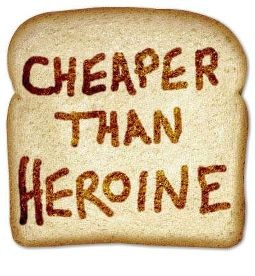
His show featured Dr. William Davis, the author of Wheat Belly, presenting his hypothesis that modern wheat, after being meddled by geneticists, is no friend to the human body (whether in white or whole wheat form). 
http://www.meandmydiabetes.com/wp-content/uploads/2013/08/Wheat-Cheaper-than-Heroin.jpg 
He argues that contemporary "Frankenwheat" is poison, which reacts with the body the way sugar does. In the same way we get addicted to the sweet stuff, so to eating wheat begets more wheat consumption. 
http://static.someecards.com/someecards/usercards/MjAxMi0zZDFmMjFiOTk5MTk4NTky.png
Every morning I used to have high fiber cereal, but I did notice that I became very hungry very quickly after eating it. Dr. Davis says that whole wheat is much healthier than white, but we would be better off if it was eliminated entirely. 
http://www.integrativepediatricsonline.com/blog/wp-content/uploads/2013/07/Frankenwheat.jpg
To clarify, this has nothing to do with gluten, so gluten-free is not the answer; standard gluten-free flours and starches really aren't good for the body either, so insubstantial and nutritionless that one is back where one started, sugar- and addiction-wise. Dr. Davis cautions not to replace a problem with a problem. 

Thankfully bulghur, while it is wheat, it is apparently from a species that has not been meddled with by scientists, since Dr. Davis gives it his blessing along with other non-wheat grains (in small amounts).

I had been already cutting back on grains when I first saw this story (with the enlightenment of Dr. Fuhrman), so the weight benefits I had already seen. There, I think, is the crux of the matter; it not just that Dr. Davis recommends cutting out simply wheat; his book markets a healthier eating plan in general. If someone was eating badly, they would lose weight anyhow, even with wheat. 

There is enough criticism of his theories that I do not take his admonishments to heart—um, to stomach. But, I have observed that I do not get satisfied from grains, only from vegetables. I could probably sit down and eat an entire loaf of buttered bread, while a few pan-roasted parsnips leaves me purringly content. 
http://static.ddmcdn.com/gif/parsnip-3.jpg
There are many nutrients in whole grains—without oat bran, my life would be empty—but I shall keep them in moderation, focusing more on the greenery to keep me full. 

Monday, August 26, 2013

Not Picky, Discerning

As someone whose teeth grind whenever an idiot launches into unasked-for detail how "single" automatically means "picky," it's a real sandbag in the head when I find myself on the other side. 

Sure, I've got criteria. One can date for only so long before she notices a correlation between "Marry me!" and a certain quality in the bachelor idly swirling the straw in his drink across the table.

OK, I'll start at the beginning. 

I was reading a Bad4 recommendation (yes, I read other books beyond Bad4's suggestions, but they mostly involve surviving the Plague, not the singles scene) entitled Data, A Love Story by Amy Webb. Webb, an non-religious Jew, succumbs to post-bad-date misery and in a fog of cigarette smoke and wine, scribbles down all the characteristics she truly wants in a man. The list goes on a bit (I don't think I could come up with 70 criteria points).
http://womensvoicesforchange.org/wp-content/uploads/2013/06/both_610x408.png
Focusing on her online dating profile, she goes so far as to erect false male avatars on JDate to stake out what she refers to as "the competition." (Hint: Fabulously skinny, false sports fans, shiksas, and of course, blonde.)

Webb constantly uses words like "data" and "crunching numbers" and "spreadsheet"—the only Data I'm into is a fictional android—so I didn't pay that much attention when she got technical. 

However, those supposedly earth-shattering conclusions that she "discovered" did not need math or dummy dude profiles to find out. I would think that it is obvious that shrewd photo selection can make a big difference—makeup and a decent outfit does do wonders, who knew! 

Oh, her "genius" epiphany is not to primarily gush about her impressive job as though her dating profile was a professional résumé. Duh. No guy needs to hear about her high-powered gig; most aren't interested in the details of how one earns the rent payment. They want to hear about interests. I could have told her that, sans statistics. 
 
But anywho, back to her male screening system. She made up a list of desired characteristics and scored potential dates by whatever info they had available before she was willing to go out. 

As a single Jewish female who periodically receives male profiles, I've been doing this for years. "He's kind of iffy about his job, and spends more time rhapsodizing about his love of 'extreme' sports. Nope, not for me." 

What is for me? I'm not going to plapel the quirks that makes me swoon, but it's not a build like Paul Bunyan. 

A friend of mine insists that she is adamant about height; she wants a tall guy. Now I will shamefacedly confess that when she first said that, I actually (silently) channeled my great-aunt. "Vhat, a six footah? Neeeee, don't be so picky." (The line should have a strong Hungarian inflection.)

But what makes my desires any less valid than hers? What makes me go weak at the knees is most definitely more personality-based; yet does that make my preferences somehow nobly permissable? Yet I am also—no need to remind me—"still" single, for all my "reasonable" expectations. I'm in no position to cast judgment on the criteria of others. 

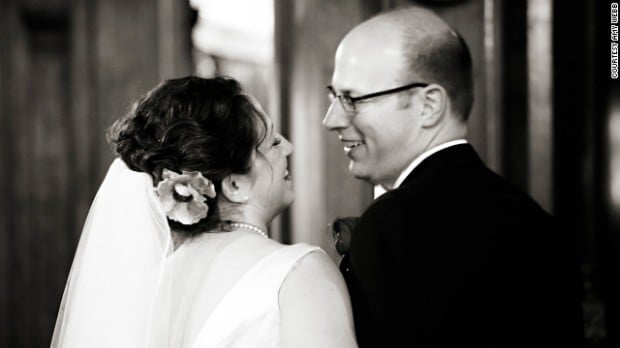
To continue: Webb found her husband in a surprisingly short time after she stopped being open to every schmo that crossed her path.
http://bloximages.chicago2.vip.townnews.com/nwitimes.com/content/tncms/assets/v3/editorial/0/e7/0e76147c-484d-51ce-b715-78944a1d9eec/516a2e0216ca9.preview-620.jpg
Amy Webb & Husband (a doctor, of course)
Obviously, there are a few chinks in Webb's system: (1) This is applicable only to the online dating world, and someone's potential spouse may not necessarily be there, on the same website; (2) Just because it went quickly for Webb makes it her own individual story, not a proven successful "method"; (3) Again, her "conclusions" were not brilliantly mathematical in nature, only commonsensical.

(As an aside, I found her being quite obvious in insisting how attractive she is in general, along with relating every time someone called her "beautiful." She posits that she has a quirky sense of humor—she even prefaces the book with a disclaimer that the reader will laugh out loud [I didn't]—but she seems to focus simply on vulgarity. Obscenity is not funny. It's just obscene.)

But in order to be discerning, one does seem to require a few years of dating experience. My approach to Bachelor #3 does differ from Bachelor #33. I don't want to say that I'm jaded, but I am wary. My glance can flick over a guy's photo and his "About Me" section and I can make a few conclusions right away. Often, in person, I was right. 

Being "open" gets old real fast, like in Webb's case. All that leads to is a string of throwaway evenings and crappy self-esteem. I have decided that it is permissible to have a few deal-breakers.

There are some characteristics that paper can't tell me. But for what paper can tell me . . . if it important enough to him to write it down, I might as well take it into consideration and not ignore it, rather than rationalize, "Oh, when he meets me he'll change his mind." 

"Thank you, but I don't think it's shayach." Love that phrase.    

Friday, August 23, 2013

Bulghur

When I was a youngster, the traditional erev Shabbos fare was farfel. With a soupçon of ketchup, it usually hit the spot. 

Now I am no longer that trusting child, and realized that all these years there was an interloper in my midst. The white flour that is farfel had to go. 

I tried quinoa for a while, and yes, while tasty (with added sautéed onions and vegetables), it never seems to satisfy me. I could sit down and consume the entire pot. 

Meddling about in the grains aisle, I spotted on the lowest shelf Sadaf Bulghur in a variety of grinds, ranging from the #1 Fine to #4 Very Course. I purchased the latter (I like a little something to chew on), cooked it with the same technique as the farfel (toasted with a little oil, add boiling water, salt, hint of pepper and garlic powder, simmer until done). 
http://www.sadaf.com/images/sites/1/products/medium/21-4038.jpg
Is it possible a grain can taste like cake? No, seriously.  

Ta is a real pasta eater, meaning farfel makes his Shabbos shine. He never was crazy about the quinoa replacement. 

I experimented by adding onions and mushrooms a lá risotto, but you know what? The bulghur tastes better without it. That hint of sweetness works fabulously alone, heightened by a dash of sea salt.
http://tiffanycooks.files.wordpress.com/2010/02/february-2010-silly-home-0011.jpg
Via tiffanycooks.wordpress.com
It takes much less time than brown rice or other whole grains to cook (20 minutes as opposed to 45+).

Dr. Oz, by the way, has crowned bulghur a "superfood."
A Turkish grain, this powerful superfood is packed with cancer-fighters including magnesium, zinc and fiber. Research has shown that pre-menopausal women eating more than 30 grams of fiber per day cut their risk of breast cancer in half. Just 1 cup of cooked bulgur wheat supplies 8 grams of fiber – one-third of your recommended daily dose.   

Thursday, August 22, 2013

Conditional Love


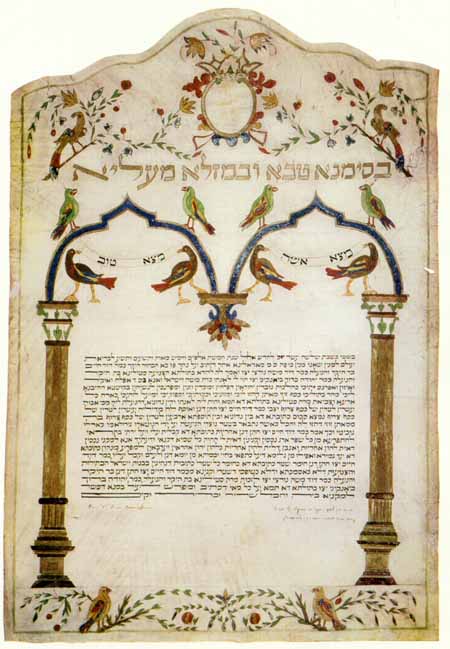
One of the contemporary issues is the saddening existence of agunos, women who are bound in a travesty of marriage from vindictive husbands. There has been some chatter to add a clause in kesubos to avoid the problem altogether, but it doesn't seem to be catching on. 
 http://www.jewishvirtuallibrary.org/images/Beauty15b.jpg
Perhaps our squeamishness to meddle with the classical text would be allayed if we were aware of what was the sort of clauses that were in the marriage documents way back when: 
Outhwaite’s team, for example, has uncovered a prenuptial agreement in which Faiza bat Solomon made her fiancé, Tobias — nicknamed “Son of a Buffoon” — promise to “abandon foolishness and idiocy,” and “not associate with corrupt men,” or face a hefty penalty of 10 gold dinars. Another document spells out a legal agreement between Sitt I-Nasab and her husband, Solomon, preventing his mother and sisters from entering his wife’s quarters or making “any request of her at all, not even a match.”  
Here I was panicking that I may have to diplomatically navigate shviggur-infested waters, but I could easily insert a clause that my mother-in-law can never insult my cooking! 

Scene: Cairo, 1182 C.E., Solomon Residence

Tobias knocks on the front door and asks Solomon for Faiza's hand in marriage. Solomon says, "Hang on, let me ask." 

"So, Faiza, Tobias has asked for your hand!" 

"Tobias? 'The Son of a Buffoon'? Are you kidding me?" 

"I'm sure his foolishness, idiocy, and association with corrupt men will change with marriage." 

"Abba, please, I'm not taking that on faith. I want that in writing."

"OK. How much should the penalty be?" 

"Let's see . . . 10 dinars? I could build up quite a nest-egg that way." 

Solomon hurries back to Tobias. "No problem! If I could just scratch in a teeny-tiny condition . . . got a quill?" 

What would I stick into my prenup? Must attend davening on time except in instances of travel, illness, and hostage situations. Penalty: Wife may purchase a pair of shoes and he must remain silent about lack of storage space.  

Wednesday, August 21, 2013

For Matrimonial Purposes

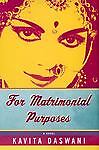
Kavita Daswani's initial novel made Bad4's shidduch lit list, and I do trust Bad4's recommendations following To Say Nothing of the Dog and The Seven Blessings
 http://i.ebayimg.com/t/Matrimonial-Purposes-Kavita-Daswani-2003-Hardcover/00/$(KGrHqJ,!pQE-v1DDhpYBP7B54G5Qw~~_35.JPG
Within the first few pages of For Matrimonial Purposes, I found myself sliding onto the floor with the glee that the name "Anju" could have been easily replaced with "Rivky," "sari" with "layering tee," and "chapatis" with "challah." That is how close to identical the Indian style of dating is to our own. They even have shadchanus and "Im yertz Hashem by you." 

Although, they seem to be a big fan of the b'sho, as opposed to the yeshivish and left onwards method of the coke in the lobby. Oh, a lobby story is in there, except her father and brothers tag along. 

Now, you may find this odd, but I have to admit the book gave me a lot of chizuk. No, really. See, the main character is very relatable; she's an Indian girl like any other, from a good background, with an energetic mother chatting up a storm on her behalf, but for whatever reasons cannot seem to find a groom. 
https://blogger.googleusercontent.com/img/b/R29vZ2xl/AVvXsEhetCWIHdLjF_33WB1eabPz3skmxqqi6V4dz_R5bDoFbr1VAvjBbdgp6pcjV1BUJsAHhua8eBudYvpEygAPatgXa2fNl3d7aaho9K11U9JlnJJ1AMVub49oP1Uei2ECtJyLUWmnriGvAhI/s400/PKS_2314.JPG
Gurus and yogis and the stars are consulted and bribed for blessings. She takes on a holy fast weekly. Charms are donned. Prayers are recited. 

Nothing doing.

She follows every single neurotic scrap of advice tossed her way. She behaves meekly in the presence of every potential suitor, even if she would like to rip his face off. She applies stinging face masks since "men only want light-skinned girls." 

Bupkis. 

She stays as open as humanly possible. She even tries online dating, despite her qualms. She overlooks quite a lot, character-wise, in the bachelors that cross her path. 

Nada.  

Anju, the protagonist (who is probably Daswani's alter-ego in what is surely her real-life tale), decides to move a little way away from the life she grew up with, but she still wants to date in the only system she knows how to. She doesn't want to defy or rebel against her upbringing. She longs for the same thing that her friends found in their teens and twenties; a husband, children, a home of her own.

That is the concept I reveled in. Comparably, I may complain about dating, sure, but I don't know how nor do I want to date any other way. This shidduch system is the method I know. It's not like my parents or grandparents met on their own, the way many of my contemporaries' did. 

Churchill once said, "Democracy is the worst form of government, except for all those other forms that have been tried from time to time." Shidduch dating is my personal "democracy"; it may not be the best, but for me, everything else seems a lot worse by comparison.

Then another point: Sometimes people are single not because they are necessarily doing anything "wrong," it's just not yet meant to be.

Reviewers online were claiming that the character of Anju was contradictory, that a traveling, socializing fashionista who wants an arranged marriage is not believable. As a frummie, it was believable to me. Heck, aren't a lot of us like that?  
http://blog.bookadda.com/wp-content/uploads/2012/08/DSC_0008.jpg
Kavita Daswani
Daswani is adept at keeping her reader's attention; I polished off the book within three hours on a Shabbos afternoon, without my usual needed breaks. Chick-lit yes (with smarmy poetry at the end that kinda pushed it), but a fun, harmless, feel-good read.