Showing posts with label Facebook. Show all posts

Wednesday, May 30, 2018

The Invisibility Cloak

"Is your engagement on OnlySimchas?" she had asked at my l'chaim. 

"No," I responded, "and I don't want it on there." 

She raised a disbelieving eyebrow. "You don't want your engagement on the jumbotron in Times Square?" 

"Nope." 

I've never been comfortable in the spotlight. Not even amongst my family. It may go back to a childhood Pesach seder, when I butchered the Yiddish Ma Nishtana and had the whole table, including my Babi, rolling. 

Han, bless his heart, actually listened to me when I said, "I don't do scenes," and gave me the simple, perfect, understated proposal I could have wanted (much to others' disappointment). 

While this may be chalked up to unavoidable genetics, I actually have biblical proof. In Melachim 2 Perek 4, we learn of the story of Elisha and who the meforshim say is the widow of Ovadiah. Her husband had died with debts, and creditors were threatening to take her sons in lieu of payment. 

Elisha asks her what she has in the house, and she says only a small jar of oil. He instructs her to borrow as many empty containers as she can. When she has done so, he says: "Close the door." Then, the miracle occurs, with no witnesses but herself, as the small jar filled the multitude of vessels, enough to sell, repay the debts, and keep her children. 
http://bibleencyclopedia.com/gs400px/stdas0460.jpg
I was once at a shiur when the speaker repeated, "Close the door." Bracha doesn't feel a need for a large studio audience. It has nothing to prove. It's nurtured in quiet, hidden places. 

This is what I thought of when I read, "Are You Really in Love if It's Not on Instagram?" by Krista Burton. 
If you have to keep reminding everyone of how happy you are, something’s not right. Happy people don’t need to announce over and over how happy they are. Happy people just … are. Your friends? They know when you’re in a healthy and loving relationship just by seeing you and knowing you. You don’t need to declare it every time you go online. These constant #relationshipgoals posts doth protest too much.
I have to second that opinion. Why must you announce how happy you are? Who are you trying to convince? Yourself? 

And if you are genuinely happy, then is it the most tactful thing to telegraph your joy to those who aren't? Who may, in turn, become envious? Who will wonder why you are in a blissful relationship while they aren't? 

Because I was on the other side for a long, long time. Every engagement I heard of had two reactions: a small amount of happiness for the couple, and a larger wallop of "Why not me? What am I doing wrong? Am I picky like the harpies say?" 

Everyone gets hysterical about ayin hara. What is it, exactly? The idea is that when one is too much in other people's mouths, it may draw a critical eye upon one. I even heard from Rabbi Glatstein (quoting a source that I cannot recall) that that is why a chosson and kallah go to the cemetery prior to their wedding. 

Solution? Don't put yourself in the mouths in the first place.  

Wednesday, May 9, 2018

Fake Princesses

There is a scene in The Crown, Episode "Beryl," where Princess Margaret is being photographed for her annual birthday portrait. Muffled beneath gauzy poofery, she smokes incessantly as Cecil Beaton gushingly invokes the glorious fairy tale that shall inspire the lowly. 

Margaret poses, smiling prettily, as the camera flashes; then she slumps backward, her unhappiness visible on every pore of her beautiful face. 

The rest of the show depicts her misery. She did not choose this role, or the facade needed to maintain it; she is trapped in a gilded cage. 
http://previously.tv/wp-content/uploads/2017-12-12-the-crown02.jpg
The irony is that while we are certainly not all princesses, many of us are stuck in the same false imagery of our own making. Social media has become a platform where only the simplistic "wonderful" is posted, omitting any of the requisite "bad" that we all have in our lives. The result is that the viewer sees only the fairy tale, and believes it. But she is not inspired by it. She is depressed by it. 

Seth Stephens-Davidowitz puts it bluntly: "Don't Let Facebook Make You Miserable."
The pressure to look a certain way on social media can do much more than distort our image of the musicians other people actually listen to. . . None of this behavior is all that new, although the form it takes is. Friends have always showed off to friends. People have always struggled to remind themselves that other people don’t have it as easy as they claim.
Think of the aphorism quoted by members of Alcoholics Anonymous: “Don’t compare your insides to other people’s outsides.” Of course, this advice is difficult to follow. We never see other people’s insides.
"My So-Called (Instagram) Life" by Clara Dollar, explains how relying on her false media self cost her a relationship, and she attempted to use it to get back at him:
And so it went, and I kept at the beautiful box I was crafting for myself. A shoe box covered in stickers and fake jewels. The kind you would make for a pet parakeet you have to bury. I would dream about Joe at night, and in the morning I would post something silvery and eye catching. It was always just tinfoil, though, not truth. And I prayed no one would notice. . . 
A girl who follows me, with whom I’ve spoken only a handful of times, told me it was so “on brand.”
My brand, specifically: funny, carefree, unromantic, a realist.
I’m like the chief executive of my own company, so I’m familiar with my branding, but its success doesn’t thrill me the way it used to. Instead of feeling validated by her comment, I felt deflated. I barely know this girl, and yet she knows me, knows my “brand,” and I am overwhelmed by the desire to tell her that I am fake, that I am heartbroken.
I have Instagram on my phone, but barely look at it. I really should delete it. If any "friends" post something obviously self-serving, I unfollow them from my feed.

For more humorously truthful Facebook postings: Joyce Wadler's "Facebook When You No Longer Care."  

To quote Stephens-Davidowitz: We're all a mess.  

Tuesday, September 5, 2017

By Work, Not By Word

"And R' Yitzchak said: If someone tells you, 'I labored but did not succeed,' don't believe him. If he tells you, 'I have not labored, yet I have succeeded,' don't believe him. If, however, he tells you, 'I have labored, and I have succeeded,' you may believe him" (Megillah 6B).  

There are a number of people who made it big with the assistance of the internet. Makeup artists (i.e. Michelle Phan), singers (i.e. Bieber), and those of other dubious talents (i.e. Kardashians) have found fame and fortune via those opportunities. But people forget there was work involved (even for the Kardashians), not just hashtagging self-promotion. 
https://storage.googleapis.com/twg-content/images/michelle-phan_lg.width-1200.jpg
"Good News for Young Strivers" by Adam Grant is a reminder that in the end, results count, not horn-tooting. Achievements lead to successful networking, not vice versa. Beneficial networking doesn't mean chasing after prey; it's about bringing the prey to you. For that, you need to draw them close with something other than a blank "Look at me!" 
In life, it certainly helps to know the right people. But how hard they go to bat for you, how far they stick their necks out for you, depends on what you have to offer. Building a powerful network doesn’t require you to be an expert at networking. It just requires you to be an expert at something.
Yes, there are businesses that take off by "happening to bump into the right person." But if one doesn't have anything for the other to remember them by, fuhgeddabouit. 
 
Cal Newport goes further ("Quit Social Media. Your Career May Depend on It") that the hashtagging is not merely a neutral influence, but a malignant one to a career. He claims that since social media is addictive, and robs one of focus that should be applied to one's work, it actually negatively impacts the performance that must speak for itself. 
If you’re serious about making an impact in the world, power down your smartphone, close your browser tabs, roll up your sleeves and get to work.  
This same premise applies, I believe, to Rosh Hashana and repentance. It's our actions that is our greatest proof of remorse, not merely "so sorry." Biting one's tongue, giving to tzedakah, flashing a smile to a stranger—you can take that to God, no status update needed. 

Thursday, December 22, 2016

I Really, Really Don't Want To Know

I've become a Facebook cynic. When people post photos of their families being oh-so-happy, I'm the Scrooge that eye rolls. "My husband is the best! #breakfastinbed Love you sooo much." That translates to me as, "I'm insecure so I must let everyone know that I am totally enviable!" 

Am I just being jealous? Perhaps. Yet my reactions are the same when it comes to vacation shots, and I'm a terrible traveler who dreams of her own bed. Seriously. The last time I went to Miami I packed so reluctantly I wondered if I was getting sick. 

Henry Alford's "Wish You Weren't There" researches yet-another oversharing situation.
While it’s fairly easy to categorize the photographically incontinent under the headlines Narcissistic and Insecure, or some combination thereof, the photo-posting folks may not have the same clarity about themselves. “People often don’t know that they’re the culprit,” said Marla Vannucci, a clinical psychologist who is an associate professor at Adler University.
In my tolerant moments I cringingly recall my early relationship with Facebook, where I felt obligated to post photos of my life. There wasn't really any thought behind it. FB is constantly begging and wheedling for me to share so they can blast me with targeted advertising, and my giddy young self succumbed. 

Yet the people posting aren't giddy young things anymore. I passed a mother and child on the street the other day; the mother had her phone up to snap a picture; the child threw her hands up to shield her face, wailing "NO!" The mother, flat-eyed with intent, grimly tapped away; she's taking the (unnecessary) picture. It was a mindless, and so thoughtless and inconsiderate, action. 

The Jabba in me was cheered by the news that the IRS now prowls through social media for proof of expensive lifestyles. "Can't pay your taxes? But you could pay for Disney World?" 

Hee hee.   

Tuesday, August 30, 2016

It's a Big World Out There

During the war in Gaza, my Facebook feed was clogged. Yes, I know the world media sucks and they are being totally unfair. I agree with you. Preaching to the choir and all that. That being the case, must you people keep sharing the obvious with me?  Go tell someone who, maybe, needs to told?

The way Facebook is set up, Frank Bruni reminds us ("How Facebook Warps Our Worlds"), is that it keeps tabs of what you like and then suggests other things you might like. 

Sounds harmless . . .  in theory. 

By constantly providing us only the information that appeals, our view is narrowed. It's like shopping for dresses whilst being adamant on only one label. There are many dresses out there. Many many many pretty, flattering frocks that differ from one another, but can still potentially suit. If not you, then someone else.

Come to think of it, my FB feed is rather monotonous. How many times can Sean Bean as Boromir be used in a meme? A million freakin' times.
 http://www.mememaker.net/static/images/memes/4350897.jpg
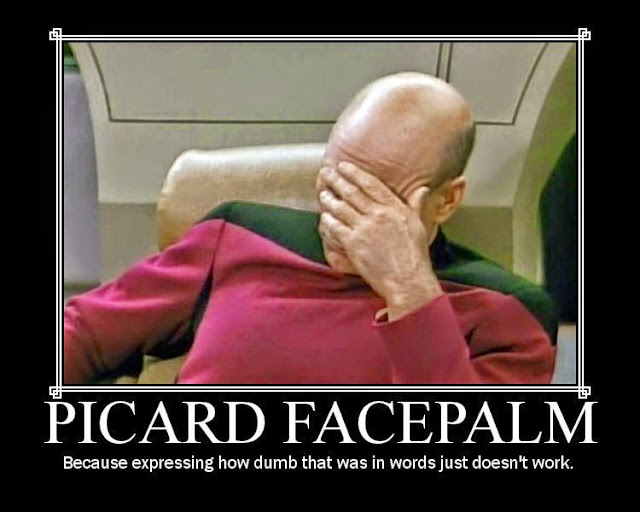
Maybe that's why I love the op-ed sections of the newspaper. I can read about all sorts of topics I didn't know existed. I can agree, disagree, or snort in derision. But along the way, I am reminded of this vast, diverse, fascinating world beyond Jean-Luc Picard face palm witticisms.
https://blogger.googleusercontent.com/img/b/R29vZ2xl/AVvXsEg1M58BFWBKVaoPuCRKD34xe1sxeBi5Tz5ovcxVbSO9mAgUeVgrqRWiYDK6Uw6PNbl-xzBEWmj56_VTS_2aFtwmLGsD-hlKJCcvk05nJQB4KAoLDJ3MajvjXpTVQrIY-FJbfsgNS4lAYfOl/s1600/322358-picard-facepalm.jpg

Tuesday, July 26, 2016

The Right to Privacy

I sometimes struggle in communicating with those of official American backgrounds. They really can't see my point of view—any more than I can see theirs. I was born on American soil, but there is something to be said for DNA and upbringing. 
 http://www.evileyebeads.org/wp-content/uploads/2009/11/hamsa-evil-eye-beads.jpg
Take the oft misunderstood ayin hara. My people don't believe that there is an independent entity from the Eibishter that can be fended off with a red string, like mosquitoes by repellent. It is more like an awareness that the bounty we have been given should not be flaunted. Ideally, the awareness of privacy keeps one humble. 

And yet, when I first joined Facebook, I mindlessly succumbed. Cool, I can upload photos! So I did. I didn't really have much thought behind it. I just thought that's what one does on Facebook, sharing pictures of your life and other people share pictures of theirs.

Ah, the horror of dawning comprehension. Disgusted with myself, I vehemently deleted all those photo albums, where I crowed over my new nephew or my pretty shots in Florida (a place I don't even like! It's so hot!). This is against everything I was raised to believe, I realized.

Elisa Albert was sucked in, too. Have baby? Have camera? Have Facebook? Must post! 
Superstitious by nature, it didn’t take me long to feel uneasy — his pure gaze, his private smiles, his perfect vulnerability: Did people I barely knew really deserve to be privy to them? The evil eye scared me off: Don’t parade your blessings wantonly lest you arouse jealously. Intimacy is to be earned, not offered. And anyway, the tropes of life online grew quickly tiresome.
Still, I did what everyone does: I have a blessed child! I am devoted to my blessed child! Won’t you look at my blessed child! Be a part of my life! Come in! Behold! Partake!
Why? Why is it so imperative that bare acquaintances know? Why must they know? 
Quoth a stranger of her kindergartner naked on the toilet: “Bittersweet! My baby’s last day in diapers!” Quoth a relative alongside a photo of her perfectly coifed daughter: “All For Her. Only Her. Always Her. All Ways Her.” My personal favorite accompanies a photo of a teenage girl: “Stop growing!” (Meaning… Die!?) What is being put on display? Whose is it to put forward?
It occurred to Albert that she should ask her son's permission before posting, and he's not crazy about it now that he knows about it. These kids who's lives have been plastered all over will approach social media quite differently than we do. 
 http://www.youaredefinitelydoingitwrong.com/wp-content/uploads/2011/01/Facebook-Baby-736313.png
The vignette that opens her article is troubling, because it is all too common: 
In a Manhattan cafe, I sit near a mother and her young daughter having tea. The daughter looks out the window. The mother takes pictures of her own shoes on a marvelously tiled floor, and of her daughter, who ignores her assiduously. I watch the mother artfully arrange the daughter’s teacup for a shot. I watch the daughter set her jaw. I watch the mother take a photo of the daughter and her teacup. The light is just so. I watch the mother consider her caption and hashtags and post it. I watch the mother scroll through her newsfeed. I watch the daughter stare out the window.
When people sigh and complain that raising children is so difficult nowadays, I would be more sympathetic once it was established that the phone was relegated to the purse and pocket, not as a constant, flashing, texting, calling interloper of quality time. Take care of your own life. No one else needs to know about it. Enjoy it, instead of constantly recording it. When you have 500 pictures of Booba on her way to camp, you won't be looking at any. 
“It’s not a secret,” my mother used to say about many things, “but it’s private.” I prefer, “Honesty is a virtue, but candor is a vice.”  

Friday, December 25, 2015

Who's Life are We Living?

"Help, My Parents are Millenials" by Katy Steinmetz in TIME: 

In scores of interviews for this article, just the mention of social media elicited groans and sighs from young parents who are barraged by handmade birthday invitations and color-coded clothes-pin chore charts on Pinterest. They debate whether Facebook or Instagram is "the hardest," whether it's the images of the home-cooked organic feast or the just-cleaned house. It helps only a little to know that people are being highly selective about what they share. "Someone will put out there, 'Oh, I just braided my child's hair.' But you just yelled at them like 50 times to sit down," says 30-year-old B. Marcell Williams, a mother of four living in St. Louis. 


Thursday, August 20, 2015

Sticks and Stones

I am in the midst of lions; I am forced to dwell among ravenous beasts—men whose teeth are spears and arrows, whose tongues are sharp swords. —Psalm 57

Today, those words are less often spoken, more often typed. Texts, tweets, posts, updates, statuses, and so forth, can be a roiling, teeming hotbed of fury and shame. With the help of technology, a thoughtless comment can be elevated and escalated to the point where people's lives are ruined. 

"How One Stupid Tweet Blew Up Justine Sacco's Life" by Jon Ronson lists anecdotes of individuals who, without sufficient thought, spoke, tweeted, or posted a statement or photo that was more offensive than they realized. The backlash and consequences insanely exceeded the severity of the crime. 
 http://static01.nyt.com/images/2015/02/15/magazine/15sacco1/15sacco1-master1050-v3.jpg
In some cases, the "muckrakers" that "outed" mindless words with the help of social media were attacked in turn, after these mild offensives were returned with firings and virulent online persecution. 

Public shaming is not a new concept. But it now extends beyond one's own small social circle to the entire freakin' world, who don't know the culprit and have no idea what they are talking about. Satire is often taken at face value; humor out of context.

Ronson's conclusion: 
When I first met her, [Justine Sacco] was desperate to tell the tens of thousands of people who tore her apart how they had wronged her and to repair what remained of her public persona. But perhaps she had now come to understand that her shaming wasn’t really about her at all. Social media is so perfectly designed to manipulate our desire for approval, and that is what led to her undoing. Her tormentors were instantly congratulated as they took Sacco down, bit by bit, and so they continued to do so. Their motivation was much the same as Sacco’s own — a bid for the attention of strangers — as she milled about Heathrow, hoping to amuse people she couldn’t see.
Why did Sacco tweet so stupidly in the first place? Probably the same reason why I used to constantly post statuses on FB—waiting for the "like" feedback, hoping someone would find me witty and worthy. 

Because Sacco tweeted under her real identity, the whiz-bang lash of ostracism was able to destroy her life. But anonymous commenters, subject to no such retribution, can write absolutely anything, snug in their invisibility: "The Epidemic of Facelessness" by Stephen Marche. 
When the police come to the doors of the young men and women who send notes telling strangers that they want to rape them, they and their parents are almost always shocked, genuinely surprised that anyone would take what they said seriously, that anyone would take anything said online seriously. There is a vast dissonance between virtual communication and an actual police officer at the door. It is a dissonance we are all running up against more and more, the dissonance between the world of faces and the world without faces. And the world without faces is coming to dominate.
I know, when I am distant to an issue, the "obvious" right and wrong side seems all too clear. It is when one comes closer that one sees that matters are not so simple. I try not to take whatever new "outrage" I see online seriously. 
 http://russia-insider.com/sites/insider/files/Unearthed-Trolls-1309-1-web.jpg
Especially since being faceless removes compassion. 
Inability to see a face is, in the most direct way, inability to recognize shared humanity with another. In a metastudy of antisocial populations, the inability to sense the emotions on other people’s faces was a key correlation. There is “a consistent, robust link between antisocial behavior and impaired recognition of fearful facial affect. Relative to comparison groups, antisocial populations showed significant impairments in recognizing fearful, sad and surprised expressions.”
. . . Without a face, the self can form only with the rejection of all otherness, with a generalized, all-purpose contempt — a contempt that is so vacuous because it is so vague, and so ferocious because it is so vacuous. A world stripped of faces is a world stripped, not merely of ethics, but of the biological and cultural foundations of ethics.
I find it interesting that those who spew horrible opinions while anonymous "of course" wouldn't say such things in the real world. Being unknown supposedly breeds "honesty." Does that mean that most of humanity, with their actual faces and true names, really don't qualify for that label?  

"What Your Online Comments Say About You" by Anna North reports on expert opinion saying that nasty comments don't necessarily come from a place of "truth"; the anonymous trolls could have simply had a "bad day." Nor do they realize that their petty frustrations can be seen by so many. 
And as they get more attention, some commenters might become more self-aware. When media outlets covered Dr. Brossard’s 2013 study, she took a look at the comments. One reader, she recalled, had indicated that “now I’m going to think twice because I realize that what I’m saying, the way I react, and my words potentially can affect other people.
One reader, she recalled, had indicated that “now I’m going to think twice because I realize that what I’m saying, the way I react, and my words potentially can affect other people.”
“There is research showing that people underestimate who’s going to see what they say” in comments sections, said Dr. Kiesler. “Unless they’ve been burned in the past, they are just not as aware that they’re being observed.”
But if research on comments continues, maybe that will change. Maybe commenters will become more conscious of each other and more bound by social norms — for better and, perhaps, for worse.
In short, think very, very hard before writing or posting pictures. And if in doubt . . . do without.  

Tuesday, February 24, 2015

Friend-ship, Not Friend-ing

The word "friend" seems to have lost its meaning. The title's potency has diminished over the centuries, and getting verbed by Facebook was the final nail on the coffin. When I looked it up in the dictionary, the definition was rather dispassionate. 
http://marlarmiller.com/wp-content/uploads/2013/12/calvinhobbes_friends.jpg
Is it just me, or should "friendship" evoke a great attachment, a sincere mutuality of love and caring? A friend is not merely someone with whom to go shopping and a movie. A friend is not the poor sucker you call up and kvetch to after an unpleasant annoyance, then don't contact when something good happens or when the other could use an empathetic ear. A friend is not someone who has a place in another's life only when it's convenient.
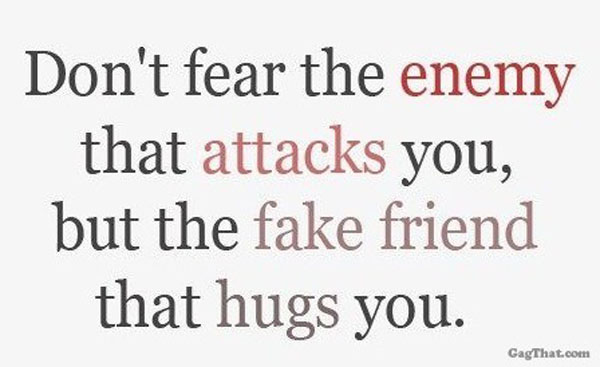
https://blogger.googleusercontent.com/img/b/R29vZ2xl/AVvXsEjY2ugL8IZpTmvYne0tHJLnpQNLvAIqN1A0r0uScq2JJzzfuR_IcimMwkBUBHWh3GWndm61QpGblYvIZ2L0QI6x29HA5sN8D5aIGphxwOzT6oaSScuezcJRkRz7TEnLpHSw7Fd602r4Dcw/s1600/Fake-Friend.jpg
Friendship is not a one-sided state of being. It shouldn't serve only half. It should bring out the best in both parties, not the worst. It should mean fierce loyalty and deep compassion.

David Brooks' "Startling Adult Friendships" lists the benefits of friendships (better decisions, freedom to be oneself, improved character). I tried to think of those examples in real life, not just in terms of my own relationships, but of others. I couldn't really come up with any couple that I have observed in its natural habitat that truly represented selfless, transcendent friendship. 
In the first place, friendship helps people make better judgments. So much of deep friendship is thinking through problems together: what job to take; whom to marry.
You know how many times I read in frum forums: "I met this great girl/guy. I'm so happy. My friend, though, says I'm making a mistake, but doesn't give me any reasons why." 

Are those "friends" really looking out for their swooning pal, or are they simply jealous and fear being alone after their chum prances off into the sunset? 

Brooks' solution—if he was magically granted millions, mind you—would be to built a friendship retreat, mixing up a diverse group of individuals and allowing them to get to know each other. 

While friendship does need time and joint activities to form, just because twenty people are thrown together doesn't necessarily guarantee a relationship. "See you soon, keep in touch" is uttered often, but rarely the promise is practiced. Friendships cannot be forced. There is an element of bashert, there, too. 

Thursday, February 12, 2015

Facebook Feeding Frenzy

When I first joined Facebook at a shadchan's suggestion—the woman never set me up, by the way—it was a new, sparkling world. I eagerly friended any poor soul that had ever crossed my path. I posted pictures of family occasions that no one cared about. I tried to come up with witty, steady updates. (Now I occupy my time with trying to come with witty, steady blog posts.) 

But after a few years, the gleam began to fade. Perhaps it felt like too much work, but I think what eventually got to me was the inauthenticity: I don't really know any of these people. And the people that I do know never login anyway.

Why I am I spending so much time with all these strangers? 

I am not the only one to have FB Fatigue; Richard Morgan wrote about his experience in "Kicking the Facebook Habit." He was a master ninja at facebooking, then he deactivated his account. He realized how much of his recorded life was strictly for social media, and began to live it instead. 
I caught myself watching folks in parks and subways looking at Facebook, so many blue-lit zombie stares. I guess that works for them, I told myself with my jealous-ex snark. It reminded me of my sister, who once eschewed meat and began calling it “carcass.” I wanted to scream, “Soylent Green”-style, “Facebook is made of people! Peeeeeople!”
I do look back on my younger self with some embarrassment, for her oversharing and confusing friending with friendship. I have scraped away a good chunk of the extraneous material from my profile, such as "friends," all photos (except the shidduch friendly one, I did activate the damn thing for that reason, right?), removed TV shows "likes" since I won't do their advertising for them, and only post if I desperately need some information that the remaining few could possibly help me with. 
http://i.kinja-img.com/gawker-media/image/upload/s--e3C8bSL5--/18mroh6nyy2gfpng.png
But then, ah, but then, there are all those luscious FB groups and pages where 1 out of 10 memes are mildly entertaining . . . well, maybe I'm not done with it completely, yet. Ideally, I would "like" to be.