Showing posts with label Marriage. Show all posts

Monday, June 13, 2022

What is the End Game?

Everything is relative, is it not? 

After marrying at our decrepit ages, Han and I are surprised to hear parents panic over their single 19-year-olds. That's still a thing? 

Han is actually, well, insulted when he hears the terror in the voices of relatives, fretting over their unwed not-yet-of-legal-drinking-age offspring. 

"Don't they see how well it worked for us?" he asked me, flabbergasted. "Don't they realize that while the wait couldn't be helped, it was worth it?" 

"Oh, my sweet idiot," I said condescendingly, patting his arm, "no." 

No one is asking our advice about launching their children into the dating realm. Because we messed up, you see. 

There could have been a confluence of factors. Perhaps our profiles didn't show us to our best advantage. Maybe we didn't consult the "right" shadchanim. Obviously, we were too picky, until we saw some sense and made the choice to "settle." 

We are the cautionary tale, not the inspiration. Sorry, Han.

I bumped into my niece's friend, who laughed how her 21-year-old sister is freaking over her singlehood. Especially considering how their parents wedded at a later age than Han and I. 

"She should be enjoying herself!" I said. "She should be doing things! Because soon," I gestured towards my burbling Anakin (yes, I'm going with Anakin, it's canon), "she won't be able to do ANYTHING. And she'll miss that time." 

I know of a gal who was shocked to find herself "still" single at 22. She married, happily, at 23. At 24, holding her bouncing baby, she finds herself hit by that proverbial Mack Truck. "I'm supposed to be up every two hours all night?!" Then: "I'm glad I didn't get married when I was 19!" 

The whole screaming infant part isn't exactly advertised in the brochure. A baby in theory is very different than a baby in practice. Even the really good ones don't let you go to the bathroom as often as their mothers would like. 

I have my moments when I sing to myself one of Ma's favorite sayings: "I'm gonna run away from home." The second time around, I'm used to the sleep deprivation, but Ben's adjustment to a new interloper was a real doozy. Then there are all those cheerful people who tell me having three is even harder, because then Han and I will be outnumbered. 

My point is this: motherhood is hard. It shouldn't be taken on lightly. 

Next: I've been hearing too many stories about young couples on the rocks. A few have lead to divorce. Which makes me sad. I know "they" say that marriage is work, but that doesn't mean it's never fun. Why else would anyone marry? There are "projects" out there that urge earlier marriages to circumvent singles, but what about the divorces? 

In today's times, younger marriages can be catastrophic. And yet these . . . children are being harried into early couplehood. That's meant for life.  

I recently came across this blog post, and when I mentioned it to Han he said that while men are allowed to nix a shidduch due to "attraction," it is considered an unimportant expectation from women. Here's the tip: if engagement is in the conversation, you both should be excited to spend time with each other.

Han and I were not willing to settle. Baruch Hashem, our parents understood and supported us, even though they found it difficult to watch us stay single. Because they also wanted us to be happy. 

Do we want our children to be happily married? Or just married? 

Monday, January 18, 2021

We All Carry Pain

***This post has been redacted. I was informed that the content was judgy and condescending, making me lose all credibility on this topic. Thank you.***

Monday, November 2, 2020

Culturally Yours, Mine, & Ours

As we know, we are not the only peoples on earth who utilize shadchanim. South Asians—Indians and Pakistanis, for instance—also dig them. 

Considering how my experiences with shadchanim were less than ideal (they tended to set me up with people who were not remotely on point, then demanded to know why I was saying no), I wondered if their matchmakers are better. Then I thought of the reality show "Indian Matchmaking," where it looked like the same six people were on rotation, so I guess not. 

From reading this article, there is little differentiation in the Indian world to being set up by a matchmaker or a family friend—a blind date is a blind date, like by us. The lovely woman who set me up with Han is a friend of my relative and a machanteneste somewhere on his side.

The interviewees in the article make a point to clarify that while the term "love marriage" is applied to couples who met on their own, it's still the same love story for those who were introduced through a matchmaker. It's not necessarily any less romantic as it would be if they met cute. Like by us, too.

In the same issue of Sunday Styles, there is a Modern Love story by Pakistani woman who grew up in the US. After seeing Bend It Like Beckham, she believed it would be possible for her to end up with a white man, and preferred not to date men of the same ethnicity. 

She moved to Pakistan for work, where it wasn't exactly easy to meet white men; when she became friendly with a fellow Pakistani, she didn't initially see him at all in a romantic light. 

I couldn’t put my finger on what finally attracted me to him. For starters, the brown culture signaling of my imagined biracial relationship wasn’t necessary because we were both brown. Gradually I realized that meant I didn’t have to do my exhausting, race-conscious performance either, the self-deprecating jokes I would mutter about terrorism (or whatever stereotype came to me in the moment), the reflexive ironic shield I felt I needed as the one Pakistani in the crowd. He understood without me having to say anything.

When I was dating, I was hoping for someone who came from a somewhat similar background. When I would go out with guys who were more American in upbringing, I would carefully edit my language lest a Yiddish word or phrase would slip out. If one did, they would look at me in annoyance. 

With Han, I don't have to do that. Especially since he understands Yiddish better than I do, and appreciates my fondness for quoting grandparents (he does the same).

After months of dating, I saw how much space that performance had taken up in my previous relationships: Without it, I was vulnerable and prone. With the weight of constant posturing suddenly lifted, I felt an intimacy I could never achieve with the not-brown guys. Ali and I are married now, and it’s the most comfortable I have ever felt with another human being.

What’s funny is that, in writing this story, I realize I have penned the exact type of propaganda immigrant mothers peddle to keep their daughters in the culture. Before Ali, my mother was fond of telling me stories of some distant friend or relative who married a white man and then divorced, only to find happiness once they remarried a Desi.

This isn’t that, but it’s not not that either. I’m not attracted to my husband because he’s brown, but I also know we wouldn’t have the relationship we have if he weren’t. That’s not to say we’re so similar; if anything, the fact that he grew up in Pakistan while I spent my youth in the Midwest separates us more than most of my past relationships. But what we share in common — an unspoken understanding of a culture that shapes the way we are, whether we like it or not — constitutes a bond much stronger than the rest of it.

You can't hide where you come from, no matter how much you may try. There's a difference being who you are and going into a relationship where your differences are accepted and even celebrated; it's another to subsume oneself in the futile attempt to "fit in." 

I've been teased and even mocked for my stubborn adherence to my heritage, especially since I don't even speak Yiddish or Hungarian fluently. But I'm proud of it, and identify with it, and I hoped to be with someone who wouldn't expect me to suppress it. I did end up with someone who is equally proud of his own background—and we enjoy the fact that our grandparents even knew each other.

Monday, August 24, 2020

Shidduch Lit: It's Not You

 OK, I know I have been saying that the persecution of singles takes place all over, in all cultures, countries, and societies, but I don't think that it really hit home until I read Sara Eckel's It's Not You: 27 (Wrong) Reasons You're Single. 

I mean, I thought it took place on some level, but not to the extreme as it is in the frum world. From what I've been gleaning from this book, which was recommended by an anonymous follower, the perception of something inherently wrong with singles is a view shared by, well, the entire human race. 

As I read, I was surprised how practically every sensation I experienced as a single was accurately described. Her chapter on being picky was practically my post on the same topic, word-for-word. 

That lead me to another epiphany: I'm expecting too much from our community. 

If the entire human race finds singlehood terrifying to look at, how is it possible for the frum demographic to calm the hell down? Eckel is describing a lifestyle where people aren't particularly religious yet they expect everyone to pair up; our faith demands that men get married and make a go at populating the earth. 

I can't expect the frummies to become mellow with the whole concept of "older singles." The campaign slogan, instead, should be kindness. Or tact, at the very least. 

Tragedy exists in a multitude of forms. People are born with disabilities. People die young by illness or accident. People yearn to be parents, but remain childless. Those subject to those circumstances must struggle with hurtful comments as well. 

The problem isn't the wrong perception of singlehood. It's the typical reaction that in our discomfort and need to control, we often say things in a desperate attempt to believe that we can prevent such circumstances, that if we do the "right thing" then we shall be thusly spared. 

So, single person, you must be too picky. You must be commitment phobic. You must not be trying hard enough.

Now we can all sleep at night. 

To get back on topic, Eckel's book is an excellent read for those who have been battered by well-meaning yet ego-devastating comments. I would have highlighted and posted 85% of it and reposted it, when it's much more gratifying to simply read it. She doesn't simply make a statement like "that's ridiculous"; she backs it up with other papers, other thinkers (even Brene!), other points, logically disproving the myth at hand.

Monday, August 17, 2020

So You Thought It Was Just Us

I think that the major frustration of being single is not that one is single, but that other people treat you like you are the most pitiable creature to grace the Earth. 

It's a form of gaslighting, really. Because when one is single, one is technically able to do all sorts of things, things that are not exactly feasible when one is wed and babied. So instead of spending one's single years doing those things, one spends one's single years calling up shadchanim, attending singles events, and feeling like crud. 

Plus, if I might be honest . . . it's not like marriage results in mindless bliss for everyone. I've been hearing a story or two that wedding does not equal happily ever after. Don't get me wrong, I'm very happy to be married—to Han. No one else would do.

Katerina Tsasis' Modern Love essay begins with awful familiarity: 

People treat you differently when you are steadily single. Not everyone, not all the time, not always overtly, not necessarily unkindly. They ask why no one has snatched you up, offer to set you up on blind dates, seat you at the singles table at formal events. . . As a child, I belonged to an immigrant community that viewed marriage and motherhood as a woman’s primary goal in life. . . Here’s another thing that happens when you’re single: Your time and plans are perceived as less fixed and less valid than for people who are married.

She did things. 

Over that next year I learned new subjects, traveled to a dozen countries, practiced speaking other languages, watched an opera staged on the steps of a castle, hiked Mount Kilimanjaro, drove the terrifying roundabout at the Arc de Triomphe.

Singles aren't permitted to enjoy themselves. If they do, then they aren't "serious" about marriage. They have to curl up in a corner and cry non-stop for divine intervention.  They have to view themselves as pathetic and in need of major overhaul. 

She got the same load of crap from people that we do/did. 

At this point, I had stopped believing one needed a partner to be fulfilled in life, but I still thought I must be lacking in some fundamental way — not good enough, attractive enough, nice enough, or something enough — in comparison.

Friends, relatives, acquaintances and even strangers will obligingly point out what you, as a single person, seem to lack. A friend of mine went to see a doctor regarding a mental health question and his prescription was that she needed a boyfriend. Well-meaning relatives urged her to go to church to find a man, even though she’s agnostic.

I have been told I’m too picky, not getting any younger, should put myself out there more, have to fight for love, and should look for a guy who’s more attractive and less attractive, more nerdy and less nerdy, more assertive and less assertive.

Men I have barely known or haven’t known at all have told me I should wear more makeup, change my attitude, do more situps, dress differently, smile more. I’ve heard it on a first date, walking down the street minding my business, and in the middle of a conversation about a totally different subject.

Deja vu all over again. 

And then, a relationship that worked.

There wasn’t any magic about it, no soul awakening, no personal reckoning, no neat and tidy reason as to why it worked where the others hadn’t. I met a man who is a lovely human being. We found shared interests and chemistry. We treated each other with kindness and respect. I’m pretty sure if I had met him years before, or years later, the outcome would have been the same: We got married.

I’m the same person, living in the same place, doing the same job, with the same friends and the same hobbies. There was nothing worse about me before. There is nothing better about me now. And yet, people who treated my singlehood with curiosity, pity or disregard are now warmer and more welcoming. It’s as if I have joined the club.

That's what annoys me. I'm now "acceptable," no longer "three- headed bearded lady." But after so many years as "circus freak," it's kind of hard to readjust to acceptance. I feel like an imposter—"Oh, you are making polite chit-chat, new acquaintance? Don't you know you're supposed to look at me with condescending derision?"

When I lived in Los Angeles, I used to go out with friends and queue for hours to get into some new, exclusive club, only to finally get in and discover there wasn’t much going on inside. The social pressure regarding marriage feels like that, an emphasis on getting through the doorway without enough care for what lies beyond.

Marriage isn't magically, effortlessly wonderful. But little conversation takes place regarding self-improvement to be in the best place for lifetime partnership. It's all about a wedding. Zeh hu. 

On the other side, decimated with exhaustion from a very demanding (yet no less squishy) baby, I'm amazed how they sell this to young young kids who haven't had a chance to do much. I'm enjoying him very much cause I waited so long to have him, but for youngsters, get a chance to do some things, cause one day all you'll want to do is sleep. Plus I've cleaned epic amounts of vomit twice in three days (he's fine! he's fine!).  

Our experiences vary. I can only describe mine. We punish and reward people for how well they conform to our ideals without even realizing it. We punish ourselves when the things we’re told to want keep us from appreciating and enjoying the things we have.

Someone may read this and find my thoughts obvious, trite, outdated. Someone may read this and think I have missed out in life. I’m writing it anyway, for the times I thought: “Maybe I’m imagining things” and “Maybe they’re right” and “Maybe there is something wrong with my life.”

Did this woman read my diary? 

It's very hard to ignore everyone's comments. It's very hard to have self-faith when everyone is telling you that you are a hideous aberration. Now on the other side, I wonder if it's a conspiracy: I'm married, you're not, so let's have a little fun. Because I don't think these comments come from a place of "I'm so delirious with joy in my marriage that I'll make this person feel terrible about being single." 

Marriage doesn't confer any special status. What is it about singles that make marrieds so nervous that they have to inform them that they're a problem? 

Hmmmmm.  

Wednesday, August 5, 2020

Marry Him?

After finishing her book, I googled "Lori Gottlieb" to find more material on her, and I discovered that she wrote a book ten years ago called Marry Him: The Case for Settling for Mr. Good Enough.

Uh-oh. 

My advice is this: Settle! That’s right. Don’t worry about passion or intense connection. Don’t nix a guy based on his annoying habit of yelling “Bravo!” in movie theaters. Overlook his halitosis or abysmal sense of aesthetics. Because if you want to have the infrastructure in place to have a family, settling is the way to go. Based on my observations, in fact, settling will probably make you happier in the long run, since many of those who marry with great expectations become more disillusioned with each passing year. (It’s hard to maintain that level of zing when the conversation morphs into discussions about who’s changing the diapers or balancing the checkbook.)
Et tu, Lori? 

Reading on, I realized the issue is based on what "settling" actually means. I can't quite relate to this, because I'm actually a very boring person who just wanted to set up house and I was on the search for someone to set up the house with. Note, it was easier said than done. 

She's making the claim that a steady, reliable guy who will be a hands-on father and care about your feelings are a dime a dozen, and women primarily search for the sweep-me-off-my-feet dashing cool dudes who will only divorce them for younger models. Generalization much?

I came across this article in Jezebel magazine from earlier this year rehashing Gottlieb's book. The author, Tracy Clark-Flory, is annoyed how women are broadly painted with the "unrealistic expectations" brush, "Meanwhile, men come under no meaningful critique for superficiality or entitlement in the realm of sex and romance. They are largely the sane observers of women’s irrational whims." 

Gottlieb considers herself guilty of "unrealistic expectations." She ended up becoming a mother via sperm donor as she had no man on the horizon. Spoiler, her most recent book, published nearly a decade later, opens with her boyfriend breaking up with her when she thought he was "The One." It makes me wonder if she believed that if she was willing to try hard enough then a relationship would work. But it takes two to tango, and don't we know that. 

However, Clark-Flory does note that the publishers insisted on this eye-catching title, while Gottlieb's point was more about prioritizing character in a life partner as opposed to his looks. 

Clark-Flory had broken up with her lovely boyfriend when she was 26 because she wasn't ready for a forever commitment. She had fretted if she had made the right decision, and did end up marrying later on. But she concludes: 
Now that we’re here, many of us have realized, if we hadn’t long ago, that marriage isn’t a guarantee of happiness, it doesn’t automatically secure an equal partnership in parenting, and it’s often only a temporary state.
More to the point: no predictive storyline emerged around pickiness or settling, because there are no rules to this game. An individual woman’s marital status at any point in time is often chiefly representative of the unpredictable lives many of us are now allowed to live.
THERE ARE NO RULES! I really thought I was not being picky about dating (even though people said I was). I went out with guys who did not fit my criteria. And it didn't go anywhere until Han came along, who, I might add, had also been accused of being "picky."

I was not looking for Brad Pitt. Other single women I know of were/are not looking for Brad Pitt. But they still had a tough time. Because finding the right partner is not always easy, nothing to do with "settling." 

A woman may find her Brad Pitt immediately, and happily spend the rest of her life gazing at his pretty face. A man may be "searching for a heart of gold," but he's "growing old." Finding the right person, for anyone, no matter what the criteria might be, is not always a simple matter "reasonable criteria." Sometimes it doesn't work, no matter how much compromise is on the table.

Wednesday, July 29, 2020

Indian Shidduchim

I don't usually binge tv. I pride myself that I don't binge tv. 

Then I binged (to the best of my mothering ability) the end of Season 3 of "Offspring" (so much suspense!). Last week I clicked on "Indian Matchmaking" (pretty lame title, I know) and plowed through 8 episodes in 2 days. 

It's supposedly a reality show, but we all know reality shows aren't really "reality." Content is carefully edited for maximum impact. Drama is often cultivated to keep things interesting. 

There also begs the question as to what sort of person wants their lives broadcasted on international screens. 

The show centers around Sima, who claims to be "the top matchmaker in Mumbai" (can that be verified?) and her travels around the world to meet various clients. 

A common complaint by Sima is how her clients expect too much, they want the perfect person that doesn't exist, that they must be more flexible and willing to compromise. Take Aparna, who is located in the US. 

Aparna, initially, doesn't come off as very likable. She's not a cheerful sort of person. Sima notes her "negative vibes." Aparna tells Sima what she's looking for, and frankly, I didn't think she was being unreasonable. She even says what she doesn't need—funny. 

Sima then sets her up with someone who barely meets her criteria—probably another way to generate some drama. No surprise, Aparna is not interested in him. 

As the show goes on, Aparna becomes less grim, more smiley, but no less specific about what she needs. Why should she be? She actually knows herself.

Then there's the India-based Akshay. He makes it quite clear that he's not interested in marriage yet, but his mother wants him wed. Akshay is obviously dragging his feet while his mother is pulling the ol' Jewish guilt about her blood pressure. 

It's kind of painful to watch Akshay in action, as he is not a natural in front of the camera. Listening to him attempt to make conversation with a girl is torturous ("So, do you like dogs?").

Then Nadia. Nadia's "issue" is that while she's ethnically Indian, her family has been living in Guyana for generations (they are now in the US). Some Indian men find that off-putting. But she's definitely who everyone (the audience) has a crush on—she's  gorgeous (those highlights!), bright, and bubbly (but definitely not flaky as she is an event planner). She's totally the opposite of Aparna. Yet Sima sets them both up with the same guy, Shekar. In fact, the same three American based candidates keep popping up. It makes you wonder how many singles Sima actually knows in the US. 

So here's the kicker: none of the people featured on the show actually ends up with a relationship. The one engagement, which is loftily proclaimed, was called off yet that detail was not included in the show (thank you Internet, for the rebuttal). 

Han was wondering why they call it "arranged marriages" when it's really not anymore. It's like us, shidduch dating, which connotes a matchmaker. Akshay had a hundred girls suggested to him, but he rejected them for nebulous reasons (because he doesn't want to get married yet! He said so!) 

It was an easy, relatable watch, but the end point is the same for us: a matchmaker is not a miracle worker. She is not an all-knowing being who can magically select one's soulmate from the mass of humanity. She flings spaghetti against the wall to see what sticks. 

So so familiar . . . 

Monday, July 6, 2020

Blessing vs. Control

"My friend married at 40," she was saying over the phone. "She says he was everything she could have wanted, he's her Mr. Perfect, and definitely worth the wait. But," she sighed, "she doesn't have children."

"But who's to say," I replied, "that if she married at 30, she would have had children?" 

The phone went silent. 

I try to think if I would have married "someone" just to have children. It sounds rather bleak. Especially as there are no guarantees that one can actually have children. 

Children are a blessing, the same way marriage is a blessing. While some insist marriage is a choice, my own experiences has made me believe that it is a blessing, meaning out of one's control.

Articles that shake their heads over the "crisis" talk about "the no" as though it is the end of everything. "She said no," they gasp, "and then he got engaged to someone else!" Well, yeah, that's bound to happen at some point. I don't think she expected him to stay single forever pining over her. 

But if he doesn't get engaged to someone else . . . I mean, we've all heard stories, right? Days later, weeks later, months later, years later, they marry. 

OK, so what's my point? It's not in our control. Not the spouse, not the kids. I've started to hate the word "hishtadlus," a term initially meant for parnassa that was applied willy-nilly to dating, because I CAN'T CONTROL WHO SHOWS UP. Suddenly everything is hishtadlus: research is hishtadlus, singles events are hishtadlus, dating online is hishtadlus. That doesn't make sense.

The joy of being religious is the belief that I am part of a greater plan. I am part of the story, not the storyteller. 

Wednesday, June 17, 2020

Not That Desperate

She couldn't bear matchmaking. In Southampton friends had tried over the years, and it had never worked. There was normally a reason why the man was still single: overbearing, or humorless, or self-absorbed, or with a disinclination to wash. And she had a perverse reaction to being told she would like someone. When she was a child, if her mother said she would like a particular dress or toy or pudding, Violet almost willed herself to hate it. — A Single Thread by Tracy Chevalier

Violet is a "surplus woman," a term for the outnumbering of British men by women by two million following World War I and the Spanish Flu. (I'll see your shidduch crisis and raise it.)  It's amazing, when you think about it, that there was a sufficient next generation of young men to fight in World War II.

Ergo, there usually was a reason why a man would still be single back then, as most women, if they wanted marriage badly enough, would definitely "compromise." Although, her list of reasons sound familiar enough to me, including a date who had a "disinclination to wash" (he was trying to be, literally, "greasy yeshivish." I didn't realize that was a thing until I went out with him). 

Are we familiar now with the term, "Good enough for yenem" meaning, "Not for my daughter, no way, but for you, he's totally good enough"? What makes it worse is when one is accused of being "picky" for not entertaining the "good enough" suggestion. 

It's not as though Violet is desperate enough for any man, for there are a few, and seem to be acceptable. She was in love with her fiance, who died in the war; but she still dislikes setups.

It was a bleak life for women back then if they decided to leave home, as Violet did; the only work they could do was usually secretarial, and that paid barely enough for Violet to eat. 

And yet, it's not even an option for her to consider a man she does not like. She would obviously rather starve. 

So why should women today, who thankfully can earn their own bread, be any different?  

Monday, May 25, 2020

Enough

I recently read "The Matchmaker's List" by Sonya Lalli, about a woman of Indian heritage who is under constant pressure by her beloved grandmother to get married already. 

At one point, the granddaughter begs, crying, for her to please stop. She loves her Nani, but this insistence was driving her away. No matter the grandmother's intentions, the message received was: You are not enough. You need someone else to complete you.  

While I did want to marry during my years and years of dating, I did not like being viewed as dofek simply because I was single. Not married? Not only are you not enough, there must be something wrong with you to boot. 

The emphasis on marriage, however, is not only from our religious community. This article notes that it's a steady message in American culture—heck, look at the reality shows. It's all about a wedding. 

I spent my youth reading books and watching comedies about women frantic to marry. Now I've tired of that storyline. I still enjoy romance, but not along the lines of insecure females acting nervously goofy in a desperate attempt to woo an improbably gorgeous man (or vice versa, for that matter). 

The stories I like better is when characters know the difference between what they can control and what they can't. They know they can't make Prince Charming walk through the door, but are open to his arrival, and don't push him away for lame reasons. ("The Unhoneymooners" by Christina Lauren was hysterical and MA). 

It's absolutely ridiculous how I was treated by some when I was single. Because we are enough, no matter our relationship status. 

Monday, December 2, 2019

I Finally Read Gluckel

Gluckel of Hameln is supposedly required reading, the memoirs of Jewish woman from the end of the 1600s. Every time I tried to take it out there was always a hitch, but I finally got my hands on it and read it through, much to Ben's annoyance ("Hey Ma! What's so interesting?")

What is surprising to me is how money is most of the conversation.  This person is worth this much; that person has that much; this person had this much but lost it. "Thalers," the currency of the time and place, is probably the most repetitive word in the book.

Gluckel had 13 children to marry off, so that was the other theme. Girls of 12 were promised to boys from other cities that they would not see until the "betrothal feast," at which point everything was agreed on. No child said, "Mother dear, not for me." Gluckel herself wed at the age of 14, and was widowed at 44, after 30 years of marriage. 

One passage in particular I found entertaining was when she recounts a visit to her in-laws. While her husband's father was worth a staggering amount,  he gave them a  gift worth a paltry sum. However, she proclaims, we treasured that present, unlike other ungrateful children who suck their parents dry. I can't tell if she's being serious or sarcastic, if she's pointedly chewing out one of her kids.

It's also a reminder of how precarious life was for Jews in the past. The rabble could be roused, the leader could banish. Life was cheap and murders were often unavenged. Never mind illness; Gluckel lost a little girl and many other relatives to diseases that probably do not plague us any longer. 

While reading of all the arranged marriages, I snarked to myself,  "Hey, solution for shidduch 'crisis' right here! Let's bring back betrothing tweens to unseen grooms!"

My neighbor has a great-granddaughter born the same time as Ben. I hear she's quite the cutie. Crisis averted. 

Monday, December 24, 2018

"Main Hoon Na"

(For those who haven't yet seen last season's black-ish, stop reading now.)

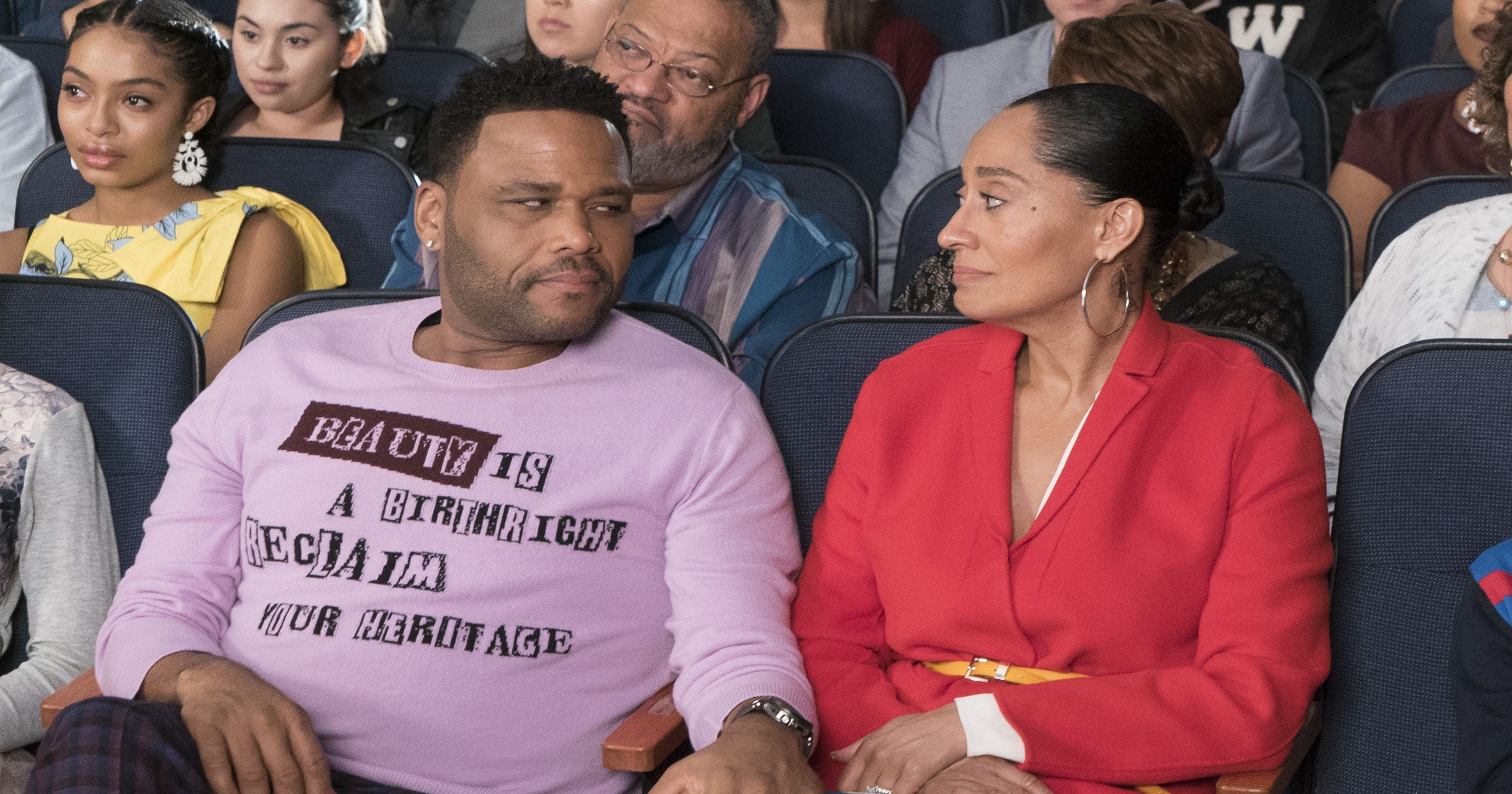
The last few episodes from black-ish season 4 got rather dark. I mean that literally. The screen became dim as we witnessed the fracturing of Dre and Bow. 

No reason is shown. Sure, he attacks her for "always doing this" and she counters with him "always doing that," but is that reason enough for him to get a new residence? 

They are on the road to divorce until he gets a call in the middle of the night. Bow is sobbing hysterically that her father died, and Dre's immediate reaction is, "I'm coming over." And he stays with her. And stays. And stays. He has no desire to leave, nor does she want him to. 
https://www.gannett-cdn.com/-mm-/8da907ebc2a652945b860ebc5eff20f2f16ca583/c=0-352-3000-2047/local/-/media/2018/05/09/USATODAY/USATODAY/636614550391814312-148827-5771.jpg?width=3200&height=1680&fit=crop
"Main hoon na," the Indian declaration of love, is not "I love you," but "I am here for you." Avraham said "Hineni" to Yitzchak, even when he believed he would be slaughtering him in a matter of hours. He would be there for his son. (As opposed to Hagar, as I heard from Rabbi Fohrman, who cast Yishmael under a bush, abandoning him because she could not bear to witness his demise.)

Love is not merely an emotion. Love is action, in presence, in commitment. When Maria Shehata and her boyfriend sought out couples' therapy, they were advised to end their relationship. But they chose not to. 
I asked my Ukrainian therapist to weigh in. She didn’t even look up from her phone when she said, “Only fools marry for love.”
She is probably right. If we do get married, it won’t be for love. It will be because we stuck it out and built ourselves up as a couple until we had huge relationship biceps and triceps from all the times we were there for each other.
Main hoon na.  

Monday, October 22, 2018

Married Guilt

I was born feeling guilty. Is it a European thing, this constant burden of guilt? I should have. I could have. If I did, why did I? 

My newest guilt is, of all things, being married. I feel like proclaiming whenever I meet a single, "I didn't get married at 21! I was a there's-no-hope-for-her-let's-get-her-some-cats 32 on my wedding day! Don't let the sheitel fool you: I'm really just like you!" 
https://media.glamour.com/photos/58dbd2e26a9459103d353155/master/w_644,c_limit/catladylede.gif
Which is totally, completely perverse.  

I wonder if, somehow, my very wedded presence grates on singles, the way some marrieds got on my nerves just by breathing. "Was it something she did? Did she go to the right shadchan? Did she act the right way? Did she do the right mitzvos and was so blessed? Or did she simply tranquilize a guy then drag him to the altar?" 

I was in a shtiebel I don't usually go to for Shabbos. I'm aware of, but not friendly with, the family of daughters who sat ahead of me. They happen to all look alike, so I had difficulty figuring out potential ages and whatnot. Another sister arrived, and I was marveling at her thick, luxurious hair until her left hand appeared and made it clear she was married.

Now that I realized her status, I noticed that she carried herself differently than her single sisters. There was an air of assurance, self-confidence, belonging. 

Her sisters' bearing was stiffer, less secure, more hesitant. Did I used to look like them? Do I look like her now? 

I don't like to think I wafted insecurity in my decade + of singleness. That even if I didn't feel it, I fiercely acted to appear assured, self-confident, and like I belonged. 

But did I? Was I fooling myself all that time? Did marriage magically grant me the aura that I had convinced myself I had attained through sheer will? 

In any case, I don't want to appear confident just because I'm married. I don't want singles to think they are so different from me, because, sister, I bolted through that gauntlet on repeat. I'm one of you. I'm still one of you, even though I may not look it anymore. 

Do you believe me? 

Monday, August 27, 2018

How to Stay Sane While Dating: XV

"You know, when you get to a certain age *sigh*, you just have to be willing to compromise." 

Smile and wave, boys. Smile and wave. 
https://data.whicdn.com/images/199337342/large.jpg
What these people who didn't know me from Adam (or Eve?) neglected to differentiate: There are levels of compromise.  

They assumed I had a detailed laundry list. Um, no. I had like maybe three criteria. And one major dealbreaker: He had to be nice. 

But "nice" was, disturbingly enough, subject to interpretation. A guy had been suggested to me for years, with this specific adjective: NICE. "He's sooooo nice!" countless advocates gushed. 

I eventually, reluctantly, agreed to a date. Pleasant discovery: He was not NICE. Not remotely. 

I heard of a girl who married "late," and divorced shortly thereafter. Someone quoted her: "I thought I could compromise on hashkafa. But I couldn't compromise on middos." 

Some people aren't into nice, so that's not an issue for them. Contrary to popular belief (eye roll) not every person prioritizes niceness in their lives. They aren't nice, they don't need nice. 

But for those that do? You do not have to compromise on your dealbreakers.  

Because Han has niceness oozing out of his pores to such an extent that those who just meet him dazedly ask, "How did you find such a nice guy?" (I didn't find him. Can't take any credit for that.) Eewok, an excellent judge of character, met Han prior to our engagement and asked, "Are you going to marry Han? Because he's sooooo nice." A nurse asked me at an appointment a standard question about domestic violence, and I burst into riotous laughter.

For those who are nice, and NEED nice, you DO NOT "compromise" on that. And "the good ones aren't all taken," either. 

Monday, August 13, 2018

"A" Feeling. "The" Feeling.

"How's married life?" she asks. I visualize her over the phone, a lovely 80-year-old.

"Very good," I reply. 

"Married life is good," she says, a smile in her voice.  

Her husband has had Alzheimer's for the last five years. But she can still say that married life is good. It must have been a great married life, that the happy memories can eclipse this sadness. 

Many years ago, a friend of Han's told him that marriages need a firm foundation. Like any other couple, he said, he and his wife have the occasional fight. Even in the height of emotion, he's able to step back, remember why he married her, and thereby diffuse the situation.

An acquaintance began chatting with Han in shul. When he learned of Han's age and that he had only wedded recently, he went on a bit of a rant. He has an "older" single brother, and he's flummoxed why he's "holding out." He was not particular about who he married; why should his brother be?

All of us have different expectations from relationships. I'm not exactly drowning in friendships because I have high standards. I wasn't willing to tolerate what my gut considered unacceptable just to get a ring on my finger.

A few months ago, I read a shidduch column response that got me really annoyed. A girl wrote in that she had been dating a nice fellow, but she didn't feel anything for him. Apparently the other side felt she was taking too long, and presented her with an ultimatum. She agreed to get engaged since she had no reason to say no. Now, she is unhappy and anxious, although enough of her friends told her they felt the same way and they are happy enough now. 

The response was to blame the current "on demand" society that expects too much. While they do agree the ultimatum was not an ideal tactic, this girl should have faith she is where she is supposed to be and it will turn out well. 

Come say what now? 

This is marriage we're talking about. A lifelong commitment, not a pair of shoes (and the chances of those turning out well are like 25%). This girl should have had the option of either dating this chap until she felt something, or decide to walk away. I felt so much for her, getting married without an iota of excitement. I'm not assuming that she won't achieve happiness with this fellow. But would it have been so terrible if she was allowed to experience it now, rather than later? 

I was discussing "the feeling" with my sister, who didn't marry either at the ideal age (younger than I had been, but in her time it was considered the end of the world). A friend's daughter was going out with a boy, a good boy, a nice boy, but she didn't feel anything, after a number of dates. Just because something isn't wrong, I noted, doesn't mean that it's right.

"She needs 'the feeling'," we agreed. Not only because "the feeling" is wonderful, but also because one day, a couple will be slammed by a curveball, and the memories of the feeling, the foundation, can help carry them through.

Friday, June 8, 2018

P'ru U'r'vu

"Get married to someone who isn't tall," she said before I even had a chance to say that I wasn't in the market for height. "Then you'll at least have kids. Before you know it, you'll be 30." 

I was 23 at the time. I have to say, I am very, very happy I rolled my eyes at her "advice."

Women worry a lot about their "biological clock," especially single women. If "declining fertility" wasn't terrifying enough, then there are those gloomy "predictions" regarding birth defects. 

Luke recently discovered Adam Ruins Everything, and I must say he is refreshingly soothing. (Check out his video on expiration dates and low-fat foods.) 


Come to think of it, regarding people I know, the myths don't apply. Babi had a miscarriage during her first marriage, pre-war; post-Holocaust, she married again at 32, and swiftly proceeded to have children, including twins at the age of 38 (that was without medical intervention. Don't think they had that in her Hungarian town). 

Fertility issues and birth defects aren't a guarantee of age, at least not to what I've heard in real life. 

So, single ladies and "elderly" newlyweds? Leave it up to God. From what I hear, He doesn't outsource this job to anyone else.

Friday, May 25, 2018

To the Nay-Sayer

"Why did it take you so long to get married?" she asked. 

I'm being accused of being picky after marriage.

"Because my man is only for me," I retorted. 

Friday, April 20, 2018

True Romance

I repeat, I have never been typically romantic. Even when I read trashy Regency romances (I was a teenager, they were fun, and I would read them again), the usual fantasized scenes involving a sprained ankle and a horsebacked savior (that one is courtesy of Jane Austen) were mentally absent. 
https://reginajeffers.files.wordpress.com/2012/06/s2526swilloughbymarianne.jpg
I believed, from an early age, that romance doesn't really mean much. It isn't proof of love to buy someone a bouquet from the drugstore while picking up antacids. It's not effort. It's a sweet gesture. At the end of a breakup, no man complains, "But I bought you flowers!" 
http://theromantic.com/wp-content/uploads/2015/08/giving-girls-flowers-first-family-date.jpg
I would actually prefer a bunch of parsley. More useful.
Due to divine timing, to quote my mother-in-law, Han and I had "the trial by fire." When someone is there for you when your world is falling apart? That's romance I believe in. 

As does Heather Havrilesky.    

Wednesday, February 14, 2018

Romantic Hooey

I am not a typical romantic. Gifts, eh. Chocolates, um, I would like my clothing to still fit me, thanks. After hearing a hilarious story of how a horseback ride on the beach ("where the sea kisses the sand") went wrong, I have merrily discarded that fantasy. 

Romance cannot be forced. It cannot be demanded. It has to be lovingly coaxed into being without stress or tension. 

That's why Valentine's Day is just another invented Hallmark holiday and should be shot. 
https://static.comicvine.com/uploads/original/7/70215/5057924-cupid-dead-14.jpg
Sam Sifton, a food writer, describes the anxious vibes in restaurants on February 14, and advocates a home-cooked meal with candles instead. 

Thursday, December 28, 2017

Married BFFs

Should spouses be best friends? 
http://www.fancylittlethings.com/wp-content/uploads/2012/09/Married-Best-Friends.jpg
There isn't one answer to that question. 

Bruce Feiler asks the question, and black-ish tackled it too last year ("Plus Two Isn't a Thing").

In terms of the latter, Bow feels like a third wheel when Dre's bestie from the hood, Gigi, shows up for a visit. However, Gigi is currently in a relationship, and all the outings she used to do with Dre she now does with Napoleon. Bow is initially gleeful—until she feels the sting of nasty kibitzing, the "perk" of being besties. Both she and Napoleon are eager for Gigi and Dre to be best friends, and they are happy to remain significant others.  
http://assets.nydailynews.com/polopoly_fs/1.2488297.1452142096!/img/httpImage/image.jpg_gen/derivatives/landscape_1200/141471-7130.jpg
Feiler's article approaches the matter from a few angles. According to one expert, spouses who consider each other best friends have an added edge. According to another, "friends" is a great understatement for the complexity of marriage. Then chimes in a third, that while friendship is about companionship, marriage is ultimately about change. 
. . . “It’s the in-between ones, when they use the language of friendship, my stomach turns,” Dr. Bader said. “It’s a red flag for a lot of conflict avoidance and intensity avoidance. It often means they’ve given up on the complexity of being with somebody. Instead of saying, ‘Oh, well, that’s who they are,’ it’s better if they try to work things out.”
Dr. Bader said that she wished popular magazines would challenge the notion that you shouldn’t get married to change someone. “I think that’s what marriage is about,” she said. “It’s where some of the juices come from, and it’s also how you get the best out of the person you marry.”
A good marriage, she said, is when people “push each other, challenge each other, encourage each other and, yes, change each other.”
Ezer k'negdo, I hear?

But doesn't change ultimately come from within? I don't want to be constantly bullying some poor fellow all day—nor do I want to be bullied in turn. I would think that initially, simply moving in with someone means that two people are exposed to different lifestyles, which, in turn, can make them rethink their previous go-tos. They have been given another pair of eyes. 

On the other hand
,  Nietzche did say: “It is not a lack of love, but a lack of friendship that makes unhappy marriages.”  
 
Oy.