Showing posts with label Health. Show all posts

Wednesday, October 13, 2021

"Healthy" is Relative

"These ices don't even have a lot of sugar," he said cheerfully. "It's only 20 grams. A yogurt has 20 grams!" 

I spluttered in outrage. "20 grams is a lot of sugar! Just because there's 20 grams in flavored yogurt doesn't make it healthy! PLAIN yogurt is healthy!" 

Later: "This non-dairy cheese is made from sunflower oil! Sunflower oil is healthy!" he says cheerfully, while tearing into slice after slice. 

I nearly started crying. Yes, if oil is needed to cook, sunflower oil is a healthy oil, but not to just recreationally chow down. Especially since this guy has no issues with dairy, and could have munched on actual cheese. 

I remember reading about a woman who actually majored in nutrition, but when she graduated she still didn't know what constituted as "healthy." Her courses went into the science and biology of the body consuming nutrition, but not how that translated into a beneficial menu.

Because it's pretty darn hard. Studies come out every few minutes debunking previously accepted "fact." I recently picked up a "healthy" cookbook that had been published in 2000. Inside, there was a brownie recipe with no oil, only applesauce, that I found initially promising. But the recipe called for 2 cups of sugar, which I think is a lot considering the small dimensions of the cake. 

Then I realized that when the book was published, fats were the villain. Later, carbs would become the bad guy. In today's day and age, the recommendation would be to focus more on "healthy" fats to help process sugar better, as opposed to it hitting your bloodstream and causing a sugar high, then crash. 

I've tried to stay current. I'm also aware that some diets are healthy for some people, while some are not for others. Celiacs have to be careful with certain ingredients, diabetics with others, colitis sufferers with others. I myself, following a round of antibiotics five years ago, have a trashed stomach and have to work with around a  low FODMAP diet; then my acid reflux restricts my diet further. But each of those diets aren't necessarily healthy for everyone, only for those with those conditions. 

A diabetic was asking if I ever used monkfruit, but since I am not (BH!) diabetic, I see no need to introduce it to my repertoire. I'd rather use real sugar, and be judicious with it. 

Online, there are always epic battles to the death over what is "healthy." 

"Fruit is a healthy dessert." 

"NO IT'S NOT! Fruit is FULL of SUGAR!" 

"But it's healthy sugar!" 

"SUGAR is SUGAR!!!" 

I can't handle all that drama. 

Personally, I have a few ingredients that I try to stay away from. I learned in my teen years that white flour doesn't like me, so I don't use it. When I learned that non-dairy whip is pure trans fat, I can't even look at it. Even though the various coconut offerings are popular—coconut oil, coconut cream, coconut sugar, coconut aminos, coconut flakes, coconut yogurt, coconut water—I hate the taste of coconut, so no coconut has crossed my threshold. 

They say, "Everything in moderation," For me that means: I don't demonize carbs. I don't demonize fats. I don't demonize sugar. I try to consume them all in moderation, as these three still are necessary for the body (okay, I physically don't need sugar, but mentally I definitely do).  

So I smile wryly and shake my head wearily as someone merrily posts a "healthy" recipe, because for me her offering is not very "healthy." At this point, "healthy" is in the eye of the beholder.  

Monday, July 26, 2021

Choose Life

I got a taste of Steven Johnson's new book, A Short History of Living Longer, with the article written by him printed in the NY Times Magazine about How Humanity Gave Itself an Extra Life

A century ago, humanity's life expectancy was half it is now. HALF. To provide some examples, approximately 25% of children died before reaching their first birthday, 50% by their fifth. 

So, what changed? Scientific discoveries, bit by bit, here and there, and applied by governments programs, made life possible. Take, for example, the realization that cholera was not spread via miasma in the air, but rather infected water. That lead to the chlorination of the water supply, which, today, is seen as evil. Or how milk used to be a killer of children, and pasteurization was resisted by the public until Nathan Straus (of Macy's), who had buried two children himself, used PR and discounts to make pasteurized milk sexy. 

The article (and I'm sure the book) continues to list all the developments that we consider to be givens in our society. Jon Stewart was recently being interviewed, and he was comparing the current pandemic with the Spanish flu crisis a century ago. A hundred years ago, they were saying what we are saying today: "Wear a mask and wash your hands." Nothing else has changed? The advice is the same? Well, yes. What's true is true. 

Steven Pinker reviewed Johnson's book, and his tone becomes positively irate at those who today discount these great advances that guaranteed life—like vaccines. When I brought Ben in to the doctor for the first time, he suspiciously asked me what's my opinion of vaccines. "My mother had whooping cough as a baby in Hungary," I said. "I believe in vaccines." There is a family photo of her following her recovery, and her scrawniness would frighten me. 

Quite frankly, in my opinion, people have been getting vaccinated for quite some time, and what we have gained has been the blessing that people live. I read an interesting article in the Wall Street Journal about how in 1957, an "Asian flu" arose that targeted the young generation. Back then, there was less bureaucracy between the government and the drug companies, and in three months a vaccine rolled out, everyone took it, and the deadly threat was gone. 

Because of people's reluctance to get the vaccine, covid is not going away. If anything, it's morphing into deadlier variants. I've read a number of articles about how since today's culture, that prizes the rights of the individual over the many, we lack the unified outlook that enabled us to beat the bad guys in WWII. Herd immunity cannot set in if people refuse to get vaccinated. It means covid will stay present and deadly. 

The year Ben was born, measles arose yet again, as many, including those in our community, chose not to vaccinate their children. I was nervous to take him into certain public areas, because he was too young to be vaccinated. I felt like I was exposing him to danger, because others would not protect their own. 

Life. It's all that matters. Vaccines have made that possible. Let's not demonize them. 

Wednesday, February 3, 2021

The Why

Han was telling me of a sad occurrence. A matriarch made a Chanukah party because "We can't not have a Chanukah party!" The occasion became a super-spreader, and three people died. 

I have been battling this mindset myself since COVID waltzed in: Not doing things because they currently aren't feasible. Having guests or being a guest. Attending levayas. Hugging my nieces and nephews. 

Han had to physically hold his father back from going into a levaya, because how does one not go in?

"Pandemic-Proof Your Habits" by Kate Murphy begins with an interesting anecdote. She attended a Thanksgiving dinner that ended up being anti-establishment. No turkey. No mashed potatoes. No cranberry sauce. The salmon, roasted potatoes, and raspberry coulis was delicious. 

The attendees lost their minds. 

She explains that being met by the unexpected can really rattle us, due to brain wiring. Going against the habitual programming can throw us for a loop. Shavuos without cheesecake? No. Just no.

It made me realize why so many couldn't cope with the cancellation of minyan. We guys have so many rituals based around religion, and we were told that it is all right to do without for now, but there were those who refused to accept it. 

COVID has made me reexamine my beliefs in some ways. I miss the Chanukah parties, the Shabbosim with family, the shul outings. But the basis of all those practices is belief. Without belief, they are meaningless. 

So until we all get vaccinated, I shall focus on believing.

Monday, October 19, 2020

I Know We'll Meet Again

I haven't put on lipstick since March. 

I don't know who I am anymore.  

I would put on lipstick if I could. But with a mask, it would end up all over my face. Same with foundation/cc+ cream. 

And in fun other news, I'm getting some seeeeerious maskne. The kind that has Luke pointing and going "Ha ha!" and has Han tenderly dabbing my face with Mario Badescu Drying Lotion (which he found reduced in Nordstrom Rack, score!) Oddly enough, this breakout started when I began to actually wash my masks with regularity. Sigh. 

What does one do when a good chunk of their identity and image is tied to "War Paint"? OK, I still do my eyes, but I'm usually behind sunglasses, so the effect is sort of lost. (I never figured out the difference between "effect" and "affect." I should look into that.) 

Ben loved my makeup, once upon a time. He'd coo happily to see my Face. Will he know who I am, when this is over? It reminds me of the time Ma had the flu and didn't go out for a month. When she finally was able to go out again, her Face threw me off. 

But I think Corona has made all of us reconsider our identities in certain ways. I always thought I'd be fine with a life of hermitude, but now that I'm here it's getting rather old. 

I do believe I'll be reunited with my lipstick hoard again. When I'll buff my punim with long-wearing foundation. When—mmmm—I can get my eyebrows threaded.

And if Mashiach is there too, nuch besser. 

Monday, August 31, 2020

Let's Talk About Flour

I, like the rest of the corona hermits, have taken to baking. When my sister stops by, she asks, "So what treats are in the freezer?" 

They haven't all been successes. The peanut butter cake that I made for Han (I hate peanut butter) is still untouched and taking up valuable space. The sourdough had a flop or three. Plus my "Battle of the Bulge" is a freakin' Waterloo, even with all my healthy swaps. Eh, it's COVID. We're all fat. 

For my cake and cookie needs, I usually use whole wheat pastry flour. The kintz with "pastry flour" is that it contains a lower protein content than regular whole wheat, meaning the cakes and cookies have the "right" texture. Or some such. 

But with the run on flour, I can't find whole wheat pastry flour anywhere. So I needed an alternative. My local store carries Shibolim whole spelt flour, so for the purposes of science I'd figure I'd give it a go. 

Whole Spelt Flour | kosher konnection

Whilst it sat nestled in the pantry, an article popped up in my Facebook feed about the glories of spelt. It claimed that while spelt contains gluten, the gluten strands are very fragile (unlike in wheat, where they are tough and sturdy). Because the gluten in essence falls apart in the stomach, spelt-based goodies are easier to digest than wheat. 

Well, I was out of pastry flour, so let's give it a go. 

1) The Bundtcake

This recipe was supposedly developed by my aunt, but it's near identical to another official recipe, so it looks like took false credit. In any case, the whole spelt tasted the same, but it's darker in color than the white whole wheat flour. 

 2) Lemon Cookies 

Han was quite clear. "Your best batch EVER," he proclaimed. When I asked for details, he said, "The crispiness. There's a dense crispiness." I'm not sure what he means by that, but he's always about texture. 

Personal Observations: Well, I'm not sure if I'm being delusional here, but it does feel easier on my stomach. My digestion, I must confess, has gone all geriatric on me (I can't eat a whole bunch of stuff anymore) so I'm rather in tune when it gets crabby. 

Conclusions: I think I'll stick with it. Some kids may get scared that the Bundtcake is a different color, but I won't tolerate racism in the kitchen.

Monday, July 27, 2020

Physician, Heal Thyself

I finished "Maybe You Should Talk to Someone" by Lori Gottlieb, a therapist who finds she needs therapy. 

She brings sagas of her own patients (with details carefully changed, she makes a point to say), along with the story of why and how she became a therapist. 

So Lori has a life event that she finds herself unable to recover from. She is so unmoored that while she gives wise guidance to her patients' crises, she is otherwise lost. She decides to go into therapy. 

What I found fascinating about this is that if a patient came to her with the same issue, chances are she would have been able to help. But she was helpless when it happened to her, requiring an outside perspective to get her over the rut. 

If a therapist, who has been trained for this, is unable to guide herself, how much more blind are we? 

It takes so much to be self-aware. Ma would say that we have to be able to look at ourselves in the mirror, but from the side, using peripheral vision. We can't be expected to handle ourselves head on. It's too much. 

Oscar Wilde said, "To love oneself is the beginning of a lifelong romance." Only the most obvious narcissists can manage to do that, I think. But coming to know oneself is a nobler enterprise, as self-improvement is a lifelong project.

Friday, May 22, 2020

Optimistic Faith

I was beginning to read a profile on Val Kilmer (I had seen a few of his movies in my youth and had a wee crush on him way back when—he was ridiculously pretty) and in the first few paragraphs, I was stunned with this line: 
" . . . if you have enough faith, you’ll see how every part of your life is just a piece of a bigger part of your life, and nothing is an accident, and everything is good." 
Oh, WOW.  

He's a Christian Scientist, but still, that line applies to all people of faith. 
"It was the special kind of optimism that maybe only the faithful have, the enduring belief that some force will come along and save us from the centrifuge of despair we’ve found ourselves in."
Is it possible to have optimism without faith?  

In my case, while I think have the faith, I also look at circumstances through a historical viewpoint. The Black Death occurred in a time when people had very little knowledge of germ theory and hygiene. The fact that an illness can be recognized and we somewhat know what to do to prevent the spread is progress indeed. 

I'm sure those who endured the Plague thought the end was nigh. As I recall, the mortality rate was approximately 50%. 

History has shown that humans are sturdier than they believe. Perhaps it is belief that keeps them going.

Tuesday, April 21, 2020

The Patient Baker

A number of months ago, I began to dabble in sourdough. I've already meddled with homemade sauerkraut, so this seemed the natural next step. 

The premise of sourdough is this: the commercial yeast we use today is a fairly new invention. Before then, "yeast" was simply flour and water that was left to ferment. Then it would be combined with more flour and water in order to make bread. 

That is why, in Mitzrayim, the Hebrews left in such a rush before their bread could rise—bread then needed a long time to rise. The first proof can take twelve hours. 

When one first starts to research, it can be quite daunting. There are words like "autolyse" and "levain" and "oven spring" and "open crumb."  There are calculated percentages for "hydration," down to specifics like "67%." I'm bad enough at math, that was almost enough to completely terrify me. 

I finally had enough with the overly complicated instructions, and decided to go about the simplest methods. It took three weeks, but I finally had a frothy jar of starter. I went with whole grain recipes only, as white flour tends to mess up my stomach. 

The results weren't technically pretty, but they were tasty (even Ben likes it!). It takes time and effort, of course. There's a method called "stretch and fold" when dealing with the dough, directions on how to "develop gluten" or something, then figuring out how to manipulate dough that tends to be very wet and blobby (I'm trying challah next. I'm going to rip my hair out). 

I've joined a number of sourdough groups for further tips to hone my nonexistent skills, as have other newbies who've decided to pick up the hobby now that they've been quarantined. 

Some people are adorable. "My starter is five days old, it's not bubbling, what's wrong?!?!?" Five days? I had to fuss over my initial starter for weeks before it would pass "the float test" (don't ask). 

Sourdough is an old world food. Instant yeast was developed as the world began to speed up. The old world was a slow world, when everything took forever and no one went anywhere. 

Fermentation reintroduced me to the concept of patience. Good things come to those who wait. I sort of learned that after dating for bloody forever, but sourdough helps to reinforce the message. 

I've noticed that the sourdough is easier on my digestion—my stomach feels good after the Shabbos meal, when beforehand it would grumble a bit. Sourdough ferments the flour, which breaks it down better; there's a theory that the instant yeast is the culprit for the modern epidemic of gluten intolerance. 

I froze my starter over Pesach, sticking it on the shelf in the freezer with the whole grain wraps and muffins, and now I'm coaxing it back to life. 

I had planned on making sourdough challah this week, but so far there's only a few sluggish bubbles. It's not ready yet. So I may have to wait until next week, and that's ok. I'm itching to try a new recipe, but one can't force things. It'll be ready when it's ready. 

I can't control that.  

Monday, July 1, 2019

Crybaby

I am not usually a crier. I'm keenly experience emotions, so I should be crier, except my mother had that European shame of overt displays of feeling (she would have been a crier too, if not for that programming). Even when she died, I did not weep excessively. 

Then, when I became pregnant with Ben, oh boy. I was bawling constantly. It took me until Ma's first yartzheit, when I was with child, to cry. I cried when there was the slightest hint of tension. I cried in the shower, just for the heck of it.

Then, when he was born—hooooooeeeeee. I cried some more. I was happy, ecstatic, but still very, very weepy. My sister reassured Han that this was normal. 

It's the hormones, yes. But I wasn't irrational. I wasn't hysterical. I just needed a box of tissues. 

Randi Hutter Epstein in "Stop Calling Women Hormonal" explains the purpose of hormones, and that blaming them is not really fair to women or to the hormones. 

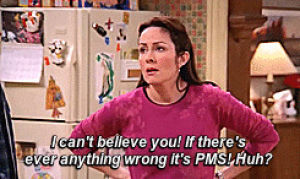
I recall an episode of "Everybody Loves Raymond" when Ray is about to enter the house but sees through the window Debra crying on the couch. He believes she's miserable, but she calmly explains that sometimes she just needs a good cry. 
 https://i.gifer.com/fetch/w300-preview/65/6530b259f8a78e09963fb827e4eecf57.gif
Then there was another episode when he believes she has PMS, and she attacks him "like a monkey tearing into a cupcake" for blaming the hormones. When Marie walks in on their argument, she actually slaps her beloved son in defense of her not-so-beloved daughter-in-law.  

So, yeah, just because I'm crying doesn't mean I don't have a point.

Tuesday, June 25, 2019

Not-As-Horrible Frosting

I had been searching for years. I tried, multiple times, but my attempts were fruitless. I occasionally gave up hope. But now, I have found what I sought for so long. 

I shall start from the beginning. 

Many of us have family recipes that defines their clan. For us, there's paprikash, bundtcake, and Shabbos cake. 

Shabbos cake was my mother's chocolate cake, baked in a massive pan. It would be layered into two rows, slathered on top and in between with pareve whip. It was named "Shabbos cake" since it only emerged from the garage deep freeze for Shabbos. 

It was a happy childhood indeed. 

Then stupid education got in the way. We learned pareve whip is made from trans-fat, the worst of the worst. Since the human body doesn't recognize it, it can't metabolize it, and simply parks it in your thighs and arteries where it remains. It has actually now been banned in new food products.

Good-bye, pareve whip. 

But I needed a replacement, which proved to be nigh on impossible. I tried cashew cream, but the frosting was dingy in color, heavy in texture. Coconut cream seemed the best option, but it tastes like coconut. I hate coconut, and so do many of my family members. Aquafaba wasn't stable enough for my needs; it sort of self-destructs in storage. 

There was one option that I stubbornly refused to attempt because of a rather silly reason: it required a candy thermometer. I didn't want to buy a gadget to take up space for one recipe. Seemed wasteful. 

Until my nocturnal surfing while feeding the baby got the better of me. I bought the dinky thermometer. 

And the results are TOTALLY WORTH IT!!!
I used my first attempt to frost a brownie my sister gave me. Quite delicious. Sadly, she can't find the recipe she used.
I used this recipe for marshmallow frosting, and I was finally able to recreate the Shabbos cake of my youth (my sister made the cake for a family birthday party, I made the frosting).
Yes, I know it's not so pretty, but that's because I need practice. No fault of the frosting.

While the recipe calls for corn syrup, one can use agave instead (I did). Additionally, it is of upmost importance that the egg whites are room temperature. I made one batch will cold whites and the frosting was a failure. After separating the next batch of whites, I waited a half hour and the frosting was magnificent.

Since someone in the audience will jump down my throat, I am not claiming that frosting with copious amounts of sugar is healthy. However, it is certainly better than trans-fat. It's all about compromise.

Wednesday, January 30, 2019

Fearfully Blessed

I have always feared the worst. Even before Ma died, I was constantly aware that all that I cherish could be lost. 

"What are you worried about?" Han asks me from time to time. 

"I'm always worried," I reply. 

Logically, this is no way to live. Will "foreboding joy" (Brené reference) mean that tragedy will be kept at bay? No, obviously. 

Religiously, this is no way to live. Worry means a lack of bitachon. My worrying is not effective action. My job is to do the mitzvos, and place my energies into that, not fretting. 

Additionally, why do I have anything I cherish in the first place? He gave it to me; it is up to Him whether it remains or not. 

Physically, this is no way to live. Jacking up cortisol levels isn't good for health. 

Joseph Lovett, 72, a filmmaker whose 2010 documentary, “Going Blind,” chronicles the slow worsening of his vision from glaucoma, told me that his best counsel was that “you cannot spend your life preparing for future losses.” It disrespects the blessings of the here and now. Besides, everyone lives in a state of uncertainty. Mine just has funky initials and fancy medical jargon attached to it.
The irony is that there is a million ways to die. Ma's death was caused by a freakishly rare illness that no one saw coming (my go-to fantasy was always a car crash. No particular reason. She was a good driver). 

After her passing, I did experience gratitude that I had the best mother for a pretty good run. I think I was appreciative while she lived, too. I hope I was. 

But I haven't stopped fretting. Now I have Han-related anxiety. "If you die, I'll kill you," I say, much to his amusement. Yet of course I know it's not in his control, nor mine. 

I must breathe, learn to rewire my faulty programming, and simply . . . cherish. Without fear of loss. 

Monday, November 12, 2018

Jacques' Poached Salmon

Ma was the master of pan-cooked salmon. I have observed her making it for a number of years. I wrote down her recipe too. 

But I can't do it. 

"I overcooked it again," I wailed to my sister. "I can't do it!" 

"I can't do it either," she commiserated. 

Fish is a delicate creature. One second, it is raw; blink, it is overcooked. I was desperate for a method to consistently grasp that small window of soft, almost creamy succulence.

After overcooking the salmon Ma's way three times, I gave up. Recalling the delights of poached salmon, I researched like mad. All roads lead to Jacques Pépin, of course.

Most poached salmon recipes call for twenty minutes of cooking. I learned from Jacques that salmon slices only need—get this—FOUR to FIVE. Then, by keeping the lid closed, the residual heat steams out any lingering rawness. 

The results? Soft, almost creamy succulence, every time

I use this method whenever I poach fish, even classic white fish (but that's another post).

The irony is that I discovered this recipe during my engagement, when Han was coming for a Shabbos. But it turns out he's not a fish fan, excepting these (whereas Ta considers canned fish "cat food"). 
Poached Salmon à la Jacques

Salmon in 6 oz. (or so) slices
1 onion, sliced into thick discs
1 carrot, chopped in half and lengthwise
1 stalk celery
1 sprig of fresh thyme or a few sprinkles dried
2 bay leaves 
1 to 2 tablespoons lemon juice 
1/2 cup white wine
1 to 2 cups water 
salt and generous amount of black pepper (1/2 teaspoon, says Jacques) 

1. Combine all the above ingredients, except for salmon, in a pot. Bring to boil. Simmer for 20 minutes or so.

2. Ensuring the flame is on a low simmer, place the salmon on top of vegetables (the onion in thick discs is helpful for this). Close pot and set a timer for FOUR (4) to FIVE (5) minutes, depending on the quantity and size of the fish. DO NOT LIFT LID. 

3. When timer rings, turn off flame. DO NOT LIFT LID. Set a timer for TEN (10) minutes. 

4. When timer rings, LIFT LID. 

5. When cool enough to handle (or even before, if one has seared out sensation from their hands), transfer to a container and strain in the broth. Cover and chill. 

C'est magnifique.  

Friday, November 9, 2018

DIY Wart Begone

I had an innocuous little wart on one finger. Not particularly noticeable, but I wanted it gone. 

The last time I treated warts I was a kid. I had one on the back of my hand, and classmates were shrieking "What is THAT?" in exaggerated horror. Ta bought me a treatment kit and it vanished rather quickly. 

This time around, I remembered that I had heard once that wart treatment is salicylic acid. The main ingredient in aspirin is salicylic acid. 
https://images.agoramedia.com/everydayhealth/gcms/5-Surprising-Uses-for-Aspirin-722x406.jpg
I double-checked with the internet and confirmed I wasn't (completely) crazy. Before bed, I dissolved an aspirin tablet in a dab of aloe, applied it to the wart, and covered with a band-aid. 

In a couple of weeks—vanished. 

Wednesday, August 15, 2018

A Thorny Topic

I suppose our grandparents, if they saw our lives today as things were in the 1940s, would have had a good laugh: specifically, in regard to the struggle to maintain a healthy weight.  

My long-time readers would be familiar with my "Battle of the Bulge" series, in which I detailed my own experiences losing weight as well as articles discussing the science of weight loss. 

But I'll be frank. There are times when I wish this wasn't a constant monkey on my back. That I didn't have to analyze and catalogue and monitor. So I would have a day or two of "hedonism" (by my usual standards), when I stubbornly insist I don't care, I've had enough, to heck with it. Then I loathe myself for my lack of control, that it wasn't worth it, and I'm back on the straight and narrow. 

Until I'm invited out for Shabbos, and my hosts coax me to please try this and that, and I want to be a good guest. Then I taste something really yummy and chances are it's really yummy for no good reason, but I still have multiple helpings (I'm a social eater. Haven't hammered that out of me yet. Anyone got any tips?). 

Sigh. 

We've all seen the thin women casually licking an ice cream and wondering, "How does she do it?" But we don't know the rest of her life. Maybe she throws it out when it begins to melt. Maybe she's one of those people who only feel a need to nibble "when hungry" (what's that like?) 
https://i2-prod.mirror.co.uk/incoming/article6001880.ece/ALTERNATES/s615/Eva-Longoria-Magnum-Ice-Cream.jpg
Weight is a very thorny topic. While it's not acceptable anymore to mock different races or cultures, sitcoms still feel free to laugh at fatness. Obesity carries with it a host of risk factors, but goal weights tend to have to do less with health than with aesthetics (I am guilty of this too). 

Taffy Brodesser-Akner's article on "Losing It" describes the contradictory messages with despair. Since she was a teenager, she has tried every diet known, faddy and dangerous and otherwise. The culture has changed now, where it is no longer p.c. to tout diets for weight loss, rather lifestyle changes for health and wellness. 

But who are we kidding: It's still about weight, just jazzed up in a new outfit. 

Kathy DeVos approaches "The Problem with Body Positivity" as an overweight woman. She was a member of the body positivity movement until she was diagnosed with Type 2 diabetes. She realized that while "fatphobia" is unfair, there are still health ramifications to weight. Her daughter, without her knowledge, chose to go on an unhealthy "diet" as she thought that was her only option. 

DeVos knows the topic is more nuanced than she originally thought. Fat shaming is cruel, as racism and sexism is cruel, but the flip side of the latter two are that there is no negativism associated with others. But there are negatives to obesity. 
The problem with today’s version of body positivity is that it refuses to acknowledge that no one approach is right for every person. One teenager might grow up to be healthy at any weight, and another might end up in the hospital. It left my own daughter afraid to approach me about a topic on which I have both personal experience and expertise. It left me feeling that I couldn’t voice the rational concerns I have about diabetes.
I was the “wrong” kind of body positive because I’d been forced to admit that there could be serious health consequences to fatness.
I was the wrong kind of mother because I felt I should support my daughter’s weight-loss goals instead of talking her out of them. . . 
I’m still trying to get it right. But I’ve come to feel that loving yourself and desiring to change yourself are two sentiments that should be able to peacefully coexist.
That sentiment is not unique to weight loss. That belief is what every Jew carries around every day: "For me the world was created" along with "I am but dust and ashes." 

We know how to carry seemingly contradictory messages together. "On the other hand" is a game every Jew plays.

I personally like it when I'm the weight I would prefer. But I've had a gain that refused to go away (like it usually does), much to my alarm. I was beating myself up about it, but then remembered the article by Sridhar Pappu regarding "Dad Bod." 

We do all come in different sizes and shapes. And those sizes can be affected by age. This is not a matter of unhealthy weight gain; it's five pounds. Five dinky pounds that refuse to leave. We can't claim it's a matter of health when it's really about aesthetics. In that case, obsessing over it can prevent one from focusing on other areas that requires improvement, like watching what comes out of my mouth. 

This is a thorny topic indeed.   

Wednesday, July 4, 2018

Guacamole

I don't really understand guacamole. There are too many foreign flavors. Cilantro? Lime? Raw onion? I prefer parsley, lemon, and my onions caramelized. 

I made it once for company in my single days. It was politely neglected. 

Yet for Han's sake, I decided to tackle it.

My one criteria was that the recipe call for dried cilantro. I abhor the stuff, and have no use for it after taking what I need. Lord Byron provided one.  
I halved the recipe, and based on Han's suggestions put in less onion (I prefer the milder shallot), and all the juice from one lime. I omit the red pepper flakes. My new delightful discovery is sun-dried tomatoes from Trader Joe's—that place is freakin' magical. Magical!  

Avocadoes soften freakishly fast at room temp, but stay inert in the fridge. So I buy them when they are very, very green, and take them out a day or two before I plan on making guac. 

Han has claimed this guac is just as good as store-bought. (Sing-song) naaaaaaiiiiiiled it!  

*Notes: I had rescued a sad avocado from my sister's fridge but didn't have any lime or shallot. I used lemon juice and scallion instead. Han still enjoyed. 

Friday, June 1, 2018

Banana Oat Cookies

Of the fruits, bananas are my nemesis. 

There is a small window when a banana is perfect. It is not wholly yellow—it is brushed with a delicate hue of green. It's sweetness is just beginning to shine through, prior to the mushy blah of over-ripeness. And it cannot bear any brown on the peel. At all. 

I can never get the banana supply right. Either I buy too many—and watch in despair as they fade into brown-spotted neglect—or to spare myself the heartbreak, decree a temporary ban on bananas. When I succumb to purchasing them again, inevitably there is the hideous banana: too soft, too sweet, too brown.

But it's not its fault! Why should it be cast into the garbage when still edible? I cannot bear it!

While I will only consume bananas in their original state, Han is more adventurous of palate. So I searched and alighted upon this ideal recipe from Ambitious Kitchen.   
I added craisins and vanilla extract to mine. Han ate them happily. 

Another banana, saved!

Wednesday, May 2, 2018

Sorry, But It's Not Up to You

I was reading a review for Barbara Ehrenreich's new book when this quoted passage caught my interest: 
“Every death can now be understood as suicide,” she writes. “We persist in subjecting anyone who dies at a seemingly untimely age to a kind of bio-moral autopsy: Did she smoke? Drink excessively? Eat too much fat and not enough fiber? Can she, in other words, be blamed for her own death?”
I would like to preface that I am a recovering "blamer" myself. There are those who do not take care of themselves to glaring degrees, and pay the price; but there are others who do not. On the flip side, there are those who treat their bodies like temples but are still stricken with illness; there are those who live to ripe old ages.

In a time when humans were more reliant on nature ("Shakai," as the Avos knew Him), we understood, quite clearly, that we are not in control. As technology advanced—irrigation instead of praying for ideal rainfall (not too much, not too little)—and farming was no longer the means for support, we started to believe, more and more, in our own powers. 

Morahs would snarkily invoke, "Kochi v'otzem yadi," and we would think, "That's not me, of course. I believe in God, and in Him alone. I don't think that it all comes from my efforts." But we do. In work, in dating, in health, in child-rearing, in parking spots. I got it. I did it. 

I'm still being quizzed as to the circumstances of Ma's passing. "But she was so healthy!" they exclaim dazedly. If the one who took care of herself (and did encourage others to do so as well) was felled by illness, what of them? If she can't be blamed, that means they are vulnerable too.

No one likes feeling subject to forces outside of their control. It's terrifying. Yet we aren't responsible for the good in our lives, either. We can't control beneficial situations. We are subject to bracha. We are subject to seeming klala. None are immune, whatever we may think. 

So we each gotta do what we gotta do, and there's only one Entity we must rely on.  

Friday, March 30, 2018

The Beauty of Vegetables

I fell off the kugel wagon. In most cases, the vegetables have to be cooked, than baked again, doubling prep time. Whereas shoving them in the oven to roast and serving the results is prettier and less caloric. 

For Shabbos HaGadol I prepared my usual fare, which is actually perfect for Pesach; these veggies are beautifully colorful to boot, unlike the browns and beiges of cholent and potato kugel:

Red, orange, and yellow bell peppers, seasoned with garlic powder, sea salt, and pepper.
 Kabocha squash, seasoned with cinnamon and sea salt.
Red and sweet onions, seasoned with sea salt. 
Cauliflower, seasoned with paprika, garlic powder, onion powder, salt, and pepper. 

All were tossed in olive oil and baked at 350 degrees for differing times. Others roast their vegetables at higher heats.  

Monday, March 19, 2018

How to Stay Sane While Dating: VI

I grew up in a house with plants. Not a jungle of plants, rather a scattering of plants. Babi had the jungle (which Zeidy tolerated, barely). 

I should note that I have murdered many plants in my time. During my teenage years I would water out of boredom, and drenching basil three times a day is really not a good idea. 

Then my dentist gave me a pothos, which are pretty much unkillable. It sits on my office desk, devoid of natural light; it hasn't stopped growing and remains a bright, vibrant green. As it thrived, I regained my confidence and began to buy plants again. 
Image result for pothos
Han, as it turned out, is a big pothos fan. His parents' house is smothered with them. It's awesome. 

So you can understand why I burst out laughing when I saw "Letter of Recommendation: Pothos" when we were dating. Jazmine Hughes fell for plants following a breakup. 
Every Tuesday morning, I fill up an old wine bottle with water and make the rounds, finding that my pothos have always survived. A pothos gives the gift of forgiveness: It grows so quickly that it seems almost regenerative. If you damage one vine, there’s another one already sprouting up — another chance to get it right.
During Ma's illness, I bought plants obsessively, plastering them not only over her hospital room, but around the house as well. There is something uplifting and soothing to the soul to be constantly greeted by flora. It's life—a lower form of life, but life. And where there's life, there's hope.