Showing posts with label Parents. Show all posts

Thursday, April 23, 2020

Maman vs. Anyu

I had been given Bringing Up Bébé: One American Mother Discovers the Wisdom of French Parenting by Pamela Druckerman when Ben was born, and only managed to read it recently. 

I should have read it earlier—I could have possibly taught him how to sleep through the night without crying it out. But besides for that, I found the rest of the book to be awfully familiar. 

Like, well, my own upbringing, although Ma was no Frenchwoman. Han easily explained why: Ma was European. Druckerman often differentiates between "English-speaking" and the French, but Britain is the land of scary nannies. I don't think the UKers let their kids run amok either. 

I laughed when I read of the technique known as "les gros yeux" or "the big eyes." Ma was a master at that. Druckerman mentions the Dr. Spock of France (Françoise Dolto) and that others, such as the Hungarian Magda Gerber, echo her beliefs. I doubt Ma was channeling the teachings of a parenting specialist, even if she was Hungarian. Babi must have been the same, except I only associate her as a chuckling grandmother who would whip out the kokosh cake whenever we came by. 

Apparently the French expect mothers to be back to their pre-baby weight at three months post-partum. Hell no. 

Excellent. I'll stick with Ma's methods.   

Friday, February 7, 2020

We Worry

Everyone in my family is understandably swoony over Ben, especially the little girls who wrestle with each other over the right to look at him. 

What is disconcerting, however, is how nobody seems to trust me with him. 

Luke: 
 
"WHAT IS HE CHEWING ON?!?!" 

"It's a piece of apple. And I'm sitting right here." 

"Oh. Phew." 

Ta: 

"He's going to swallow the pacifier! Also, you're holding him too much." 

Sister: 

"He's hot" or "He's cold." 

Other brother: 

"The blanket is too close to his nose." 

What I find confusing is that these people left their kids with me when they went on vacation. It's because they left their kids with me when they went on vacation that I actually somewhat know what I'm doing. 

Hey, I gave them back their children in one piece, right? 

I know their constant admonitions means that they care. But there's only so much a relatively capable mother can take. 

Luke: 

"WHAT'S HE CHEWING ON?!?!" 

"Dear God, you left your kids with me without a backward glace, they survived, and now you question my ability to keep him alive?!?!" 

Sheepish Luke. 

Ta walks in. 

"WHAT'S HE CHEWING ON?!?!" 

I give up.

Monday, August 12, 2019

For Cuteness!

A number of months ago, there was an article in the NY Times that niggled at me. And niggled at me. And niggled at me. 

I have found the only way to deal with the niggles is to write about it. 

The article, by Pagan Kennedy, was called "Why You Want to Eat This Baby Up: It’s Science." She begins by describing how since childhood, she never wanted to have children, to the horror of everyone. 

She just doesn't find babies cute, she claims. According to her, that's the only reason a woman would want to have a child. 

Like, for reals?

The only reason why people have children is because they're cute?

What I never quite understood about those who profess no desire to besmirch their comfortable existences with demanding little humans is this: we were ALL children once. Our parents besmirched their comfortable existences to create and raise you. 

Additionally, how long are we cute? Not very long, in the grand scheme of things. Many babies enter the world colicky and crabby. Babies leak from every orifice. As Han's friend joked, "Babies begin smiling when we're about to chuck 'em out a window." Cuteness is for survival. 

But why do we have kids? As Jews, we know why. Heritage, mesorah, passing on the flame, etc. etc. The cuteness is just a perk. 

Monday, February 18, 2019

My Mother's Armoire

Ma and I were of similar clothing size, and wore the same shoe size. 

Her one "vice," if that is what it can be called, was a love of beautiful attire. Our outings were usually shopping in nature, and the thrill of the hunt—finding garments and footwear that were stunning yet exponentially reduced in price—gave us such pleasure. 
http://campfire-capital.com/wp-content/uploads/2015/07/Saks-5th-Ave-SHOES.jpg
Cleaning out her closets was a difficult enterprise; I'm still only halfway. I have fantasies of altering her magnificent wardrobe for my own use, and I have appropriated what fits already. Will I ever give away her designer skirts, sweaters, suits? She would burrow in there on Shabbos morning, already liberally scented with perfume, as she tenderly selected her attire for shul. She would stride in, in stylish sunglasses and red lipstick that lasted overnight, whipping off her glamorous fur.

She also loved her bling. She had a right-hand ring that I always coveted, and I now wear it daily. It's a constant, comforting reminder of her. My sister-in-law said years ago of her "gam zeh yaavor" ring how looking at it, when the kids were misbehaving, reminded her that this too shall pass. Looking at my mother's ring, I recall her capability, her wisdom, her powering through even when it was difficult. 

While Ma could be the classy "lady," she could also strip down to the basics in order to prep for Shabbos and yuntiff. She loved the holidays, to the point that while there was effort, it was definitely worth it.  

Ari Scott's "Wearing My Dying Mother's Clothes" echoes my sentiments. Her clothing and accessories were an extension of her; wearing them keeps her close. 

Wednesday, December 26, 2018

Mamma Lushon

Every family has their own language, and that unique vocabulary can live on. 

In my family's case, cutely mispronounced baby words can cling for decades. For instance, as a toddler, Luke said "dahngess" (which is actually Yiddish for "worries") instead of "downstairs," and to this day, we say "dahngess." Then the next generation of kinfauna left their mark, and in short order. Luke's now 6-year-old son used to say "chapach" instead of "garbage," and I seem to be stuck saying the same. 

Then there are the European pronunciations from my parents' backgrounds. "Interasant" for "interesting"; "stoordy" for "sturdy"; "banant" for "banana." 

Then, when one marries, the spouse introduces their own family language. One of the reasons why I feel like I can be completely myself with Han is his ready acceptance of my verbal quirks, as this vocabulary is so much a part of me that it's unthinkable that I can let it go. 

"Shoin nisht the vaaser," Babi would say when washing hands. "Frozen meat doesn't rot," Zeidy would say regarding the health benefits of frigid weather. Quoting my grandparents, my parents, my siblings, the kinfauna—it's comfort, it's continuity. 

I thought of this while reading Deborah Tannen's "My Mother Speaks Through Me." Her mother died nearly 15 years ago.
I was grateful to be reminded that whenever I open my mouth to speak and my ears to hear, my mother is still with me.
Luke is a scientist; he told his kids that Babi will always be with them because they carry her DNA, she is literally in them. DNA can be seen in action, I have noted. I look like my father's side of the family, but Luke constantly says my mannerisms are like Ma's. When I echo her words, when she quoted her parents' Yiddish and Hungarian, I feel as though she is not gone, but with me. 

Monday, December 24, 2018

"Main Hoon Na"

(For those who haven't yet seen last season's black-ish, stop reading now.)

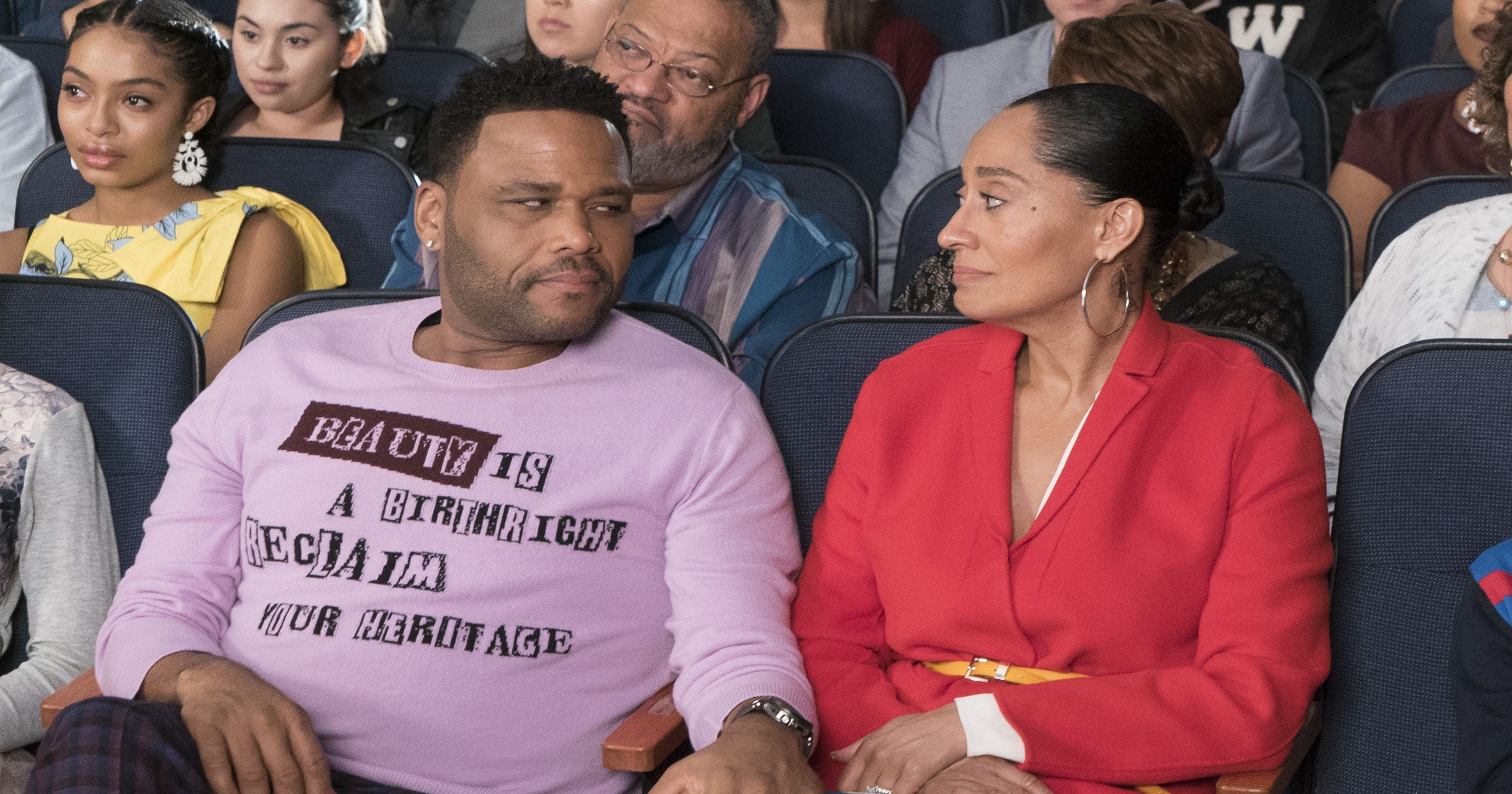
The last few episodes from black-ish season 4 got rather dark. I mean that literally. The screen became dim as we witnessed the fracturing of Dre and Bow. 

No reason is shown. Sure, he attacks her for "always doing this" and she counters with him "always doing that," but is that reason enough for him to get a new residence? 

They are on the road to divorce until he gets a call in the middle of the night. Bow is sobbing hysterically that her father died, and Dre's immediate reaction is, "I'm coming over." And he stays with her. And stays. And stays. He has no desire to leave, nor does she want him to. 
https://www.gannett-cdn.com/-mm-/8da907ebc2a652945b860ebc5eff20f2f16ca583/c=0-352-3000-2047/local/-/media/2018/05/09/USATODAY/USATODAY/636614550391814312-148827-5771.jpg?width=3200&height=1680&fit=crop
"Main hoon na," the Indian declaration of love, is not "I love you," but "I am here for you." Avraham said "Hineni" to Yitzchak, even when he believed he would be slaughtering him in a matter of hours. He would be there for his son. (As opposed to Hagar, as I heard from Rabbi Fohrman, who cast Yishmael under a bush, abandoning him because she could not bear to witness his demise.)

Love is not merely an emotion. Love is action, in presence, in commitment. When Maria Shehata and her boyfriend sought out couples' therapy, they were advised to end their relationship. But they chose not to. 
I asked my Ukrainian therapist to weigh in. She didn’t even look up from her phone when she said, “Only fools marry for love.”
She is probably right. If we do get married, it won’t be for love. It will be because we stuck it out and built ourselves up as a couple until we had huge relationship biceps and triceps from all the times we were there for each other.
Main hoon na.  

Monday, October 29, 2018

Love and Fear

I was reading Safy-Hallan Farah's tale of driving when this line made me laugh: 

"Like many immigrant daughters, I fear my mom more than I fear God, death or the police . . ."

I was born in the U.S., but Ma was not. And I feared her. 

Don't get me wrong: of course I loved her. 

But I feared her. I was more terrified of her than the pediatrician—I wouldn't scream in his office, because she did not condone "scenes." When we pulled up to the public high school building so I could pick up work papers, she bellowed at me to go get them on my own already (Luke was the only one who was able to resist her fury). If I (we) said one word out of line, hoooooo boy. 

Yet because of my relationship with her, I understand what it means to love and fear Hashem.

Ma was still cuddly. I would crawl into her bed when I was little (and not so little) and she would croon endearments in Hungarian. She cheerfully made our favorites for our birthdays. She was big on kisses and hugs.  

We are given parents, we are told, so we should know how to interact with our unseen Papa. We are required to both love and fear Him. So it would make sense that we should both love and fear our parents. 

Strictly loving our parents wouldn't be sufficient; after all, when love is divorced from awe, disrespect can creep in. 

Whereas only fearing one's folks leaves many a hapless adult on the shrink's couch.  

Rabbi Ephraim Stauber said that if you love something, you are afraid to jeopardize it. One doesn't disrespect someone they love, because they are afraid to damage the relationship. One guards that which they love—like my favorite pair of sneakers from my niece's questing eye—because they are afraid of it being taken away. 

I have seen many a parent make themselves into doormats for their kids, but from what I learned from my upbringing is that they aren't doing their kids any favors. Children have to learn the concept of parental respect because how else will they respect anything in life? How will they respect an unseen Hashem? 

And the parents who don't demonstrate their love, focusing on submission only, create an image of a cold, unloving Creator who spends all day sharpening His lightning bolts.  

It's all about balance.

Friday, June 8, 2018

P'ru U'r'vu

"Get married to someone who isn't tall," she said before I even had a chance to say that I wasn't in the market for height. "Then you'll at least have kids. Before you know it, you'll be 30." 

I was 23 at the time. I have to say, I am very, very happy I rolled my eyes at her "advice."

Women worry a lot about their "biological clock," especially single women. If "declining fertility" wasn't terrifying enough, then there are those gloomy "predictions" regarding birth defects. 

Luke recently discovered Adam Ruins Everything, and I must say he is refreshingly soothing. (Check out his video on expiration dates and low-fat foods.) 


Come to think of it, regarding people I know, the myths don't apply. Babi had a miscarriage during her first marriage, pre-war; post-Holocaust, she married again at 32, and swiftly proceeded to have children, including twins at the age of 38 (that was without medical intervention. Don't think they had that in her Hungarian town). 

Fertility issues and birth defects aren't a guarantee of age, at least not to what I've heard in real life. 

So, single ladies and "elderly" newlyweds? Leave it up to God. From what I hear, He doesn't outsource this job to anyone else.

Tuesday, February 7, 2017

Mesorah

For many of us veterans of the frum school system, "funny" or "bizarre" stories of misinformed educators abound. Like when they misquoted sources or outright invented halacha to validate personal chumras. 

When I returned home at night, there was often casual deprogramming following these incidents. "Ma, Ma! My morah said that—" "Ta, Ta! My morah said that—" Between the two of them I managed to emerge 12th grade pitying, as opposed to resenting, my teachers. Bless them, but to grant themselves security for their wobbly nerves they drew lines where none were needed. 

Mesorah was the go-to at home. Mesorah is everything. Hey, if we got it, why not stick with it? There is a comforting security when you do what your grandfather did, knowing he did what his grandfather did. 
http://richardmcbee.com/images/writings/contemporary_jewish_art/Bezalels_Legacy/Rembrandt_Jacob_blessing.jpg
Jacob blessing the children of Joseph, Rembrandt
There is always room for improvements in halacha, of course. Yet showing the kinfauna how it's done by us is first and foremost. Then we can turn to the newly available old texts. (According to the Maharam M'Rutenburg, we "have to" bring in the newspaper on Shabbos. Really.) 

Wajahat Ali mentioned us folk in his article about raising Muslim kids today.  
One potential route in producing “superior Muslims” is to follow the model of Orthodox Jewish Americans and invest tremendous resources and time to create enclosed schools or home schooling co-ops for our communities.
The "superior Muslims" comment was from his friend: 
Hina Khan-Mukhtar, a mother of three in the Bay Area, said the only way is for us to transform into “Super-Muslims,” minus the cape. “In America, you can’t be a mediocre Muslim,” she said. “You have to be the best of the best, and you have to show your kids that you have a ‘superior product’ that you are offering them. There are so many ‘-isms’ calling for their attention and for their loyalty — individualism, atheism, materialism, extremism. Islam needs to trump them all.”
That means parents really have to bring their a-game. While we do send our kids to private schools, but I made it out sane and informed only because of my parents.
Unfortunately for my children, I excel in mediocrity. This Ramadan, I opened my fasts at home with a date and some takeout food. I usually prayed Maghrib, the evening prayer, by myself in the family room. My wife, a full-time doctor, supermom and pregnant with our second child at the time, did her best to join me, but her schedule left her exhausted.
Ali explains how the available options for Muslim community life don't quite fulfill him and his wife. Yet they want their children to be as attached to Islam as they are.
We’re trying to retain so much of the good we inherited from our parents, throw away the rotten parts and improvise along the way. .  . The sources we don’t trust: shady, unqualified imams and right-wing religious material published overseas.
Instead, we’re turning to our peers and our collective best judgment as well as centuries-old traditions.
At home, my wife and I now deliberately pray in front of the kids. I prostrate toward Mecca and recite the Arabic verses out loud.
Ali adores the Islam he was raised with (his mesorah), yet knows it won't survive with misinformation (morahs with an agenda). When kids find out that something isn't true about one thing, they start questioning the whole enterprise. Luckily my folks were always on call to clarify and explain.    
http://elishira.com/wp-content/gallery/artwork/painting-elisheva-shira-a-mothers-morning-blessings.jpg
Elisheva Shira, elishira.com
The Sh'ma says so, flat out: "You shall teach them diligently to your children, and shall talk of them when you sit in your house and when you walk by the way and when you lie down and when you rise up." Parents gots to be constantly talking about it. 
Two weeks ago, during my night prayers, my son came up next to me, bowed and turned his head and smiled. There is no compulsion in religion, nor should there be. It’s up to him and Nusayba to embrace or reject the faith and our traditions. My job is only to plant the seeds with care.

Thursday, September 15, 2016

Can't Fix Sunsets

When it comes to childraising, look no further than Oprah-find Dr. Shefaly Tsabary.
She is all about boundaries and consequences, but with acceptance and celebration of a child's unique nature. On one program, a rather sweet mother was complaining that one child is very happy-go-lucky, while the other is serious. She wants the former to knuckle down and the latter to lighten up. It would be ideal if she could fuse the two of them together, she says wistfully. 

Dr. Tsabary provides a mashal: When gazing upon a magnificent sunset, do we say, "Well, why isn't it like last night's sunset? It's missing pink. It needs more pink over there. And a dash of orange." 
http://6iee.com/data/uploads/44/731841.jpg
Ah, no. We just gaze upon a magnificent sunset. That's all we do. "We don't mess with nature because we know we can't." It's outside of our control and purview. So to with children's inherent natures. For instance, extrovert parents are flummoxed by and attempt to change their introvert offspring, or vice versa.

Often parents drag their own personal baggage into their children's lives. I heard this line once, but can't get it right, that if a parent gives their child everything they didn't have, they won't be giving their children what they did have.  

Judy Batalion ("Should I Make My Daughter Clean Her Room?") grew up with a hoarder mother. Once she could live independently, she made her environment as extremely minimalist as possible. Her husband grew up the same way, and is happy with their stark home. 

Her children, however, are not growing up with hoarding parents. They are being raised by the other extreme. 

Batalion gathered opinions from friends and professionals as the best way to go, and received a jumble bag of responses and advice. One of them was:
Tamar Gordon, a psychologist specializing in anxiety disorders, thought people could be too hung up on cleaning. “What’s important for children is structure,” she said, “not necessarily the same thing as a clean room.” She explained that some kids are naturally neat, freaking out over a spot of paint on their hand, while others barely notice their visual environment. The parents’ job is to assess their child, and teach the opposite: Sticklers needed to learn flexibility, messy kids, regimen.
R2 was a neat freak from birth. I kid you not. Before he could even support his bobble head on his scrawny neck, he could be fascinated by a dust speck—yes, a dust speck—for 15 solid minutes. His idea of entertainment is sweeping the floor. When left in my care, I try to get him to be a little mellower about cleanliness.

As to the other messier ones (R2 is a rare exception), they need clear instructions. "Pack away five things," I tell them, and instead of procrastinating and claiming they will do it later when we both know they won't, they gleefully pounce on the mess, usually picking up more than the required five.   

I haven't even yet read her books, but Dr. Tsabary made me realize the importance of consciousness when interacting with rugrats. Also to embrace and enjoy them as they are. 
https://s-media-cache-ak0.pinimg.com/736x/0f/be/56/0fbe56503081f858b7b4483b6ba1cd10.jpg
It's really not a contradiction. 
Making Zelda clean her room might satisfy my organizational needs, but it probably wouldn’t make her a superior person. O.K., I admit that when Zelda dumped a box of musical instruments onto her glitter-strewn floor that evening, I panicked. But as she danced around, banging her drum, I let it go and joined in, saving my energies for the battle of bedtime.

Thursday, August 18, 2016

The Time is Now

I once read that there is no official psychological term known as "closure." I found that very gratifying, indeed. 

"Closure" is a term we use instead of "curiosity." 

"Don't you need closure?" Chava asks. "Ask Sarah why she stopped answering her texts!" 

It's more like Chava's curious.

"Closure" is one of those cultural go-to terms, like "romance" and "gluten-free."
 https://s-media-cache-ak0.pinimg.com/564x/3d/48/4b/3d484b2114cf691e8a3e19d76e99306c.jpg
Books and movies promulgate its necessity. Cantankerous, deathbed-ridden parents realize their hurtful errors in raising their children, confess their sins and affirm their love to teary-eyed offspring, then slip from this world with a casual "I'm so tired." 
 http://i.dailymail.co.uk/i/pix/2015/03/29/22/271D570600000578-3016954-image-a-59_1427665061729.jpg

Real life . . . oh, real life. 

Katie Roiphe in "Dying, With Nothing Left to Say" begins how her father's sudden death robbed her of one reassurance she wished to have given him before he went. 
. . . I realized that while nearly everyone has a fantasy of a “last conversation” with someone they love, very few people actually have it. It is the fantasy of resolving all conflicts, of emotional catharsis, that rarely ever comes to pass, because the habits of reticence or resentment that were there the whole time are still there, because the proximity of death does not transform personalities, or compel us to cut through to the heart of things, however much we want it to.
People are people, even when the end is nigh. Roiphe had wanted to ask her father more about his youth, but he never had been a chatty man. My paternal grandmother never opened up about her time in the camps, and would it have been fair to her to demand painful information when she craved peace?
Even the writers I was researching — people who lived in structure, plots, words — mostly did not find their way to conversations that offered a satisfying ending. They left things messy, unresolved, dangling.
The bedspread of life is not known for neat, military corners. Life is more like the impossible-to-fold fitted sheet. 

Two letters, in response to this article, stuck with me: 
In 2005, I picked up my mother-in-law, Mary, from the airport as she returned from vacation. I brought her to my home for some soup and then helped her load her car for her half-hour drive home. As she was stepping into her car, she turned and said, “Johnny, I tell all my friends that you are perfect.”
An hour later, my wife and I were called to the emergency room, where we found that Mary had died in a car accident.
While knowing that I am hardly perfect, I have treasured Mary’s last words ever since. Katie Roiphe suggests in her article that, with the approach of death, we anticipate the opening of a “new, honest, generous space” in which “there is a directness, an expansiveness” that can be filled with meaningful last words.
Mary showed that we can create and fill such a space with special words on any day, without knowing whether or not death is at hand.
JOHNNY WILLIS
Schenectady, N.Y.
We have heard it often enough: Live every day as though it is your last. Kind speech does not have to be reserved for meaningful moments. It should be an everyday habit. 
While Katie Roiphe writes about people in the last hours of life, the uncomfortable reality is that we are all dying.
I am a health psychologist who studies people at the end of life. I became a bereaved daughter when I was 25 years old. These experiences taught me that the trick to “having something to say,” or those deep and meaningful conversations, come to people who are able to face their own mortality well before they are on their deathbeds.
Dying, like giving birth, is a biological event. Giving birth does not instantly turn women into excellent mothers any more than dying turns one into a wise Buddha.
If we want to have a good death, we need to invest in a good life. Look death in the eye every day, and remember that time is finite, that our loved ones will not always be here, and that the time to talk is right now.
LEEAT GRANEK
Tel Aviv
The writer is an assistant professor and head of the gerontology and sociology of health program at Ben-Gurion University of the Negev. 

Thursday, June 2, 2016

iPeople

It's been a while since I had an anti-phone rant, right? Well, let's make up for lost time: 

We have—rubbing hands together in glee—Sherry Turkle's "Talk to Each Other, Not Your Phone"; Jonathan Franzen's review of her book, Reclaiming Conversation; Tony Schwartz's "Addicted to Distraction"; Amy Cuddy's "Your iPhone Is Ruining Your Posture—and Your Mood"; and a CBS News story, "What makes us happy and healthy?" (it has to do with giving our loved ones undivided attention).
 https://cdn-webimages.wimages.net/0513cc8b78e189764489179f91611c505b0859-wm.jpg
First Turkle, who has written extensively on the subject of how technology is destroying the quality of our relationships. This article is addressing the feedback she received regarding another article of hers that I already linked. One comment she received was that if an interaction is boring, why shouldn't one seek entertainment elsewhere? 
I have heard this objection before: In order for conversation to earn its right to be attended to, it needs to be compelling and novel. This way of thinking incorporates a view of conversation as a transactional tool: It has to accomplish something or provide new information. So, if these are your values and you find yourself in a conversation, there is pressure to be interesting and to perform. With that kind of pressure, it is not surprising that so many of us find it more relaxing to interact on screens. There, where we can edit and revise, we imagine that we are less likely to be dull and more likely to seem interesting.
Middleton offers his view of human conversation as a critique of my thesis; I see it as evidence of why we find ways around conversation. It holds conversation up to a standard that inhibits us from talking with spontaneity, from letting conversation develop naturally. Yet these are the kinds of conversations in which intimacy and empathy thrive.
In order for true connection to happen, there will be some emptiness, a lull, silence. Embrace it. Be freakin' bored, it won't kill you. 
According to this view, when you are engaged in talk, you are interested in hearing how another person approaches things — her opinions and associations. In this kind of conversation — I think of it as “whole person conversation” — if things go quiet for a while you look deeper, you don’t text another friend. You take the moment to read your friend more closely or look at something you haven’t attended to before. Perhaps you look into her face or pay attention to to her body language. Or you simply allow the silence.
On to Franzen on Turkle: 
The people she interviews have adopted new technologies in pursuit of greater control, only to feel controlled by them. The likably idealized selves that they’ve created with social media leave their real selves all the more isolated. They communicate incessantly but are afraid of face-to-face conversations; they worry, often nostalgically, that they’re missing out on something fundamental.
The potential detriment to children, in particularly, is the most alarming. Without conversation, they don't develop empathy, nor do they learn the means to deal with hardship, like bullying. Eek. 
 http://pop.h-cdn.co/assets/15/40/980x490/landscape-1443799206-gettyimages-142322603.jpg
Schwartz relates his struggle to detach from technology. When he was unable to focus on a book, he realized he had to cut back on email and web surfing. With his daughter's assistance, he went cold-turkey (except for texting).
During those first few days, I did suffer withdrawal pangs, most of all the hunger to call up Google and search for an answer to some question that arose. But with each passing day offline, I felt more relaxed, less anxious, more able to focus and less hungry for the next shot of instant but short-lived stimulation. What happened to my brain is exactly what I hoped would happen: It began to quiet down. 
That was for vacation. He's back to work, which means, of course, he has to deal with emails and internet. But now he's able to control how much time he devotes to it.

Cuddy was the one who taught us that standing tall makes you feel awesome; so slouching over an iPhone can make you pretty bummed. Also premature hunches cannot be that appealing (but that's just my note).
http://i0.wp.com/www.sopitas.com/wp-content/uploads/2015/12/phone_2799032b.jpg?resize=620%2C387
iHunch.
I'm not so much of the DOOM outlook. I believe when something new comes on the scene, those who grew up without it don't know how to deal with it responsibly, as opposed to those who were born with it in hand. Print books are back to the point that bookstores are reopening, and e-book sales are decreasing. The novelty of ignoring real people will wear off soon. I hope.         

Thursday, May 19, 2016

Emma Redeemed

The works of Jane Austen have been sacred to femalekind prior to the A&E adaptation of Pride & Prejudice. It is not my favorite, frankly (wildly ducking the hail of tomatoes)—I'm drawn more to Persuasion—and Emma never was a top contender.

Austen herself said Emma is "a heroine whom no one but myself will much like." I always found her meddling and cluelessness to be frustrating. But there were two articles regarding Emma, however, that made me consider it in a new light. 

"Jane Austen's Guide to Alzheimer's" by Carol J. Adams humbled me. She explains that Emma's querulous, demanding father is not a humorous caricature, but rather an accurate depiction of a man suffering from mental decline. Adams, her mother stricken by Alzheimer's and so her caregiver, found in Emma a priceless guide.
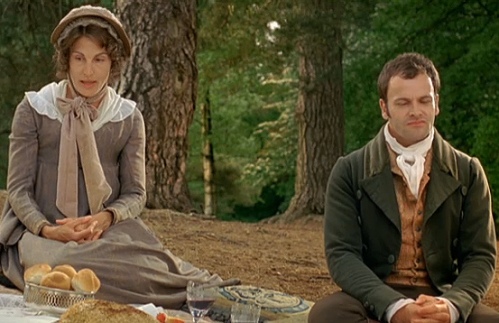
http://www.strangegirl.org/emma/gallery/d/3648-2/Screen+shot+2010-01-09+at+8_50_52+PM.png 
Emma is remembered mostly as a middling matchmaker harboring prejudices, nearly destroying her friend's chances at happiness. But that is not all she is. Like Adams, she is caretaker to a parent, a role all the more burdensome and heartbreaking given her youth. 
In Emma’s case, rather than arguing with Mr. Woodhouse, she redirects him. It is as though she had read the books. With Emma’s help, I could give more and not feel I was losing myself in caregiving, because she was always there, in my mind.
Emma demonstrates one of the casualties of caregiving: When you lose your cool, it might not be with your care receiver, but some unlikely individual in the wrong place at the wrong time. In an important scene that occurs toward the end of the novel, Emma is extremely rude to a downwardly mobile spinster. 
That scene did not endear me to Emma. But with the perspective that due to stress, as opposed to spoiling, she snapped a cruel comment in an attempt to divest . . . it is more understandable, and forgivable. 
 https://opionator.files.wordpress.com/2012/04/emma-box-hill-incident.jpg
The second was Bookends: "What Do Jane Austen’s Novels Have to Tell Us About Love and Life Today?" Adam Kirsch writes that Austen's books are not universally loved (especially not by "serious" authors) because they accept rather than object to society's conventions. (Which is true; in P&P, when Lydia runs off with Wickham, Elizabeth does not blame Darcy for leaving. She understands that, despite her innocence, she will be tainted by association. And that is that, until Darcy fights for her by paying off Wickham into doing the honorable thing.)

But still within the framework of convention, all ends (improbably) well: 
The idea that social life is just — on the marriage market and elsewhere — is the greatest fiction in Jane Austen, and the one that makes her happy endings possible. But it is also the key to her wonderfully intimate imagination of happiness. Few books make the reader as happy as “Emma,” because few depict so well the joy of being understood, the way Mr. Knightley understands Emma Woodhouse. For all of Austen’s heroines, it is this sense of being truly seen, of marrying a man who loves them as they really are, that is the great reward. The institution of marriage, like the novel itself, has changed greatly since Austen’s time; but as long as human beings long for this kind of mutual recognition and understanding, “Emma” will live.
Isn't that just perfect?

http://img.photobucket.com/albums/v606/peculiar_treasure13/picspams/emma07.png

Anna Holmes notes that Emma was in a privileged position: comfortable from home, needed at home, and claimed no interest in marrying. She had the luxury to do so, and in turn, she was unconcerned for the regard of men. Nowadays, women are free of the "need" for husbandly support—and so can also be free to be themselves. 
In addition to reflecting how women’s economic autonomy creates freedom in other areas of their lives, Emma Woodhouse is a powerful example of a woman who puts herself first, placing a greater value on her needs and desires than on those of many of the men around her. Embedded within Austen’s comedy of manners is the subtle but sustained assertion that women should concentrate less on whether they are worthy of a potential suitor and more on whether a potential suitor is worthy of them.
Esther Wein explains (cannot locate the link, sadly) how in the beginning of creation, man and woman were of equal standing. But the nature of the curses meant that females, weakened by childbirth and whatever else that goes with it, would be reliant upon the physically stronger males.
 https://blogger.googleusercontent.com/img/b/R29vZ2xl/AVvXsEjrKflpzAyNVNY2t_NxnpQShjSTp8_jrz4nxKRSmdExXOjedxzw0cMhT51bqU2K9Gl5eMhpoylIVfWiJ1c277h6SyHbsgD34dVqhoR2X9YWgb4sVwhV3QzEFTvKGkspojPBFX4B9Q0_wZY/s400/Image2.jpg
Yet as we draw closer to the days of Moshiach, the curses will lessen. Women are no longer reliant on men to survive. Therefore, they can have relationships which are based on being "seen" and loved for one's own sake (not their dowries or child-bearing hips). Austen's popularity proves that this was the fantasy of all women—not to fight against society, but to find bliss within it, yearning for marriages based on shared values as opposed to shared land. 

The courting game has changed drastically in a short amount of time. And that's all to the good. 

Friday, March 18, 2016

TGIF

  • Seek freedom and become captive of your desires. Seek discipline and find your liberty. — Chapterhouse: Dune, Frank Herbert

Thursday, March 17, 2016

Nietzsche's Peanuts


Exposure to the potentially deadly, it turns out, is the better way to go. ("That which does not kill us makes us stronger.")

Food allergies are exploding today, and the cause is unknown. There are a few as-yet unproven theories as to the why, but in terms of how to prevent or treat them, exposure is key. 
http://www.israel21c.org/wp-content/uploads/2015/02/117.jpg
In "Letter of Recommendation," Marnie Hanel hails Bamba. 
One night last summer, around 3 a.m., I was reading on my iPhone while nursing, and I came across a study led by a pediatric allergy specialist named Gideon Lack. He had noticed that Israeli Jews were much less likely to be plagued by peanut allergies than their British counterparts, and he sought an environmental explanation. It didn’t take long for him to land at the high chair. Lack and his colleagues designed a longitudinal study, feeding small amounts of Bamba to babies at high risk for developing an allergy (and none to a control group) from the time they began eating finger foods until they turned 5, ulti­mately finding that the snack reduced their risk by 81 percent.
Upon reading this, I proceeded to do what any literal-minded new parent might do in the middle of the night: I opened the Amazon app and ordered Bamba in bulk. . . 
(Until as recently as 2008, parents were advised to avoid feeding peanuts to at-risk kids until age 3.) In doing everything they could to protect their children, they instead made their children more vulnerable.
Today's parents, it would seem, are terrified their children should suffer any sort of upset, the physical to mental. I've now heard of mothers of dating-age children wanting guarantees that the lined-up guy or gal won't reject their children; as stated above, in their eagerness to protect, they make them more vulnerable. How can a person be expected to be ready for marriage yet still need to be shielded from rejection? C'mon, moms, there is no chance at happiness without risk!

But I digress. We're talking about peanuts. 

Current therapy for children with extreme cases of deadly food allergies involve gradual, microscopic doses progressing to amounts that can be tolerated ("The Allergy Buster" by Melanie Thernstrom). Like iocane powder, wink wink. It's called "desensitization."

I have the same approach to germs; I frolic barefoot in grass, and if doing any gardening I plunge my hands fearlessly into dirt. I carefully avoid antibiotic soap, opting for non-nuking suds. Nothing that claims to "sterilize" is welcome. 

For whatever reason it is, germs are welcome to dinner.