Monday, November 16, 2015

Walk It Off

On a Shabbos afternoon, I was perusing the many papers that had piled up, and noted "The Funny Thing About Adversity" by David DeSteno. 
https://mabb0tt.files.wordpress.com/2014/09/empathy.jpg
He reported that while difficulty did make sufferers more empathetic, there was one exception: When others were going through the same trial. Even though they battled the same dragon, the brain has belittled the tribulation to the point that empathy vanishes: "Walk it off." 
. . . the human mind has a bit of a perverse glitch when it comes to remembering its own past hardships: It regularly makes them appear to be less distressing than they actually were.
As a result of this glitch, reflecting on your own past experience with a specific misfortune will very likely cause you to underappreciate just how trying that exact challenge can be for someone else (or was, in fact, for you at the time). You overcame it, you think; so should he. The result? You lack compassion.
I thought that point was interesting, but I wasn't going to link it since I couldn't think of a connecting point. I then moved on to the Jewish newspapers.

The previous week, the letter of a recently divorced woman had been published, in which she expressed her feelings of isolation. She isn't invited out anymore. She feels like a pariah. 

The letters printed this week were less than sympathetic, from fellow now-single mothers. "Invite people over instead!" more than one proclaimed. "Who said you have to stay at home feeling sorry for yourself?" 

Disbelievingly, my glance darted between the two newspapers, back and forth. I just read this. A divorced woman is opening up about her loneliness, and she is flatly told by those floating in the same boat to stop being such a kvetch. 

Wait. Have I done the same thing, too? Have I also been impatient and dismissive of the hurt of others simply because their pain echoed mine?

I have this memory that still haunts me from first grade. We were having a class play; Ma had gone to visit her parents, and wouldn't be attending. Rivky began to wail that her mother wouldn't be coming. 

"So what?" I had snapped. "My mother isn't coming either, and I'm not crying." 
In separate experiments, they next exposed them to people who were expressing dejection and showing difficulty in enduring one or the other hardship. Those who had overcome more severe bullying felt less — not more — compassion for current bullying victims. Likewise, those who had faced greater difficulty with unemployment had less sympathy for the currently jobless. When the adversities didn’t match, no such empathy gap emerged.
. . . Living through hardship doesn’t either warm hearts or harden them; it does both. Having known suffering in life usually heightens the compassion we feel for others, except when the suffering involves specific painful events that we know all too well. Here, familiarity really does breed contempt.
I hope I have progressed in indiscriminate empathy since I was five.      

Thursday, November 12, 2015

You Will Find Your Place

There is a difference between "fitting in" and "belonging," as I have learned from Brené Brown. "Fitting in" is conforming oneself to wedge into surroundings; "belonging" is being oneself yet being accepted in surroundings. 
 https://s-media-cache-ak0.pinimg.com/736x/21/1a/09/211a0991e04bf11028e874db85e4e163.jpg
Pamela Druckerman, an American in Paris, has written before about the differences in American and French outlook. When a country doesn't comprehend children's songs like "If You're Happy and You Know It," that says a lot. 

In "How to Find Your Place in the World After Graduation," Druckerman describes her careful choice of topic for a commencement speech, since France doesn't do "Reach for the stars!" 
I based my talk on a common French expression that’s optimistic, but not grandiose: Vous allez trouver votre place. You will find your place. I’ve always liked this idea that, somewhere in the world, there’s a gap shaped just like you. Once you find it, you’ll slide right in.
How to find that place?

Druckerman presents a number of points, but I don't agree with them all. The ones I like: 

1) Give yourself space and time to think. 
You need to be blank, and even a little bit bored, for your brain to feed you ideas. The poet Wendell Berry wrote that in solitude, “one’s inner voices become audible.”
2) First tries usually suck. Don't expect magic immediately.

3) Everything you hear and get exposed to is material. Keep track of "ah-ha!" thoughts. 

4) If being occasionally obsessive creates good work, that's cool.

I had thought that when Druckerman started about finding one's place, she would mean in the social sphere. But no; she means finding one's place in the wold, even when alone. 

Wednesday, November 11, 2015

Kiss Me Kate

Ah, the squabbling lovers. I never understood the appeal.  But the musical redeems itself otherwise. 

Kiss Me Kate is about a staging of "Taming of the Shrew" and the actors that play them. Fred and Lilli, who embody the roles of Petruchio and Katherine, also happen to be ex-spouses. They yell, they scream, they holler, they kiss. Typical. 
 
My basis for a good musical is if the songs are sing-able. Since Cole Porter was the composer, most of the tunes are. One of my favorite scenes is where two leg-breakers for the mob serenade Fred on how to woo a woman. 
 
Poor Kate. Shakespeare wasn't being that loose with the realities of life back then when a loud, stubborn woman was married off to the next indiscriminate fortune hunter. 

I was so curious as to what causes Katherine's capitulation that I actually checked out Cliff's Notes. Its theory is that Kate begins as a spoiled bully, who would rather die than give in. But her initially miserable marriage makes her realize that that childish tactic won't work anymore; she has to take craftier action. 

She finds out how Petruchio thinks and instead of fighting him, she plays along. It is Cliff's opinion that her final speech was actually just for public's sake; she knows now that Petruchio's success is her success, that they are stuck together so might as well make the best of it. While she may proclaim servitude, that is not her intention. She has grown up, and she has to make peace instead of railing against the cards she is dealt. 
 
This is a major segue, but I couldn't resist.  

Tuesday, November 10, 2015

Things

There's now a whole movement in de-cluttering, complete with rules like "When you buy one thing, give another away." In my case, that usually involves a divinely long-enough skirt, and no way am I giving away any of my other divinely long-enough skirts. 
 https://dirtyworkservices.files.wordpress.com/2013/08/messycloset.jpg
It is a sign of distinction to have streamlined, neat, decor. Serious hoarding is not healthy, and attachment to things is not the ideal, but is it so bad to have some junk around?

From an interview with Iris Apfel, the snazziest nonagenarian around: 
. . . people seem to be obsessed with decluttering their homes these days, but you’re known for keeping your house filled with all sorts of treasures. Why? I love clutter. I think being totally minimal shows a lack of history and soul, and I find it sort of pitiful. I think it’s wonderful to have stuff and live with memories and things you enjoy.
Dominique Browning echoes her sentiments in "Let's Celebrate the Art of Clutter":
I would like to submit an entirely different agenda, one that is built on love, cherishing and timelessness. One that acknowledges that in living, we accumulate. We admire. We desire. We love. We collect. We display.
And over the course of a lifetime, we forage, root and rummage around in our stuff, because that is part of what it means to be human. We treasure.
Why on earth would we get rid of our wonderful things?
. . . The stuff we accumulate works the same way our body weight does. Each of us has a set point to which we invariably return. Each of us has been allotted a certain tolerance, if not a need, for stuff; each of us is gaited to carry a certain amount of weight in possessions.
Some of us, rare breeds, tend toward the minimalist; some tip into a disorder of hoarding. Most of us live in the middle range. How marvelous it is to simply accept that, and celebrate it.
Many types of people plod along this Earth. Some cannot handle excess; some cannot handle bareness; some just seek a delicate balance. 

I have been making a point to be more mindful when it comes to purchases. Will it have use? Will I adore it? Will I not regret buying it? 

Browning hopes her children will treasure her priceless antique finds; I am more partial to the artifacts that have traveled down my family tree. My Zeidy's menorah, his esrog halter, the painting he bought in Israel. 

Because my niece had an assignment, I discovered a whole back story to one of my favorite items, a Pesachdik enamel tin plate, always called Lúdas Matyi for the image of a boy and a goose painted on it. 

I googled Lúdas Matyi (which means "Mattie the Gooseboy") and discovered that it is actually an epic poem about a lowly gooseboy who gets revenge over an unscrupulous lord who tries to cheat him. When communism came to Hungary, they took to it for obvious reasons. 
http://dia.osaarchivum.org/public/filmstrips/002588/ludasff00.jpg
Hey, I'm eating my Pesach potatoes on a communist plate! Cool!

Monday, November 9, 2015

Hearsay

"Objection, Your Honor, hearsay." 

"Objection sustained." 
http://cdn.hitfix.com/photos/5243209/Jack-McCoy-Sam-Waterston.jpg
While watching Law & Order, I didn't quite understand what was so bad about hearsay. After all, if they said it, why can't it be admitted into evidence? 

Until there was more than one incident with my niece. I should have seen the signs. 

"But you said you would!" she wailed. 

"I did?" She's too honest for her own good, so I questioned my own memory and capitulated. Yet when she claimed more than once "You said you would," I realized that she wasn't being truthful. 

"Babi said she would buy me anything if I go to bed on time!" she reported happily one day. 

"When did I do that?" Ma questioned. 

"You said so!"

"No, I didn't." 

The story eventually untangled; Ma had told her to be sure to go to bed on time during the school year, and then moved on by asking her what she wanted for breakfast: "I'll make you anything you want." 

My dear Eewok, in her eagerness for presents, simply heard what she wanted to hear, editing out the inconvenient bits. She should never be allowed to testify in court. 
http://40.media.tumblr.com/7fb0e6a9e53956eab983abc17ae66c16/tumblr_nskjvvasxx1rmw0cso1_500.jpg
I thought of this as I read "My Father's Last Romance," the author's widowed elderly father had found love again, and had announced to his son that she had asked him to marry her. But as time passed she did not show such matrimonial-inclined behavior. Soon, his father passed away.
. . . I took a breath and put a question to her that I hadn’t been able to stop thinking about for months: “Why did you ask my father to marry you?”
She shook her head. “I never did that,” she replied. “I told him if he were well I’d want to marry him.”
His father had heard what he wanted to hear, and the son was judging her harshly for a crime she had not committed. Eewok does not lie to be craftily manipulative; she has an image in her head of what she wants so badly she alters her recollections to support that fantasy. To the extent that she had caused a number of misunderstandings that could have gotten nasty if left undiscovered. 

I'm trying now, when told "they said," to recall: "Objection: hearsay." These words could be spectacularly inaccurate, and should not be held against any.   

Friday, November 6, 2015

Mendel!

A few weeks ago, Oprah's network OWN had a series called "Belief." The first episode featured this tattelah sheinz, Mendel Hurwitz (from Budapest!) 

I can't find the complete aired segment, but I have a follow-up:


And he's still adorable. 

The show also featured a Lubavitch couple from Crown Heights. Again, not the original video, but a follow-up. Very lovely. 
 

Wednesday, November 4, 2015

Fave Recipes II

1) My sister made this recipe for a Chanukah party, and I think I cleaned out the bowl with little help. I tracked down the recipe online after she listed for me the ingredients, but not the measurements: Quinoa Salad with Edamame.
Via applesartichokesasparagus.wordpress.com
I messed about with it, however. I mixed red quinoa together with the original (it came out so pretty and colorful). I opted out of the pine nuts and craisins (I didn't have the former, and felt the latter was unnecessary). Instead of red onion, which I find harsh and overpowering, I utilized a shallot. Additionally, I sauteed the diced peppers and shallot for a few minutes to soften. 

As for the white wine vinegar, I dug up light balsamic instead and the flavor remained lovely. Chances are other vinegars will work fine as well. 

Next time I would like to cut back a little on the olive oil and see if that alters anything considerably.

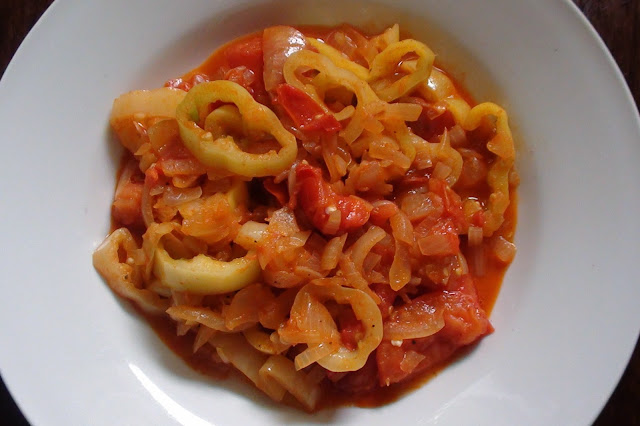
2) I've posted about the ratatouille that was inaccurately labeled lecsó under our roof; here is the real stuff. When I tried it one Sunday morning with red and yellow bell peppers, both Ma and Ta practically teared up at the fond childhood memories it brought to the surface. As Zsuzsa's follow-up informs, mushrooms are also welcome.
http://3.bp.blogspot.com/_qNzS_rXPDRU/TL3rcmfGz6I/AAAAAAAACNE/Utf0RjlHQXs/s1600/hungarian+ratatuille.JPG
Via zsuzsa is in the kitchen.blogspot.com
I happen to like both the ratatouille and the lecsó cold; to me, there is some sort of flavor that is present when slightly chilly as opposed to warm. The mushroom-pepper version was served at room temp for a Shabbos meal and was quite tasty. 

However, Zsuzsa's cooking steps were not followed exactly. The onions were sliced into thin half-moons, not diced. The paprika was placed early in the oil to infuse, rather than later. Instead of tomatoes, I used a little Pomi. The peppers were diced into bite-sized pieces. Also, the lecsó was simmered longer than her recipe dictates, since we are fans of melded flavors and stew-like consistencies.

3) This one is a little more complicated than I'm used to, but I found it yummy-licious. Since most of her recipes involve pork topped by Parmesan, it's rare that one of Lidia Bastianich's recipes are kosher-friendly. But her Melanzane Ripiene (Meat-Stuffed Eggplant) is up for Jewish experimentation.
https://blogger.googleusercontent.com/img/b/R29vZ2xl/AVvXsEjqApjFAz_irANQkFzV1p254lIRTdMh5Ng9Dshp2s-XRJsIHU1k7J6793FVVOpbb_ltkm_iJYwvMVmxp-8y-BIIt0i-32p0ijLjf2C-3Vn8ZXvkougBwFK_2kQqn2nsNnRNlrO10FvcMYQ/s1600/eggplants+stuffed+042.JPG
Via http://sundayatthegiacomettis.blogspot.com/2012/04/melanzane-ripiene-stuffed-eggplants.html
While searching for a linkable version of her recipe, I came across another in the process that was less ungepachkit, sans chazzer and cheese (and is also Pesachdik). Lidia's has breadcrumbs, eggs, tomatoes, and a red pepper, but I can bet this alternate version is quite tasty without it.

Sprinkling with nutritional yeast would give an acceptable cheesy flavor. Another option, which I did, would be to paint it with the same glaze that I used on the Salisbury Steak.            

Tuesday, November 3, 2015

"RBF"

I was walking along one morning, thinking deep mysterious thoughts ("Did I remember my lunch?"), when I dreamily reached the busy intersection, complete with a police officer posted for crossing duty. 

I always make a point to be nice to our boys in blue, but decided to wait until I crossed the street before grinning my head off. I thought my face was arranged in its default blandly polite expression, but the officer bawled across the street: "Smile!"

I sheepishly did so, feeling colossally stupid. It felt like a violation, he ordering my face to be cheerful on his terms, a complete stranger, yet.

RBF, Resting, er, B**** Face, is now a topic of conversation. 
RBF is a face that, when at ease, is perceived as angry, irritated or simply … expressionless. It’s the kind a person may make when thinking hard about something — or perhaps when they’re not thinking at all.
Poor Jessica Bennet ("I'm Not Mad. That's Just My RBF") was shocked to discover how terrifying she looked at rest.
Now, it’s safe to assume that humans have always made The Face. (Doesn’t the Mona Lisa sort of have it?) And it does have its uses. It is great for staring down Greenpeace solicitors on the street, or glaring at men who catcall you on the subway.
At a crowded bar, the expression can serve as a kind of armor against unwanted pickup artists (better, as one young woman put it, “than a fake engagement ring”).
And, as Tanya Tarr, a 36-year-old professional coach, described it: When engaged correctly, it can part a crowd of tourists on a busy street “like the Red Sea.”
When I started taking the subway regularly, I cultivated the Touch-Me-And-You-Die Face. No one, as yet, ever messed with me, no matter how sardine-like the situation. It's also great while navigating city streets and staring down a reluctant sales associate who doesn't want to process a return.
 https://s1.yimg.com/bt/api/res/1.2/seANCSB5MnYzUHgXCSU7yw--/YXBwaWQ9eW5ld3NfbGVnbztmaT1maWxsO2g9Mzc3O2lsPXBsYW5lO3B4b2ZmPTUwO3B5b2ZmPTA7cT03NTtzbT0xO3c9Njcw/http://l.yimg.com/os/publish-images/omg/2015-08-04/759f5b70-3af3-11e5-a4d0-55d698aea75d_Anna-Kendrick-Bitch-Face-01.jpg

And, of course, it makes disciplining children all the easier.

I have been trying to smile more in situations when I don't need to protect my virtue, and it is true that then the world smiles with you. I do feel good when I can make someone grin when they weren't before. I crack a joke, sunnily flash hopefully white-ish teeth, and sing "Have a good day!" 
 http://cdn.sheknows.com/articles/2013/03/mike/loving_you/981651/Vivien-Leigh-circa-1939-wenn.jpg
But I wouldn't demand "Smile!"       

Monday, November 2, 2015

One Amongst the Many

I'm in my late 20s and have been reading Modern Love since I was a teenager. I have the most supportive family and friends. I have a challenging and rewarding job I enjoy. I love living in New York and traveling even more, and work hard to see as much of the world as I can. I didn't feel heartbroken when my engagement to my boyfriend of many years ended this spring because it always felt wrong and I finally felt free. 
But now, finally single, I find myself an addict just as the author has described. Loved ones describe me as rational, pragmatic to a fault and successful in whatever I put my mind to. But in love I am the opposite. I put so much stock into an intense initial connection or early excitement of a new encounter only to find myself heartbroken when it doesn't work out.
I wish I could find the balance that the author achieved. I wish I didn't feel this massive hole in both my head and my heart every moment of every day wondering how and when I will find that person I'm meant for. I wish I was convinced of my self-worth in the way my family and friends say I should be. 
Instead, I just feel like a desperate little girl with no control over her life seeking something you can't force yourself to find. I truly hope one day I have a happy ending to share like the author of this column does. 
—K, N.Y.C.

This letter was printed in response to this article, "Overcoming Love Addiction: One Apple Martini at a Time" by Peter DeMarco. A diagnosed "love addict" who saw a fairy tale ending in every encounter with a female, he was eventually redeemed by an offhand comment to become a teacher. In pursuing that career, the void he desperately attempted to fill was appeased, and shortly thereafter established a romantic yet healthy connection which led to his happy marriage. 

But it was the above letter that spoke to me. I could have written part of it. 

I do find, at times, days, weeks, or even months of calm, however. I think the secret is when I take the individual out of the equation. 

Prior to Rosh HaShana, I listened to a number of online shiurim to get my focus in the right place. They tend to all be delivered by Rabbi Daniel Glatstein. Since his shiurim are delivered to numerous audiences, there can be some repetition, but when the same sentiments echo more than once they stick to you. 

A Navi geek, I perked up when he cited the story of the Isha haShunamis. Quick rundown: A wealthy woman, the Isha haShunamis, eagerly accommodates Elisha whenever he is in town, even having another floor added to her home to provide him with a private sanctuary. 
http://www.lifecoach321.com/wp-content/uploads/2012/03/elisha-shunammite-woman.jpg
Grateful for such comfort, Elisha sends Geichazi, his sidekick, to discover any wants or needs she may have. She informs Geichazi: "I dwell amongst my people." The meforshim glean from that statement that she wished to be included in the zechusim of klal Yisroel, not to be singled out.

Geichazi reports her response to Elisha, who was probably flummoxed. A navi, especially of his repute, was probably begged for brachos all the time. Not wishing to leave without some sort of compensation, he realizes that she has no child. Without her say-so, he blesses her with one. 
 https://obscurecharacters.files.wordpress.com/2015/01/chp-3-image-3-2-elisha-healing-shunammite-womans-son.jpg
Rabbi Glatstein references this happening to reinforce the importance of viewing oneself as part of the kehillah. Then the gray cells began to percolate: 

Do you think that the Isha HaShunamis didn't suffer over her barrenness? That she hadn't plead, wept, sobbed for a child, as Sarah, Rochel, and Chana did? And yet here she is offered, on a gleaming silver platter, an opportunity to ask for anything

But at this point, she had already made her peace, by realizing she "dwells amongst her people." (I'm guessing that if she's the type to build a second floor on the chance Elisha may visit, she was probably an all-around mitzvah lady.) She is one of many, a nation with a cause. It gives her joy and purpose to care for this great man, without any thought of return. When she selflessly gave, without ulterior motive, she was showered in bracha.

Because there are a multitude of stories that display the same moral—giving freely opens many doors—am I even capable of giving freely? In the middle of the spiritual high that is generosity and consideration, a little voice pipes up, "Look how nice you are! You'll probably get something for this!" It saddens me when I hear it. I want to give like she gave. 

In the meantime, until that day, I forget about my own obsessions . . . and dwell amongst my people.