Showing posts with label Mussar. Show all posts

Monday, July 27, 2020

Physician, Heal Thyself

I finished "Maybe You Should Talk to Someone" by Lori Gottlieb, a therapist who finds she needs therapy. 

She brings sagas of her own patients (with details carefully changed, she makes a point to say), along with the story of why and how she became a therapist. 

So Lori has a life event that she finds herself unable to recover from. She is so unmoored that while she gives wise guidance to her patients' crises, she is otherwise lost. She decides to go into therapy. 

What I found fascinating about this is that if a patient came to her with the same issue, chances are she would have been able to help. But she was helpless when it happened to her, requiring an outside perspective to get her over the rut. 

If a therapist, who has been trained for this, is unable to guide herself, how much more blind are we? 

It takes so much to be self-aware. Ma would say that we have to be able to look at ourselves in the mirror, but from the side, using peripheral vision. We can't be expected to handle ourselves head on. It's too much. 

Oscar Wilde said, "To love oneself is the beginning of a lifelong romance." Only the most obvious narcissists can manage to do that, I think. But coming to know oneself is a nobler enterprise, as self-improvement is a lifelong project.

Monday, July 20, 2020

The Cruel and the Thoughtless

When the libraries are shut down, it can be a lifesaver to bump into a reader whilst out for a stroll. Then you can negotiate an exchange. I got my hands on Magpie Murders by Anthony Horowitz. 

I'm not usually into whodunit books (I prefer to watch them, courtesy of BBC via PBS). But Horowitz was the writer of Foyle's War, one of my favorite series (Foyle is a detective solving murders in England while World War II rages).  

Magpie Murders was quite gripping, to the point I shamelessly let Ben play with my phone (in airplane mode, so he can't call Luke's doctor friend) so I could finish it. 

There were two quotes in there I found intriguing. 

One: 
In fact, Fraser had often heard the detective remark that there was no such thing as a coincidence. There was a chapter in The Landscape of Criminal Investigation where he had expressed the belief that everything in life had a pattern and that a coincidence was simply the moment when that pattern became briefly visible.
The detective, I should note, is a Holocaust survivor who is a professed atheist. 

Two: 

OK, I don't have the actual quote, because I failed to memorize the correct page on Shabbos. I didn't have the energy to start rifling through a few hundred pages to locate it, and then my sister-in-law popped by and she desperately needs books the way I do, so I handed it off. 

So, as best as my memory can summon it: Cruelty and thoughtlessness have the same results. 

Or something like that.   

Han was telling over something he had read by a black Jewish woman. She is constantly hurt by people who make assumptions that this is her first time at a frum simcha, or that she is a guest as opposed to part of the family. She has gone home in tears more than once. 

But here's the thing: I'm FFB, and I've gone home in tears from people's comments as well. You don't have to be obviously different to suffer from stupid assumptions or unfiltered words. 
https://pbs.twimg.com/media/Eck7j-XXkAAD4QD.jpg

There are those who are malicious, and will tear others down, knowing what they are doing is mean. But most people are simply thoughtless. There is a direct line between their mental dialogue and their mouths. They don't intend to be hurtful. They may even think they are being considerate and sensitive. 

I've been guilty of that too. I recently made a friend (I know! Me! A friend! Call the papers!) and I have, in our last few meetings, consistently screwed up. I made assumptions, and said mindlessly hurtful things because of that, thinking all the while that I'm so nice. 

And I've been doing it over, and over, and over! Yes, I do have baby brain and about a year's worth of sleep debt, but even so, couldn't I use that filter thingie that I wish other people would use? 

I'm a card-carrying grudge-aholic. I still think about the time in high school a girl said to me, "You're tall," and I said, for lack of a better response, "Thank you," and she said, "I didn't mean it as a compliment." It was almost TWENTY YEARS AGO. Like, GET A LIFE, PRINCESS. 

I have to cut other people slack, because I wish they would cut me slack. It's hard to make a response in the socially acceptable time frame after properly thinking it through from every possible angle. I think, "Yup, sounds good!" and then as soon as I have uttered it, think, "OMG, did I do thaaaaat?"

Most people are clueless, not malicious. Most people are trying their best, and we really don't know what burdens other people have. 

So when this COVID mishagaas is over, and I finally socialize again, someone will say something to me that will upset me. If I am aware enough, I will remember that I am not perfect either, and may actually let it go.  

Tuesday, November 8, 2016

The Gift of Sight

There is seeing, and there is seeing.

Mild example: Eewok is (finally!) a reader, and she is eager to curl up in bed with a book, which then necessitates a nightstand and lamp. In my error, I got her the Kosher Lamp first, before it had an official base; it took a crack-inducing tumble. 

Now she requires a new lamp, but I was adamant about a nightstand first. Orgiana repeatedly emerged from Homegoods empty-handed and frustrated. I considered possible obsolete pieces about the house that I could lend until the ideal was discovered. 
http://dylangallery.com/wp-content/uploads/2016/06/cool-nightstand-lamp-design-also-gray-interior-wall-painting-idea-feat-smart-girl-bedroom-furniture-with-headboard-bookshelf.jpg
Whilst cleaning my room on Sunday (more like "half-heartedly hanging up tossed aside skirts") my glance fell on a dark corner. Tucked away, under a desk, was my sister's old white wicker nightstand, complete with shelf. 

You MORON. 

See what I mean about seeing and seeing

Sometimes it is based on a frame of mind—there are moments when we are so fakocht that even though our eyes are open, we are so caught up in the fog of our own mind that our vision is fuzzy. 

Sam Anderson, in "Letter of Recommendation," suggests the joys of looking out the window. (From my serious kinfauna-sitting days, taking a baby to a window was a lifesaver; they were usually entranced by the outdoor view.)

As Anderson explains, outside is out of our control, unlike selecting images or video from the internet. As a Jew, I still need to be reminded of that: We've got no control. 

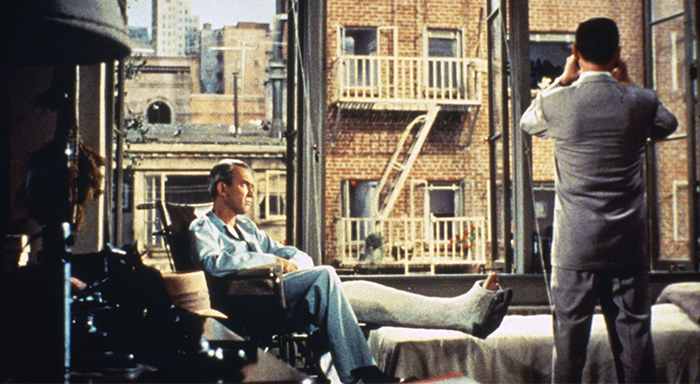
The second message he imparts is this: After witnessing a car crash into a fence, he took a dislike to the driver, neatly boxing and labeling him. Yet what he saw showed something completely different. 
http://images.amcnetworks.com/sundancechannel.com/wp-content/uploads/2016/04/Rear-Window-700x-3841.jpg
Rear Window
I judge even while trying not to judge. Dan l'kaf zechus is so bloody hard. Yet one day, one gets to a point where assuming the worst of people is more of an effort than assuming the best. One feels better too. 

Then one wonders why she would have opted for bitterness and wrinkles, when the alternative is so much easier on the skin. 

Friday, September 30, 2016

"The Eve of Rosh Hashanah" by Yehuda Amichai

The eve of Rosh Hashanah. At the house that’s being built,
a man makes a vow: not to do anything wrong in it,
only to love.
Sins that were green last spring
dried out over the summer. Now they're whispering.

So I washed my body and I clipped my fingernails,
the last good deed a man can do for himself
while he's still alive. 

What is man? In the daytime he untangles into words
what night turns into a heavy coil.  
What do we do to one another—
a son to his father, a father to his son?

And between them and death there's nothing
but a wall of words
like a battery of agitated lawyers. 

And whoever uses people as handles or as rungs of a ladder
will soon find himself hugging a stick of wood
and holding a severed hand and wiping his tears 
with a potsherd. 

Discovered via this article by Rosie Schaap. 

Tuesday, August 9, 2016

Shame We Believe In

"I can't do that," she said. 

I had been telling her about some of my healthy eating practices (she asked; I did not volunteer), but she was shaking her head in the negative. 

I already know from my own experience that when I have decided I "can't" do something, then I don't even bother to try. It's called "limiting beliefs," a term I heard from Esti Hamilton (she's got a series on the topic, check 'em all out). 

Many moons later I see this gal. "By the way," she grins happily, "I've been doing what you told me about." She looks great, if I may say so myself. 

According to scientists, addiction is not an illness like schizophrenia and cancer. There IS choice involved. I have just finished reading Charles Duhigg's fascinating The Power of Habit, and one chapter deals with addiction, specifically gambling. In "Can Shame Be Useful?", the authors address gambling addictions, but use the same term: habit. 

Whenever I read stories of addicts who turned their lives around, it was usually kick-started by a light bulb moment: I can't go one like this. I can be better. I'm letting my family down. I can't believe I did THAT to feed this addiction. 
 http://www.annemoss.com/wp-content/uploads/2016/04/Rock-1.jpg
It's rarely from a place of back-patting. 
So under what conditions does shame end up prodding people into correcting their course? Alternatively, when does intense self-criticism make matters worse by further fueling an addiction (for example, drinking even more to mute the pain of those shameful feelings)?
An important influence appears to be whether people buy into the notion that a habit is under or out of their control. . . 
They found that study participants who were vulnerable to experiencing shame were less inclined to engage in corrective actions when they believed their mistakes were not fixable, such as when they had no opportunity to apologize to someone they’d offended. In contrast, participants were more inclined to engage in positive behaviors when they thought their errors could be repaired.
The lesson is that shame can act as a spur to amend self-inflicted damage when people perceive that damage is fixable and manageable. In light of this finding, comparing addiction to a purely biological disorder, like cancer, might backfire, leading people to see their habits as unalterable.
I have said "I can't do that" plenty of times. Then years later, waddya know, I AM doing it. Not with effort and thought, but mindlessly and automatically. A good habit.  

Can I alter the Earth's axis? No. Can I insist that someone like me? No. Can I prevent the haze of humidity that is supposed to hit this week? No. 

Can I be more thoughtful? Act deliberately, not instinctively? Can I change my bad habits? 
 https://upload.wikimedia.org/wikipedia/commons/1/12/We_Can_Do_It!.jpg
With some elbow grease and "can"s, yup.     

Thursday, July 28, 2016

Envy

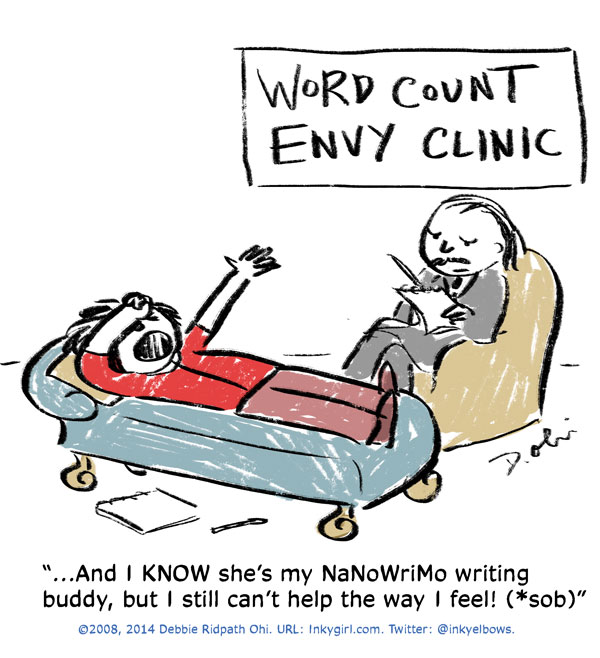
We writers (that's right, I called myself a writer!) are full of it. 

Writers, like academics, claim to be an evolved lot. Presumably well-read, seemingly intellectual, assuredly above all that sort of petty stuff like primal emotions. Who, me, envious? 

Of course. 
 http://static1.1.sqspcdn.com/static/f/601505/25635699/1415281792380/OHI0153-NaNo-WordcountEnvyClinic-v2-600.jpg?token=4S3yQLNk%2FPASznE7yja21QWbXnQ%3D
My envy can manifest in a number of ways. Sometimes it is admiration/jealousy of a young fellow co-religionist's piece featured in the New York Times; sometimes it is the shock that a sloppily formed book was inexplicably published; sometimes it is the devaluation of one's ability in the presence of perfect, polished, pristine prose.   

"Green-Eyed Verbs" by Sarah Manguso addresses the last form of envy. While Keats was determined to be the best, he—
. . . also wrote, to another of his publishers, “If Poetry comes not as naturally as the Leaves to a tree it had better not come at all.” As leaves to a tree. A tree does not leaf out of envy of other trees. It leafs out all by itself, within a system of life and light, matter and time. Writing out of envy will not produce a tree in bloom. It will produce an expression of envy, and envy’s voice is ugly, small, cheap and false.
"Rabbi Elazar HaKappar said: Jealousy, lust and the [pursuit of] honor remove a person from the world." It removes us from this world because it prevents us from enjoying this world, and from utilizing our own talents. 
I can tell that I’m making the wrong type of effort when I start to lament my work isn’t turning out the way I’d wanted it to. . .
Manguso explains that when writers think that, they are trying to copy another's brilliant work. That's not how writing works. 
Writers must labor from a vague feeling, usually some large, old emotion, and in so laboring, come to understand the qualities of that feeling, and the source of it, and the reason they still feel it. That effort is practiced in a place typically insulated from even the idea of publication, and it depends upon a combination of exerting and relaxing one’s will over the writing.
The purpose of being a serious writer is not to express oneself, and it is not to make something beautiful, though one might do those things anyway. Those things are beside the point. The purpose of being a serious writer is to keep people from despair. If you keep that in mind always, the wish to make something beautiful or smart looks slight and vain in comparison. If people read your work and, as a result, choose life, then you are doing your job.
Oh, wow. 

She insists that reading is vital, for without reading one cannot truly write (Stephen King says so. I'm sure he's not the only one to believe the same).
My least favorite received idea about writing is that one must find one’s voice, as if it’s there inside you, fully formed and ready to turn on like a player piano. A voice is what emerges from an informed intelligence as it reaches toward accurate perception.
Without exposure, one is not speaking from a place of knowledge (daas). Binah, intuition, is dope, but it needs the partnership of chochma, wisdom, to become knowledge. Wisdom comes from experience and the gathering of information.

All writers will envy other writers, other writing. No one who reads is immune. To write despite it I must implicate myself, to confess to myself, silently or on the page, that I am envious. The result of this admission is humility. And a humble person, faced with the superior product of another, does not try to match it or best it out of spite. A humble person, and only a humble person, is capable of praise, of allowing space in the world for the great work of others, and of working alongside it, trying to match it as an act of honor.