Showing posts with label Work. Show all posts

Tuesday, September 5, 2017

By Work, Not By Word

"And R' Yitzchak said: If someone tells you, 'I labored but did not succeed,' don't believe him. If he tells you, 'I have not labored, yet I have succeeded,' don't believe him. If, however, he tells you, 'I have labored, and I have succeeded,' you may believe him" (Megillah 6B).  

There are a number of people who made it big with the assistance of the internet. Makeup artists (i.e. Michelle Phan), singers (i.e. Bieber), and those of other dubious talents (i.e. Kardashians) have found fame and fortune via those opportunities. But people forget there was work involved (even for the Kardashians), not just hashtagging self-promotion. 

https://storage.googleapis.com/twg-content/images/michelle-phan_lg.width-1200.jpg
"Good News for Young Strivers" by Adam Grant is a reminder that in the end, results count, not horn-tooting. Achievements lead to successful networking, not vice versa. Beneficial networking doesn't mean chasing after prey; it's about bringing the prey to you. For that, you need to draw them close with something other than a blank "Look at me!" 
In life, it certainly helps to know the right people. But how hard they go to bat for you, how far they stick their necks out for you, depends on what you have to offer. Building a powerful network doesn’t require you to be an expert at networking. It just requires you to be an expert at something.
Yes, there are businesses that take off by "happening to bump into the right person." But if one doesn't have anything for the other to remember them by, fuhgeddabouit. 
 
Cal Newport goes further ("Quit Social Media. Your Career May Depend on It") that the hashtagging is not merely a neutral influence, but a malignant one to a career. He claims that since social media is addictive, and robs one of focus that should be applied to one's work, it actually negatively impacts the performance that must speak for itself. 
If you’re serious about making an impact in the world, power down your smartphone, close your browser tabs, roll up your sleeves and get to work.  
This same premise applies, I believe, to Rosh Hashana and repentance. It's our actions that is our greatest proof of remorse, not merely "so sorry." Biting one's tongue, giving to tzedakah, flashing a smile to a stranger—you can take that to God, no status update needed. 

Tuesday, January 31, 2017

I'm, Like, Soooo Busy

As we know when it comes to food choices, there's what the head believes, and what the scale says. 

The same premise works with another precious commodity: time. No one's got any, right? That's a trendy topic, like bone broth (an imminent post). 
http://i.huffpost.com/gen/2687486/images/n-BUSY-MIND-628x314.jpg
Laura Vanderkam believed the same—and considering her schedule and family size, so did I. Yet after carefully logging her hours, she was delighted to discover otherwise ("The Busy Person's Lies").  

Despite her fourth baby and speaking engagements around the country, she wasn't being run to ground. Sure, there are busy weeks here and there, but those busy weeks are not reflective of the usual normal. 

When other people tried time-tracking, their anxieties over their supposedly neglected families and responsibilities faded. Some did find that their work was demanding more than they were willing to give, and they quit, but most were happy to learn that their lives were not overwhelmed. 

She concludes the article with the familiar message that time is precious: 
A life is lived in hours. What we do with our lives will be a function of how we spend those hours, and we get only so many.
Natalie Henderson, a pediatric I.C.U. fellow at the University of Louisville’s Kosair Children’s Hospital, tracked her time for several weeks. She found that despite her 28-hour shifts, she was sleeping more than she thought. Her service weeks were intense — 70 to 80 hours — but others were light enough that she saw she could carve out time for exercise and real breakfasts with her children. More important, though, was the reason she wanted to add these things to her life. In the pediatric I.C.U., she says, “we lose kids.” It’s a constant reminder that “time goes, no matter what you do. I’m covetous of the time I have. I want to make sure I use it more wisely.”
Life is full, and life has space. There is no contradiction here.
This past Sunday, 60 Minutes aired the story of the avalanched hotel in Italy, and the appreciation of the survivors. As one survivor realized, what should we be prioritizing? Our busy-ness? 

I think not.

Monday, November 21, 2016

Bad Patient

To this day I have an odd relationship with sick days. 

When I was a child, it would happen from time to time that I would awake feeling crummy. I would crawl into the kitchen, croaking, "Ma, I think I'm sick." Ma would take one look at my woebegone form and say, "Nah, you're fine. Go get dressed." 

Not the ending you were expecting, I'm sure. 

To this day, I never know if I am sick or if I am imagining it. I take polls if my forehead is hot. I experiment if my legs can support me. I peer into the mirror to analyze my skin hue—pale green, perhaps?

Luke had it differently. There were mornings he would cheerfully boom, "Ma, I think I'm sick." 

He would be bundled back into bed with a cup of hot cocoa. 

Ergo, my firm belief that I was adopted. 

I remember once leaving my bedroom, attired in the atrocious polyester uniform skirt, walking past Luke's room. He was merrily burrowing under the covers, thermometer leisurely swirled in his hot cocoa, sending me off with a smirk and a jaunty wave. 

Now, what was Ma's thought process? 

She knew that missing a day of school is no simple matter. The concepts taught in those few hours never take root the way it does if one is there to learn it firsthand. On some level, one just cannot catch up, especially when the whole class has had a shared joke about something that happened in one's absence and, well, "You had to be there." 
http://patrickniebres.com/wp-content/uploads/2015/07/IMG_3826.png
Since I was a good enough student, Ma thought it was worth it for me to be nudged. Whereas Luke . . . she had already kinda given up on him. He spent his class time spacing out, bringing home meh grades, so if he isn't paying attention anyway, what the heck, let the kid have a sick day. (He surprised everyone later on when he shot to the head of high school classes and became a pretty smart cookie.)

It was only in college when I comprehended Ma's logic. In those years, if ill, I made the choice to heave my diseased self on the subway, clinging to the pole for dear life as fellow commuters nervously edged away. I could never find a classmate whose notes were more than four words and doodles; mine, by comparison, were four pages of closely written script. I knew then what a difference a missed day makes, and I was adamant, even if I collapsed trying, to get there.

Now, I have a job when I can take a sick day. But I still hesitate to do so, associating it still with opportunities missed.        

Thursday, November 10, 2016

One at a Time

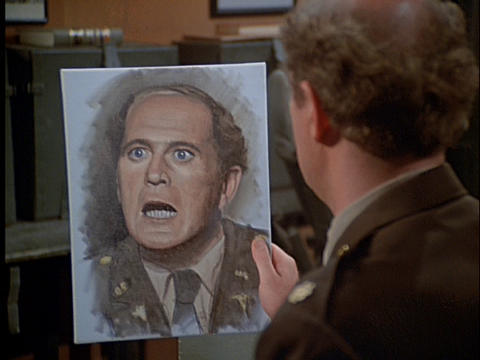
On the his first episode on M*A*S*H, Major Charles Emerson Winchester III pompously intones, "I do one thing at a time, I do it very well, and then I move on." 
 http://www.mash4077tv.com/images/misc/spotlight/125_winchester_tapes.jpg
It turns out, the fathead was right. If I supposedly "multi-task," incompetency reigns. 

I can't listen to a shiur and surf Facebook. I can't text and maintain a conversation. Preparing too many dishes at one time rarely ends well. 

There are many who claim they can multi-task. Note that they claim. Try reading this story without distraction. Can you? Will you recall what you have read? Will you have processed it?
Earlier research out of Stanford revealed that self-identified “high media multitaskers” are actually more easily distracted than those who limit their time toggling.
So, in layman’s terms, by doing more you’re getting less done.
Perhaps you are familiar with the person who is always busy, yet doesn't seem to accomplish anything? 
But monotasking, also referred to as single-tasking or unitasking, isn’t just about getting things done.
Not the same as mindfulness, which focuses on emotional awareness, monotasking is a 21st-century term for what your high school English teacher probably just called “paying attention.”
I have learned, at my work, to complete each task one by one. Then I don't come back, spend a minute remembering where I left off, then forget that one vital action necessary to prevent my having to start it all over again. 
As much as people would like to believe otherwise, humans have finite neural resources that are depleted every time we switch between tasks, which, especially for those who work online, Ms. Zomorodi said, can happen upward of 400 times a day, according to a 2016 University of California, Irvine study. “That’s why you feel tired at the end of the day,” she said. “You’ve used them all up.”
The term “brain dead” suddenly takes on a whole new meaning.
Multi-tasking is not productive at all, because not only are the jobs not done right, one is rendered unproductive in the process. 

There is pleasant satisfaction in a job well done and complete, von Pfetten writes. That reminded me of the "debt snowball method," paying off the smallest debt first even though that seems contradictory to financial savvy. When those in hock are able to cross off an item from their list, they tend to be so galvanized by that signal of progress that they throw themselves wholeheartedly into further headway. 

Kids, of course, tend to interrupt mono-tasking. In cases where tackling one job at a time is difficult, just try to do it whenever possible, like reading offspring a book while the phone is elsewhere, the article recommends. 
“Practice how you listen to people,” Ms. McGonigal said. “Put down anything that’s in your hands and turn all of your attentional channels to the person who is talking. You should be looking at them, listening to them, and your body should be turned to them. If you want to see a benefit from monotasking, if you want to have any kind of social rapport or influence on someone, that’s the place to start. That’s where you’ll see the biggest payoff.” 

Tuesday, May 3, 2016

Work For It

In my parents' day, high school graduates got jobs. While Ta was in college, he taught math and science in his yeshiva. Ma, like the rest of her classmates, got a secretarial job in Manhattan. (Zeidy thought such an opportunity for a young girl to easily earn money to be near miraculous.) That's not really the current default today, which is a shame.

A job—any job—is an education. The first time I babysat for the neighbor across the street—I was eight, with my parents in yodeling distance—I was crushingly aware of responsibility. For that hour while the mother had to quickly run out, I stood ramrod straight clutching the cordless phone while the little(r) girls played peacefully at my feet and the baby gurgled at me from the crib. 

Working is an invaluable experience that many of our youth miss out on. Children can have an over-inflated sense of self—which is mostly due to underexposure—which is crushed the first time they screw up on the job. Bosses aren't going to humor them, or give them a pass. They expect results. 

It is a bleak moment when one realizes that the more one knows, the more one doesn't know. 

At the same time, employees can discover their own capabilities, realizing what is truly worthy of admiration, and feel that soft, fuzzy glow of a paycheck well-earned.
http://img.ifcdn.com/images/cb4f15cb121f53ae2b973cb2267b520606472364399b423fa80ee93517a015b4_1.gif
Those memories of my first jobs came back to me as I read Leslie Jamison's response to the question, "What early job later informed your work as a writer?"

Jamison dabbled in many different fields, but she greatly enjoyed her time in a bakery, even though she didn't have quite the knack. 
 . . . Messing up in a kitchen taught me more about “constructive criticism” than any workshop ever had. . . 
I was humbled by that job, over and over again: humbled by how much I needed to learn, how much I needed to keep learning; how I needed to keep practicing what I kept getting wrong. Just because I had published a book, just because maybe 500 people had bought it, didn’t mean I wouldn’t show up (at 7 a.m.) and suit up (in my apron); and it didn’t mean I wasn’t held accountable to my production list, stuck to the walk-in cooler beside the more ambitious lists of my colleagues.
This is one truth that hasn’t gone away: Whatever happens in my writing, I still have to show up for the rest of my life, whatever that entails — 100 gingerbread cookies or a boyfriend with the flu; a student’s last-minute rec letter or my daughter’s musical.
But it was another truth — the humility of that kitchen, confronting what I didn’t know — that has felt most resonant across my writing life. As my work has evolved, it has demanded uncomfortable, new kinds of capacity: learning how to pursue a difficult subject; how to seduce her in an interview; how to get corrected by fact-checkers; how to live in archives.
Writing hasn’t felt like getting progressively better at a single task; it’s felt more like stumbling toward the bewildering call of each new project, learning how to be a person who knows nothing; how to arrive on time, put on a batter-smeared apron and show up for whatever happens next.
In work, there will be times when one messes up. There will be medicine: criticism, humiliation, but learning. And the next day, with all the residue of the previous day's snafus still twinging, one still has to show up. There is no sick leave for goofs. One clocks in, and keeps on truckin'. 

"Eighty percent of life is showing up," Woody Allen might have said. Yup.
 https://cdn.meme.am/instances/48839576.jpg
Jews kinda know that it's not necessarily the end of the world if they trip up in an aspect of observance. Jews are supposed to keep on truckin', knowing they can do better and going doggedly after it. There isn't much glamor, mostly batter-smeared aprons. But there is a great satisfaction nonetheless.

Thursday, January 21, 2016

It Pays to be Nice

One of the fun concepts of Sho-Gun is that the Japanese are inordinately polite. A daimyo could be telling his samurai that he should commit seppuku, but they will be awfully civil about it. No screaming. No name-calling. A lot of "Please" and the honorific of "-san." 
https://i.kinja-img.com/gawker-media/image/upload/d9r3eocsklztsxsanvao.png
"Being nice" is relative. My nice is not your nice. Heck, forget about nice—feigning decency is too much to ask. B'H I don't have this problem, but many suffer in intolerably stressful work environments, Christine Porath reports in "No Time to Be Nice at Work." What I find upsetting is not only is there such bad behavior is supposedly professional environments, but even employees feel that being nice is a sign of idiocy.  
Many are skeptical about the returns of civility. A quarter believe that they will be less leader-like, and nearly 40 percent are afraid that they’ll be taken advantage of if they are nice at work. Nearly half think that it is better to flex one’s muscles to garner power. They are jockeying for position in a competitive workplace and don’t want to put themselves at a disadvantage.
Why is respect — or lack of it — so potent? Charles Horton Cooley’s 1902 notion of the “looking glass self” explains that we use others’ expressions (smiles), behaviors (acknowledging us) and reactions (listening to us or insulting us) to define ourselves. How we believe others see us shapes who we are. We ride a wave of pride or get swallowed in a sea of embarrassment based on brief interactions that signal respect or disrespect. Individuals feel valued and powerful when respected. Civility lifts people. Incivility holds people down. It makes people feel small.
I believe that those who think nice = stupid are insecure. They do not believe they are worthy of being treated nicely, and so feebly attempt to boost their own egos but putting others down. Judgement on you, bro, not on me. 
Incivility often grows out of ignorance, not malice. A surgeon told me that until he received some harsh feedback, he was clueless that so many people thought he was a jerk. He was simply treating residents the way he had been trained.
Ah-ha. Sure. His mother never taught him to be nice? 
Technology distracts us. We’re wired to our smartphones. It’s increasingly challenging to be present and to listen. It’s tempting to fire off texts and emails during meetings; to surf the Internet while on conference calls or in classes; and, for some, to play games rather than tune in. While offering us enormous conveniences, electronic communication also leads to misunderstandings. It’s easy to misread intentions. We can take out our frustrations, hurl insults and take people down a notch from a safe distance.
I hate texting since I feel that without the nuanced delivery of tone and body language, there can be major misunderstandings. At least read texts over before you send them (a nicety my niece found laughable). 

If you're looking at your phone, you aren't looking at anyone else. 
Although in surveys people say they are afraid they will not rise in an organization if they are really friendly and helpful, the civil do succeed. . . What about the jerks who seem to succeed despite being rude and thoughtless? Those people have succeeded despite their incivility, not because of it. . . . Sooner or later, uncivil people sabotage their success — or at least their potential. Payback may come immediately or when they least expect it, and it may be intentional or unconscious.
The impolite win the battle to lose the war. 
Given the enormous cost of incivility, it should not be ignored. We all need to reconsider our behavior. You are always in front of some jury. In every interaction, you have a choice: Do you want to lift people up or hold them down? 

Thursday, November 26, 2015

It's Not About the Money

Steve Jobs was not known for his cuddliness. However, Nick Bilton discovered an important lesson upon hearing a story when Jobs was being a jerk to a waitress ("What Steve Jobs Taught Me About Being a Son and Father"). 
No matter what you do for a living, should you do the best work possible?
It's not about vocation, Bilton realized. He spent plenty of time in non-vocational work—waiter, hair washer, costumed cartoon animal. 
And yet it wasn’t until my mother found out that she had terminal cancer in mid-March and was given a prognosis of only two weeks to live that I learned even if a job is just a job, you can still have a profound impact on someone else’s life. You just may not know it.
His mother's appetite dwindled, then disappeared; the end was nigh. But suddenly she asked for her favorite, shrimp. Bilton bolted to the nearest Thai restaurant to fetch his mother's dying request. 
While I stood waiting for my mother’s shrimp, I watched all these people toiling away and I thought about what Mr. Jobs had said about the waitress from a few years earlier. Though his rudeness may have been uncalled-for, there was something to be said for the idea that we should do our best at whatever job we take on.
This should be the case, not because someone else expects it. Rather, as I want to teach my son, we should do it because our jobs, no matter how seemingly small, can have a profound effect on someone else’s life; we just don’t often get to see how we’re touching them.
Certainly, the men and women who worked at that little Thai restaurant in northern England didn’t know that when they went into work that evening, they would have the privilege of cooking someone’s last meal.
Shortly thereafter, Barry Schwartz's "Rethinking Work" presented this concept under more scientific parameters, complete with cited studies.
Though the custodians’ official job duties never even mentioned other human beings, many of them viewed their work as including doing whatever they could to comfort patients and their families and to assist the professional staff members with patient care. They would joke with patients, calm them down so that nurses could insert IVs, even dance for them. They would help family members of patients find their way around the hospital.
The custodians received no financial compensation for this “extra” work. But this aspect of the job, they said, was what got them out of bed every morning. “I enjoy entertaining the patients,” said one. “That’s what I enjoy the most.”
Finding meaning in what may be considered menial work is what makes life great. 
These are just ... examples from a literature of cases demonstrating that when given the chance to make their work meaningful and engaging, employees jump at it, even if it means that they have to work harder.
Humans are not motivated by money alone. We are more likely to help if not offered financial compensation. Schwartz was arguing for a change in workplace policies that would make meaning part of the job, but Bilton shows how one can find the meaning, even if it isn't obvious.

http://www.austingunter.com/wp-content/uploads/2011/11/Steve-Jobs-Damn-Good-At-It.jpg   

Thursday, January 1, 2015

The Brilliance of Spacing Out

The Big Bang Theory, "The Einstein Approximation": 

Sheldon is hit by major physicist block. He obsesses, can't sleep, and becomes even more erratic and annoying than usual. He even creeps out at night and breaks into a Funzone, desperate for visual aids. 
Eventually, he concludes that his mistake is in overtaxing his brain; when Einstein was faced with the same frustration, he took a mind-numbing job at the patent office to allow his subconscious to breathe.

Penny, the starving actress who works as a waitress, is quite stunned to discover him in the restaurant, scurrying around as a busboy. And lo, he does achieve his elusive epiphany.
 
According to Daniel Levitin in "Hit the Reset Button in Your Brain," the television writers weren't making up this phenomenon.
But the insight that led to [harness fire, build the pyramids, discover penicillin and decode the entire human genome] probably came from the daydreaming mode. This brain state, marked by the flow of connections among disparate ideas and thoughts, is responsible for our moments of greatest creativity and insight, when we’re able to solve problems that previously seemed unsolvable. You might be going for a walk or grocery shopping or doing something that doesn’t require sustained attention and suddenly — boom — the answer to a problem that had been vexing you suddenly appears. This is the mind-wandering mode, making connections among things that we didn’t previously see as connected. 
From personal experience, I know that after spending too much time focusing too much on a problem, the solution suddenly pops into my head at the oddest (and oven most inconvenient) of times. 

However (I cannot ignore an opportunity to throw the smartphone under the bus) constant pings and chirps prevents that thought process. 
Every status update you read on Facebook, every tweet or text message you get from a friend, is competing for resources in your brain with important things like whether to put your savings in stocks or bonds, where you left your passport or how best to reconcile with a close friend you just had an argument with.
If you want to be more productive and creative, and to have more energy, the science dictates that you should partition your day into project periods. Your social networking should be done during a designated time, not as constant interruptions to your day.
Email, too, should be done at designated times. An email that you know is sitting there, unread, may sap attentional resources as your brain keeps thinking about it, distracting you from what you’re doing. What might be in it? Who’s it from? Is it good news or bad news? It’s better to leave your email program off than to hear that constant ping and know that you’re ignoring messages.
The so-called yet imaginary concept known as "multi-tasking"—it doesn't exist. 
Increasing creativity will happen naturally as we tame the multitasking and immerse ourselves in a single task for sustained periods of, say, 30 to 50 minutes. Several studies have shown that a walk in nature or listening to music can trigger the mind-wandering mode. This acts as a neural reset button, and provides much needed perspective on what you’re doing.
Want to solve problems? Put the phone on "Do Not Disturb" and go fold some laundry.       

Tuesday, November 11, 2014

Do It To Do It

A number of years ago I heard Rabbi Mordechai Becher speak. He was explaining that while we know the reasons for some of the commandments, the reasons themselves should not be the motivation for fulfilling the mitzvah. 
http://www.yutorah.org/_images/roshei_yeshiva/mordechai_becher_lp.jpg
"We aren't supposed to eat the gid ha'nasheh, right?" he said. "Why? Because Yaakov Avinu wrestled with the malach and his sciatic nerve was damaged. But that is not the reason why I don't the gid ha'nasheh. I don't eat the gid ha'nasheh because Hashem said not to eat the gid ha'nasheh." 

I thought of this shiur when I read the article "The Secret to Effective Motivation" by 


Our study suggests that efforts should be made to structure activities so that instrumental consequences do not become motives. Helping people focus on the meaning and impact of their work, rather than on, say, the financial returns it will bring, may be the best way to improve not only the quality of their work but also — counterintuitive though it may seem — their financial success.

http://www.oztorah.com/wp-content/uploads/2008/10/ArtScroll-Kohelet.jpg

Thursday, October 23, 2014

Do What You Gotta Do

In this season's The Big Bang Theory, Penny (finally) abandons her dream of becoming a famous Hollywood actress, gets a job as a sales rep for a pharmaceutical company, and can actually pay her bills and live comfortably. 
http://www.glamour.com/images/fashion/2014/09/penny-big-bang-theory-black-blazer-square-w352.jpg
She looks so responsible now!
I found this shift to be interesting. Usually, television will boost the belief that one should follow her dreams, and no matter how many times one fails, one will reach the stars (or something like that). 

Gordon Marino is an occupational counselor, who used to ask his students what they love to do when they seek his guidance. But now he is rethinking that method ("A Life Beyond 'Do What You Love'") and unleashed television memories in my mind's eye. 

Yes, there are people who rocketed to success while clinging to their calling. But there are as many individuals, if not more, who didn't, and elected to put aside the struggle by undertaking pragmatic, stable employment. Does that make them quitters? Does it mean their passionless work is meaningless?

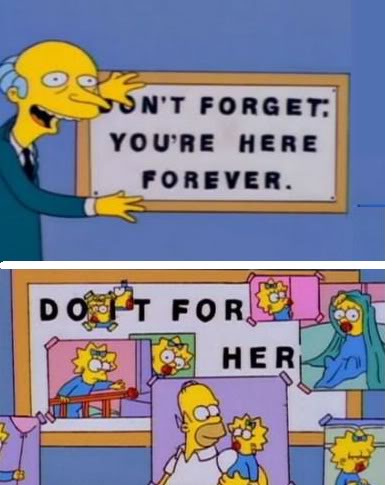
The 1995 episode of The Simpsons "And Maggie Makes Three" flashes back to when there was only Bart and Lisa, and Homer achieves his dreams by leaving the power plant to work for less money in a bowling alley. Life is great. But when Marge becomes pregnant, the bowling alley salary is not enough, and Homer has to beg Mr. Burns for his job back. He's miserable. 

To add a final, devilish touch to his evil overlordness, Mr. Burns hangs up a sign that says, "Don't forget: you're here forever." Homer gives meaning to his misery by plastering every photo of Maggie around his cubicle, even over the sign, so now it reads, "Do it for her." 
http://www.raisingsienna.com/wp-content/uploads/2013/06/tumblr_mfhobj5ZfG1qenp82o1_400.jpg
Yes, you may cry now.

But what if one isn't as selfless as Homer (that doesn't sound right), and one seeks only personal satisfaction. What if that someone can do so much for so many, but decides to reach for the petty-by-comparison dreams instead? 

An episode of House, M.D. called "The Greater Good" deals with just this: the patient is a prominent cancer researcher who opts to become a chef. After her illness she is still a chef—she chose happiness over greatness. 

Marino cites Kant, who operated on the belief (as philosophers did at that time) that one's abilities were gifts from Above, and so one should use their divinely ordained talents for the greater good. But today, God is no longer the first thought; "self-fulfillment" now reigns.
The faith that my likes and dislikes or our sense of meaning alone should decide what I do is part and parcel with the gospel of self-fulfillment. Philosophy has always been right to instruct that we can be as mistaken about our views on happiness as anything else. The same holds for the related notion of self-fulfillment.    
"Self-fulfillment" kinda sounds a lot like the yetzer hara, doesn't it? It's about, in essence, what I want to do, and to heck with anything else. Yeah, that always turns out well.

Marino's father toiled at a job he hated because he wanted to put his children through college and, in turn, have a better life. Some would call that meaning, Marino says, but his father would have seen it as simply doing what had to be done.
Dr. King taught that every life is marked by dimensions of length, breadth and height. Length refers to self-love, breadth to the community and care of others, and height to the transcendent, to something larger than oneself. Most would agree with Dr. King’s prescription that self-fulfillment requires being able to relate yourself to something higher than the self. Traditionally, that something “higher” was code for God, but whatever the transcendent is, it demands obedience and the willingness to submerge and remold our desires . . . Our desires should not be the ultimate arbiters of vocation. Sometimes we should do what we hate, or what most needs doing, and do it as best we can. 
"What has to be done" is different than "meaning"; "meaning" is a pleasant perspective, "what has to be done" is an obligatory directive, outside of our own selfish selves. If there is a way to combine what has to be done and what we like to do, that's nice. But in the end, we gotta do what we gotta do.