Showing posts with label Meditation. Show all posts

Wednesday, July 25, 2018

The Place for Mindfulness

My niece is always looking toward the next thing. She could be in middle of a really fun activity, but then begins to badger me with, "What are we doing next?" 

I get annoyed (reasonably, don't you think?) as she is pushing aside the pleasantness of the present by fretting about the future. She would benefit from some "mindfulness" training. 

Yet what if someone is in middle of a really unfun activity, like vacuuming or scrubbing the bathroom? Is "mindfulness" really to her advantage? Is "being in the moment" going to make her happier while pre-treating laundry? Wouldn't day-dreaming be more beneficial, if not more likely to provide a "Eureka!" moment? 

Ruth Whippman attacks the "mindfulness" movement by pointing out that it is a uniquely human ability to think outside the present. She is also irritated by the self-help movement that promotes it, as they seem to claim that there is no problem that cannot be rethought in a more glowing light, rather than finding a solution that problem. 
 http://www.fromtheleftfield.com/wp-content/uploads/2015/04/mindful-funny.jpg
However, I think "being in the moment" has its place. Like instructing my niece that she should flipping enjoy what she's doing now, or else we'll never do anything fun together ever again, got it, sweetie? *Cough*

Also, there is beauty in everyday life that can be overlooked when we don't pay attention. When doing a neutral activity, like taking a walk. There are interesting scenes to witness, as long as we aren't busy texting. 
Whereas, there are difficult times in life when floating through unreality is a lifesaver. 

Thursday, April 7, 2016

Meditation Options


Hey, I've given it a shot. Here and there. In very short quantities. 

But I agree with Adam Grant ("Can We End the Meditation Madness") that the trend is kinda overblown.  
The primary reason people meditate, the experts tell me, is that it may reduce stress. Fine. But so does quality sleep and exercise. And you can reduce stress simply by changing the way you think about it. When you’re feeling anxious, it’s a signal that you care about the outcome of an upcoming event — and it can motivate you to prepare. . .
In a nationally representative eight-year study, adults who reported a lot of stress in their lives were more likely to die, but only if they thought stress was harmful. Over a hundred thousand Americans may have died prematurely, “not from stress, but from the belief that stress is bad for you, ” as the health psychologist Kelly McGonigal notes.
Luke is not like me. He absolutely comes alive—alive!—when he has a deadline. He hums. He's pleasant. He loves it. 

Me? I'm not remotely that adorable if I'm bound by a deadline. But I don't have to view stress that way. I should work on that. After I've conquered all that other stuff first.

As for mindfulness, there are other ways to get there, too. 
After spending the past four decades studying mindfulness without meditation, the Harvard psychologist Ellen Langer has identified plenty of other techniques for raising our conscious awareness of the present. For example, it turns out that you can become more mindful by thinking in conditionals instead of absolutes. . . 
Change “is” to “could be,” and you become more mindful. The same is true when you look for an answer rather than the answer.
Thank goodness. Using "Liz Lemon" as my mantra was getting old. 

Tuesday, June 2, 2015

Healthy in All Ways

What is the ideal state of being? Is it strict focus on the expansion of the mind? But what about the maintenance of our physical bodies—quality of life certainly does rely heavily on the quality of our health. 
http://thumbs.dreamstime.com/x/golden-path-22923882.jpg
The Golden Path
Pico Iyer writes about this balance in "Healthy Body, Unhealthy Mind." Once a happy consumer of Big Macs, he gradually learned to eat better, and to exercise more. However, he remained the same person mentally: Busy, busy, busy. Too busy to think. 
But I recalled something a 17th-century mathematician and philosopher had whispered to me . . . We run and run in search of contentment, Pascal wrote in his “Pensées,” and so ensure we’ll never be settled or content. We mindlessly race away from the one place where happiness is to be found.
I was, in short, what I’d call an externalist — a person who’ll exercise great care over what he puts into his body and never think about what he puts into his mind. Who will dwell at length on everything he can see, in order to distract himself from the fact that it’s everything he can’t see on which his well-being depends. Who will fill his head with so much junk that he can’t remember that wolfing down Buffalo wings is not the problem, but a symptom.
Are physical trainers any more enlightened? I find them quite frightening sometimes. The sculptured form of the human body is the divine extreme. 
http://www.theuntappedsource.com/blog/wp-content/uploads/2015/02/Easy-History-Lesson-of-Michelangelos-David.jpg
That requires constant motion to burn off any errant ounces of fat. While they eat like a caveman, they could also be doomed to thinking like one.
An externalist makes a point — even a habit — of cherishing means over ends, effects over causes and everything that fills him up over everything that truly sustains him. He interprets health in terms of his body weight, wealth in terms of his bank account and success in terms of his business card. He’ll go to the health club, and never think of the mental health club, like someone who imagines the only arteries to be unclogged are the ones that course with blood.
Iyer discovered the serenity and joy to be found in quiet contemplation, in exposing himself to intellectual prose as opposed to People magazine.
http://paleospirit.com/wp-content/uploads/2014/01/Less-More-2.jpg
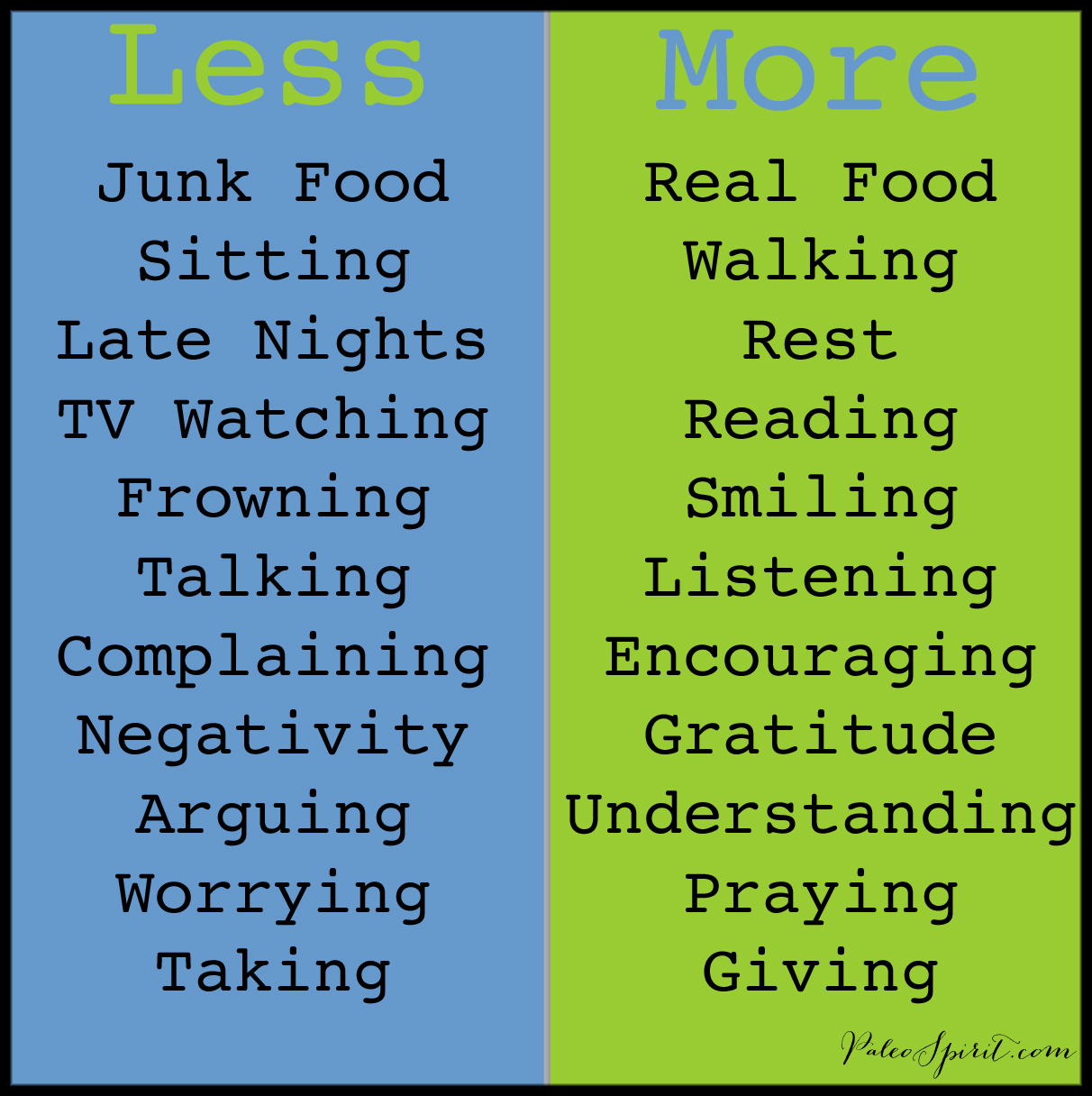
When one makes a choice to become healthier in weight, it should also be a choice to become healthier in mind. The negativity of jealousy and anger can be just as poisonous to the body as cholesterol. Getting to know oneself can be delightful, and also leads to the understanding of where and how one requires self-improvement. 
Iyer concludes: 
But I know that one day my doctor is going to come into the room with a very dark look on his face and news that no treadmill or repudiation of onion rings is going to make better. And then the only thing I’ll have to turn to will be all I’ve done when going nowhere — and everything I might have stored in some less visible account.