Showing posts with label Loshon. Show all posts

Sunday, April 12, 2020

Triggers

Han and I were taking a walk on one of these Shabbosim, pushing the stroller. We took a scenic route.

I saw a house, a beautiful house. "Oh my God," I said, as a sickening feeling took my stomach.

It came flooding back: It was during my single days. A shadchan had called. She asked me to visit her on Shabbos, before lunch, while she was visiting her parents. 

I carefully dressed that Shabbos morning, for yet another "interview." It was winter, or it was at least cold out. I arrived with a chilled nose. I was nervous and hopeful. 

I was embarrassed to be welcomed into a full house, her other married siblings having all come for some sort of family occasion. I want to say her father's birthday. I was ushered into a side room. 

I don't remember much of the conversation itself. I remember her expression, initially friendly, becoming stiffer and stiffer with disapproval. I remember leaving with that all-too-familiar sensation of hope turning to sludge, as I was yet again deemed "unworthy" by a stranger. 

Maya Angelou said, "I've learned that people will forget what you said, people will forget what you did, but people will never forget how you made them feel."

Sometimes I see a person, and my insides freeze up. I don't remember what she said, but I remember how she made me feel. Many people (male and female) made me feel that way when I was single. Opening pleasantries. A shidduch suggestion. Then, for lack of a better term, the bitchy comments on my life choices or appearance or behavior. 

I'm sitting now typing this at my kitchen table with a baby babbling at my feet, with Han washing dishes. I've proved them wrong, obviously, not that they care. They met me, judged me, and dismissed me, without a second thought; those remarks haunted me. I questioned myself repeatedly, vacillating between self-faith and "But are they all wrong? Or am I the insane one?"

I know I'm being a broken record, that I've been harping about this constantly lately. I know the people who should be reading this probably aren't. But for those who are: 

1) If you have been hurt by such remarks, be strong. All that matters is that you are striving to be a good person and try to be kind to others. Whatever anyone else says is bull. 

2) If you have said such remarks for others "own good," shut up. There is no such thing. Don't be the messenger. They get shot. 

3) There is someone for everyone. I repeat, THERE IS SOMEONE FOR EVERYONE. 
 
4) Ice cream will always be there for you while you are hurting. Wallow in your pain, acknowledge your feelings. Then get up the next day and use your fury to vacuum like a boss.   

Wednesday, February 26, 2020

The Shame Continues

As my readership may recall (if I still have any, that is), singles get a lot of soul-destroying feedback. You aren't doing this right, your personality is sort of eh, and because you didn't go to summer camp when you were 12, you are therefore single. 

But then, the magical time arrives when one's soulmate FINALLY shows up, and you can dance off into the sunset while cackling, "In yo FACES!!!"

There is, for the first time in a decade, the blissful sound of NOTHING. No one has anything to say to you beyond, "Hello." Oh, it is wonderful. So wonderful. 

Then Ben was born, our blissful squishy baby, the offspring we were waiting for. 

But then they came back. They found me again. 

"He doesn't sleep through the night? At his age? When my baby was three hours old, I programmed him to sleep for 24 hours straight." 

"His diaper leaked and you don't have a change of clothes? I don't go anywhere, not even to the mailbox, without three backup outfits." 

"Do you read to him enough? I started my baby on advanced poetry by six months." 

I've discovered I've started to self-flagellate in advance, just in case. "I'm so terrible, I resort to Cheerios as most of his snacks. While I'm at it, he doesn't sleep through the night yet and so he would be better off in foster care as I am therefore an incompetent caregiver."

Maybe because Ma's not here to reassure me that I'm doing an ok job keeping him alive, but I find myself succumbing to all the comments,  doubting my efforts. 

Damn. I thought I was done with this. 

To all the lovely singles who are badgered by everyone: Tune them out. Because they are a fact of life, along with death and taxes. 

Wednesday, February 6, 2019

Conversate

"It's conversations," my sister tells me. "You have to be able to talk about things." 
http://lovemybrit.com/wp-content/uploads/2014/07/stock-footage-beautiful-couple-talking-at-table-in-restaurant-730x410.jpg
There's nothing more a conflict-avoider (like me) dreads than "talking." Not fun banter, or "how was your day" exchanges. "Talking" as in, "We have to talk." 

Yet I'm also a big believer in living in reality. If a relationship is based on fantastical fluff, it's not worth much. A commitment is only valuable if the nitty-gritty is acknowledged, and yet the couple remain happy and true. 

So disagreements are inevitable. Yet the method how to go about the disagreement is not.  Daphne de Marneffe, a therapist, tells us the best way ("The Secret to a Happy Marriage is Knowing How to Fight"): 
I’ve seen how the best marriages involve people who can deal with strong negative emotions — and who are cleareyed about how hard it can be. They don’t avoid anger, but they don’t indulge it. They tackle hard issues without shutting down. They apologize for their own bad behavior.
What will matter most in marriage is what’s possible on the other side of love’s first blush: conversations that are rewarding, intimate and real. It’s not that we come together in electric recognition and pure understanding, then fall away from that through conflict. Rather, we come together in a rush of passion, then we achieve love through continuing conversation.
Through that conversation we cultivate the essential emotional attitude in marriage: I can try to understand what you think and feel, without it taking away from my own experience. Your reality doesn’t cancel out mine.

Monday, November 5, 2018

Too Above, Too Beyond

I've become rather attached to a Jewish cooking group on social media. They've been very helpful, really. While the majority of posted recipes do not pass my self-defined "healthy" criteria, they've provided plenty of inspiration and options. 

As the "fun" parshios have swung back, the feed is cluttered now with women posting their "parsha desserts." Cakes covered in blue fondant and animal crackers. Rainbow blondies. Star cookies. Some breathtakingly elaborate. 
https://assets.bonappetit.com/photos/57b271fad2b3234663509038/16:9/w_1000,c_limit/mare_cranberry_and_raspberry_star_cookies_h.jpg
Group members tend to post what they made, which can give others much-needed ideas when they're tired of making the same chicken for supper three nights in a row. But there was some backlash to all the parsha postings, to the point that the administrator gave everyone a scolding. If you don't want to make it, then don't make it!, she said. That doesn't mean you have to be snarky and disapproving!  

Am I the sort of gal who'll spend my Friday carefully crafting a "mabul cake"? (I still don't know what that is). No. Not me. 

I do think it's an excellent idea to get children excited about the parsha. However. However: 

I'm pretty stressed on Fridays. I pride myself in not overdoing things, but after hitting the stories at 7:30, cleaning chicken, and praying I don't burn the broccoli again, I can get pretty busy. I'm also unwilling to do certain things, like stay up past my bedtime, to make a special something for Shabbos that, chances are, will not get the reception I was expecting for so much effort. 

Cooking for Shabbos can be overwhelming. When one is overwhelmed, one can get . . . testy. Maybe a little yell-y. So if any wife, mother, or daughter lost it because of the complicated desserts that are being made in the name of Torah, IT WASN'T WORTH IT. Because no matter how "ooh, aah" that confection is, people would rather not get their heads taken off. 
 https://www.tabletmag.com/wp-content/uploads/2018/01/820-4.jpg
So if all of those mothers made multi-colored challahs with a smile on their faces and a song in their hearts, kol ha'kavod! You are amazing. But if one cross word was uttered, one irritated look flashed, because they took on more than they should have—

It missed the point. Buy the cookies instead.  

Wednesday, September 5, 2018

The Terror of Silence

When I get upset, I don't get loud. I get vewy, vewy quiet. 

It's genetic. It's also an INFJ characteristic. Ma would get quiet, too. As does Owen. My niece gets quiet (it freaked us out when she did it for the first time when she wasn't yet two). 

When I am flooded with emotion, my body shuts down. My sister-in-law commented that it's a good thing, as Owen doesn't say anything regrettable in the heat of the moment. 

I don't like to lose control. I don't like to have to amend for vicious words spoken while infuriated.

I'm also a little slow on the uptake. It may take me a full five minutes (usually longer) to realize someone is insulting me. 

Considering how a basic Judaic tenet is "do not respond," that means I can have fantasies of chapping up Olam HaBah, all without trying. 

Yet I recently realized another perk. 

When one remains quiet in the face of insult, the offender's hurtful words float in the air, echoing in all their horror. There is a very good chance the offender now hears exactly what was said, and realizes the error of such speech. The offender may flush, and mumble, then hopefully vanish in shame. 

I believe that is known in layman's terms as a "win-win." 

You see, if one quickly jumps in defensively, those painful utterances are pushed aside and forgotten by the enunciator. They smirk instead at one's feverish efforts to explain or clarify. 

Being quiet just makes perfect tactical sense. For there is one thing I have learned: Silence, in the face of insult, reflects self-discipline. Those who revel in taking others down exploit insecurities. But if I refuse to take the bait . . . they get very frightened indeed.

I constantly quote from Lord of the Rings: "I did not pass through fire and death to bandy crooked words with a witless worm." 
https://i.pinimg.com/originals/6f/b8/eb/6fb8ebc91be2ea0d58271438b91c311b.jpg
Muhahahahaha. 

Tuesday, August 8, 2017

"Be That Person"

I like to think I have reached a point where I no longer absorb snippy comments. Often, if on the receiving end, I look intently at the other and wonder, "Golly, she must be really hurting about something." 

Anonymous trolls, the most cowardly of the cowardly, offset their own misery by depositing nasty little statements here and there. This cooking blogger posted a video taking such a one to task, by sharing her own burdens and appealing to the world to just be freakin' nice.  
Dr. Perri Klass, M.D. ("What Knitting Can Teach Us About Parenting"), is a pediatrician; to unwind, she browses through a knitting website, where she noted that despite the, er, straight-up ugliness of the various posted projects, the vast majority of comments are nice. Yet she doesn't see that empathy outside, as parents are usually subject to sniffing disdain if their toddler has a public meltdown (an occupational hazard, and to be expected). 
I would like to suggest that everyone who has posted more than one comment in the last two years passing judgment on other parents learn to knit as soon as possible. Winter is coming, and we all need scarves. There are some really nice, easy patterns on Ravelry, and you can download many of them free — and then you can choose your yarn and put your heart into it and make something beautiful.
With luck, the people who see it in real life and the ones who admire it in the photos you post online will respect the effort you put into it, and offer praise and encouragement. And if they don’t have anything nice to say, they won’t say anything at all.
Whenever I now get that judgy voice in my head, I'm disappointed in myself. Then I choose to see a quality about the other that I am forced to admire. And I can.

Friday, August 4, 2017

TGIF

Thursday, February 2, 2017

Words Words Words

It's a miserable talent to be able to see the topic of "shidduchim" everywhere. Like this article, specifically about race ("Why Calls for a 'National Conversation' Are Futile"), that notes action is not a guaranteed result from talking. 
I've been listening to shiurim lately that mention hishtadlus. Hishtadlus doesn't change—it stays the same. One does their (reasonable) part, and sometimes there are immediate payoffs. Doing "more" hishtadlus, however, is not what is necessarily called for as a response to a seemingly "failed" attempt. 

I always exit calmer after a visit with the family guru. Hishtadlus, he says, is simply how we react to a situation—nothing more. Golly, I love the man. 

A lot of talk is about fomenting the correct action to subvert the current situation, instead of recognizing our own piddling humanity. 

Like shidduchim (I'm getting so sick of that word). "It's because there is no place for singles to meet." Really? With all the "events" and Shabbos meals and mingling in college hallways? "Boys are too picky." That's a generalization. "Girls are too picky." So's that one. "Mothers are too picky." Oh, God gets around them, too, belieeeeve me.
A national conversation involved a large portion of the public talking about both important and frivolous stuff more or less at the same time. The term has since taken on a lofty, moralizing weight. Now the belief in a national conversation is a belief in positive outcomes, in correctives, in shoulds. 
What is the "should" that is the basis of our hysteria? That no one "should" be over 23 and unmarried. When looked at it that way, that seems kind of ridiculous, doesn't it? Okay, let's make it more reasonable: no one should be over 30 and unmarried. I dunno, still a ridiculous premise to get hysterical about, don't you think?

There are people out there who are dealing with waaaaay more serious situations that need help that can actually be given. No matter how much a someone hopes to be my shadchan, she can't force that. Yet I can easily provide tzedakah to assist a needy kallah with buying household essentials. No talking needed, either.  Action done.
The country can’t stop talking about race, because racism won’t let us change the subject. But there’s room to alter how the conversation is facilitated, to strip away the loftiness and self-congratulation. What Barack Obama seemed to be urging in 2013 is precisely what tends to go missing, still, from all of this national conversing: empathy. . . because empathy isn’t a realization you come to by having a conversation with the nation. It’s a conclusion you reach first in conversation with yourself.
Ah, that word: empathy. What is constantly irritating about the conversation surrounding this manufactured "crisis" is how there's always enough blame to go around. Instead of individuals recognizing the Eibishter's Hand in their (and others') lives, they opt for a scapegoat to shove off the cliff.

Everyone should take it easy, on themselves and everyone else. Single people should try breathing again; it's wonderful. Married people don't have to feel guilty, nor should they point fingers at singles' supposed fault. 

It comes down to this: If you have an idea that seems possible (I mean taking personality, background, what-they-say-they're-looking-for, etc. into consideration) then suggest it. Don't call yourself a "shadchan"! Just make a phone call, as a friend. That's all the talking/action that's needed.   

Monday, January 23, 2017

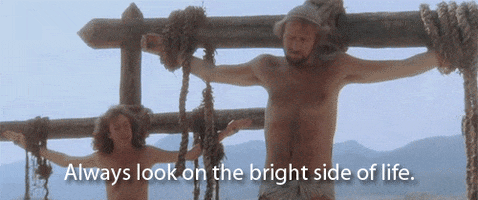
Always Look on the Bright Side of Life

I didn't know it was possible for someone to kvetch about everything.

The yeshiva looked down on him for going to college. In the business field, there is little available. Where he grew up, there were only two kosher eateries—can you imagine? The weather. Other Jews. Yeesh, those other Jews.

Years ago, I had one date that I cringingly recall. I was annoyed with this fellow to begin with, and allowed myself leeway where I shouldn't have: I kvetched a bit about my siblings, having recently gone through the babysitting wringer. 

Complaining is a no-no, in general. Rabbi Yisroel Reisman speaks very sternly about it. Jews are the people of gratitude, not ingratitude, and whining is a guaranteed way for the universe to kick one in the rear. 

I've cultivated a sunny disposition (it didn't just happen, folks!) and been all the happier for it. Like attracts like, so it is said, and I'd rather keep the Debbie Downers away. 
https://media3.giphy.com/media/PH2JVXCni3QRO/200_s.gif
And kvetching is such a turn-off.  

Thursday, September 8, 2016

With the Help of God

"B'ezrat/Im yertzeh Hashem."

It was not until I read "Inshallah is Good for Everyone" by Wajahat Ali that I realized how gratuitously and often inappropriately we chuck about that phrase. 

Inshallah is the Arabic version of “fuggedaboudit.” It’s similar to how the British use the word “brilliant” to both praise and passive-aggressively deride everything and everyone. It transports both the speaker and the listener to a fantastical place where promises, dreams and realistic goals are replaced by delusional hope and earnest yearning.

If you are a parent, you can employ inshallah to either defer or subtly crush the desires of young children.

Boy: “Father, will we go to Toys ‘R’ Us later today?”

Father: “Yes. Inshallah.”

Translation: “There is no way we’re going to Toys ‘R’ Us. I’m exhausted. Play with the neighbor’s toys. Here, play with this staple remover. That’s fun, isn’t it?”

If you are a commitment-phobe or habitually late to events, inshallah immediately provides you with an ambiguous grace period.

Wedding Planner: “We only have the hall from 7 to 10 p.m. We’ll incur extra charges if we go past 10. Please tell me you’ll be on time.”

Wedding Attendee: “But of course! Inshallah, we’ll be there.”

Translation: “Oh, you sad, sad, silly little man. I hope you have saved a lot of money or have access to an inheritance. I’ll leave my house at 9:45 p.m.”

Inshallah is also an extremely useful tool in the modern quest for love.

Man: “So, you think we can go on a date later this week?”

Woman: “Yeah, let me think about it, inshallah.”

Translation: “No. Never. There is no way we are ever going on a date. Even if there was a zombie apocalypse and you were the last man on earth, I would not consider this an option and would rather the human species perish as a result of my decision.”

I drop about 80 inshallahs a day, give or take. I’ll get to the gym, inshallah. Yes, I’ll clean up around the house, inshallah.

C'mon. Doesn't this all sound so familiar? 

As long as we don't blame Him for us not taking care of anything.  

Thursday, August 18, 2016

The Time is Now

I once read that there is no official psychological term known as "closure." I found that very gratifying, indeed. 

"Closure" is a term we use instead of "curiosity." 

"Don't you need closure?" Chava asks. "Ask Sarah why she stopped answering her texts!" 

It's more like Chava's curious.

"Closure" is one of those cultural go-to terms, like "romance" and "gluten-free."
 https://s-media-cache-ak0.pinimg.com/564x/3d/48/4b/3d484b2114cf691e8a3e19d76e99306c.jpg
Books and movies promulgate its necessity. Cantankerous, deathbed-ridden parents realize their hurtful errors in raising their children, confess their sins and affirm their love to teary-eyed offspring, then slip from this world with a casual "I'm so tired." 
 http://i.dailymail.co.uk/i/pix/2015/03/29/22/271D570600000578-3016954-image-a-59_1427665061729.jpg

Real life . . . oh, real life. 

Katie Roiphe in "Dying, With Nothing Left to Say" begins how her father's sudden death robbed her of one reassurance she wished to have given him before he went. 
. . . I realized that while nearly everyone has a fantasy of a “last conversation” with someone they love, very few people actually have it. It is the fantasy of resolving all conflicts, of emotional catharsis, that rarely ever comes to pass, because the habits of reticence or resentment that were there the whole time are still there, because the proximity of death does not transform personalities, or compel us to cut through to the heart of things, however much we want it to.
People are people, even when the end is nigh. Roiphe had wanted to ask her father more about his youth, but he never had been a chatty man. My paternal grandmother never opened up about her time in the camps, and would it have been fair to her to demand painful information when she craved peace?
Even the writers I was researching — people who lived in structure, plots, words — mostly did not find their way to conversations that offered a satisfying ending. They left things messy, unresolved, dangling.
The bedspread of life is not known for neat, military corners. Life is more like the impossible-to-fold fitted sheet. 

Two letters, in response to this article, stuck with me: 
In 2005, I picked up my mother-in-law, Mary, from the airport as she returned from vacation. I brought her to my home for some soup and then helped her load her car for her half-hour drive home. As she was stepping into her car, she turned and said, “Johnny, I tell all my friends that you are perfect.”
An hour later, my wife and I were called to the emergency room, where we found that Mary had died in a car accident.
While knowing that I am hardly perfect, I have treasured Mary’s last words ever since. Katie Roiphe suggests in her article that, with the approach of death, we anticipate the opening of a “new, honest, generous space” in which “there is a directness, an expansiveness” that can be filled with meaningful last words.
Mary showed that we can create and fill such a space with special words on any day, without knowing whether or not death is at hand.
JOHNNY WILLIS
Schenectady, N.Y.
We have heard it often enough: Live every day as though it is your last. Kind speech does not have to be reserved for meaningful moments. It should be an everyday habit. 
While Katie Roiphe writes about people in the last hours of life, the uncomfortable reality is that we are all dying.
I am a health psychologist who studies people at the end of life. I became a bereaved daughter when I was 25 years old. These experiences taught me that the trick to “having something to say,” or those deep and meaningful conversations, come to people who are able to face their own mortality well before they are on their deathbeds.
Dying, like giving birth, is a biological event. Giving birth does not instantly turn women into excellent mothers any more than dying turns one into a wise Buddha.
If we want to have a good death, we need to invest in a good life. Look death in the eye every day, and remember that time is finite, that our loved ones will not always be here, and that the time to talk is right now.
LEEAT GRANEK
Tel Aviv
The writer is an assistant professor and head of the gerontology and sociology of health program at Ben-Gurion University of the Negev. 

Friday, July 22, 2016

Communication is Futile

Amie Barrodale precedes her new collection of stories, “You Are Having a Good Time,” with an epigraph attributed to a Bhutanese lama by the name of Dzongsar Jamyang Khyentse Rinpoche: “There is no such thing as communication. There are only two things. There is a successful miscommunication, and unsuccessful miscommunication. And when you have unsuccessful miscommunication, you are having a good time.” All of the stories in this stark and cutting collection grapple with our failure to communicate, and investigate not merely the woeful inefficiency of language itself (although that’s bad enough) but also the inherent impossibility of truly understanding another person’s internal state.—Nicolas Mancusi

A large percentage of communication is non-verbal (the exact number is up for debate). That's why I find texting exhausting; lacking the quirk of my eyebrow, the twitch of my nose, the flick of my fingers—emojis don't always do the job right—I am positive my message is coming out wrong. 

Not only that, we don't know, even when we think we know, where other people are coming from. How can we communicate successfully when vocabulary means different things to different people, when different experiences excite different reactions, when what is hateful to me is bliss to you? 

We might as well just try to have a good time, then.  

Thursday, July 21, 2016

#Blessed

Kate Bowler is a historian of the American prosperity gospel—"Put simply, the prosperity gospel is the belief that God grants health and wealth to those with the right kind of faith." Ask any Jew, and they will scoff, of course, at such a precept being in Judaic belief. Yet there is a vast disconnect between official doctrine and the desperate flailings of the mind. For I see others, and also am guilty of, believing and acting on such a mindset. 

Chevi Garfinkel says, "Don't confuse bracha with accomplishment." Finding a life partner is a bracha. Having children is a bracha. Being healthy is a bracha. There is nothing one does to achieve that. There are wonderful people out there who are unmarried. There are wonderful people out there who are childless. There are wonderful people out there who are ill. If one believes that bracha comes from earning, the logic that would follow is that others "earned" misfortune as well. 
Blessed is a loaded term because it blurs the distinction between two very different categories: gift and reward. It can be a term of pure gratitude. “Thank you, God. I could not have secured this for myself.” But it can also imply that it was deserved. “Thank you, me. For being the kind of person who gets it right.” It is a perfect word for an American society that says it believes the American dream is based on hard work, not luck.
If Oprah could eliminate a single word, it would be “luck.” “Nothing about my life is lucky,” she argued on her cable show. “Nothing. A lot of grace. A lot of blessings. A lot of divine order. But I don’t believe in luck. For me luck is preparation meeting the moment of opportunity.” This is America, where there are no setbacks, just setups. Tragedies are simply tests of character.
It is the reason a neighbor knocked on our door to tell my husband that everything happens for a reason.
“I’d love to hear it,” my husband said.
“Pardon?” she said, startled.
“I’d love to hear the reason my wife is dying,” he said, in that sweet and sour way he has.
My neighbor wasn’t trying to sell him a spiritual guarantee. But there was a reason she wanted to fill that silence around why some people die young and others grow old and fussy about their lawns. She wanted some kind of order behind this chaos. Because the opposite of #blessed is leaving a husband and a toddler behind, and people can’t quite let themselves say it: “Wow. That’s awful.” There has to be a reason, because without one we are left as helpless and possibly as unlucky as everyone else.
For all the development of empathy, petty thoughts, feeding on fear, still lurk within. My brain, pathetically, has lurched to the blame mode—the very blame mode that I have been subjected to by others—when I hear of others' horrific pain. Because in my selfish, primitive, chimp-mind, I want guarantees: This can't, won't happen to me. 
One of the most endearing and saddest things about being sick is watching people’s attempts to make sense of your problem. My academic friends did what researchers do and Googled the hell out of it. When did you start noticing pain? What exactly were the symptoms, again? Is it hereditary? I can out-know my cancer using the Mayo Clinic website. Buried in all their concern is the unspoken question: Do I have any control?
I can also hear it in all my hippie friends’ attempts to find the most healing kale salad for me. I can eat my way out of cancer. Or, if I were to follow my prosperity gospel friends’ advice, I can positively declare that it has no power over me and set myself free. 
I struggle with this. It is so easy to say, to write, to nod matter-of-factly, but when in that situation, all that mental prep struts out the door.  
. . . And God is always, for some reason, going around closing doors and opening windows. God is super into that.
The prosperity gospel tries to solve the riddle of human suffering. It is an explanation for the problem of evil. It provides an answer to the question: Why me? What do you hear God saying when it all falls apart?
Well, for me, it feels like He's not talking. But that's because I'm not really listening. 
It offers people a guarantee: Follow these rules, and God will reward you, heal you, restore you. . . The prosperity gospel has taken a religion based on the contemplation of a dying man and stripped it of its call to surrender all. Perhaps worse, it has replaced Christian faith with the most painful forms of certainty. The movement has perfected a rarefied form of America’s addiction to self-rule, which denies much of our humanity: our fragile bodies, our finitude, our need to stare down our deaths (at least once in a while) and be filled with dread and wonder. At some point, we must say to ourselves, I’m going to need to let go.
Being frum is not about being certain. We are certain about a number of things; the existence of God, the validity of His Torah, the laws He gave us to follow. Often there are clear descriptions about divine reward. But remember Acher and that incident with the young boy who died while performing shiluach hakan for his father (two "long life" compensations right there)? Judaism was not decommissioned because of it. Acher is faulted for his inability to comprehend.   
But cancer has also ushered in new ways of being alive. Even when I am this distant from Canadian family and friends, everything feels as if it is painted in bright colors. In my vulnerability, I am seeing my world without the Instagrammed filter of breezy certainties and perfectible moments. I can’t help noticing the brittleness of the walls that keep most people fed, sheltered and whole. I find myself returning to the same thoughts again and again: Life is so beautiful. Life is so hard. 

Friday, July 8, 2016

TGIF

Monday, November 23, 2015

"So Happy For You!"

The Big Bang Theory, "The Bon Voyage Reaction"

Stephen Hawking is sending an expedition to the North Sea to test his theories; one of the experimental physicists dropped out, giving Leonard the opportunity. 

From the beginning, Sheldon has been attempting to talk Leonard out of it; in typical Sheldon fashion, he predicts doom, citing the possible hazards of boat travel, even going so far has to hint how the four-month separation might affect Penny's affection for Leonard. 

Sheldon continues to sulk; Leonard believes it is because Sheldon is terrible with change, and worries about him. But it's Penny who calls him on it: 

Sheldon: You know, I have to say, Penny, I don’t understand why you of all people are encouraging Leonard to do this. 

Penny: Honey, this is a big deal for Leonard, okay? He gets to work with Stephen Hawking. Who, by the way, will not be on the boat. I checked it out. 

Sheldon: It’s not that big of an opportunity. And even if Hawking’s theories are correct, all they prove is where the universe came from, why everything exists and what its ultimate end will be. I mean, me? I’m interested in the big questions. 

Penny: Oh, my God, Sheldon the genius is jealous of Leonard. 

Sheldon: I’m not jealous. I’m just very unhappy that good things are happening for him and not happening for me. 

Penny: Look, sweetie, this is a natural thing to feel, okay? But just because good things are happening to Leonard doesn’t take anything away from you. You know what? Let me tell you a little story. Once there was a girl who worked at the Cheesecake Factory, and she wasn’t very good at her job. 

Sheldon: It was you. 

Penny: It wasn’t me. But she was also an actress, and we were both up for the same part in a toothpaste commercial. She got it. Look, I was so jealous. But instead of ripping out her fake blonde hair… 

Sheldon: You ripped out your own fake blonde hair. 

Penny: I looked her in the eye, smiled and said, I’m happy for you. Because that’s what friends do. 

Sheldon: They lie so they don’t look petty. 

Penny: Yeah. 

Sheldon: How?

Penny: Like this. (Fake smiling) I am so happy for you.
http://i.onionstatic.com/avclub/4297/86/16x9/960.jpg
Sheldon: Wow. No wonder you didn’t get that toothpaste commercial.

Later, at Leonard's going away party: 

Sheldon: Um, can I have your attention, everyone? (Clinks glass) That’s, uh, B-flat, for those who don’t have perfect pitch. I would like to propose a toast to my best friend, Dr. Leonard Hofstadter. He has been presented with a wonderful opportunity, and I couldn’t be happier for him. 

Leonard: Thank you, Sheldon. That must’ve been very hard for you to say.

Sheldon: Well, I mean it. I’m really happy for you. And that’s how you get a toothpaste commercial. Cheers. 

For a better boost on being happy for others, I recommend this Chevi Garfinkel shiur (the link won't work unless you are a girl already in possession of a torahanytime account confirming that fact. Yeah, I know). 

Monday, November 9, 2015

Hearsay

"Objection, Your Honor, hearsay." 

"Objection sustained." 
http://cdn.hitfix.com/photos/5243209/Jack-McCoy-Sam-Waterston.jpg
While watching Law & Order, I didn't quite understand what was so bad about hearsay. After all, if they said it, why can't it be admitted into evidence? 

Until there was more than one incident with my niece. I should have seen the signs. 

"But you said you would!" she wailed. 

"I did?" She's too honest for her own good, so I questioned my own memory and capitulated. Yet when she claimed more than once "You said you would," I realized that she wasn't being truthful. 

"Babi said she would buy me anything if I go to bed on time!" she reported happily one day. 

"When did I do that?" Ma questioned. 

"You said so!"

"No, I didn't." 

The story eventually untangled; Ma had told her to be sure to go to bed on time during the school year, and then moved on by asking her what she wanted for breakfast: "I'll make you anything you want." 

My dear Eewok, in her eagerness for presents, simply heard what she wanted to hear, editing out the inconvenient bits. She should never be allowed to testify in court. 
http://40.media.tumblr.com/7fb0e6a9e53956eab983abc17ae66c16/tumblr_nskjvvasxx1rmw0cso1_500.jpg
I thought of this as I read "My Father's Last Romance," the author's widowed elderly father had found love again, and had announced to his son that she had asked him to marry her. But as time passed she did not show such matrimonial-inclined behavior. Soon, his father passed away.
. . . I took a breath and put a question to her that I hadn’t been able to stop thinking about for months: “Why did you ask my father to marry you?”
She shook her head. “I never did that,” she replied. “I told him if he were well I’d want to marry him.”
His father had heard what he wanted to hear, and the son was judging her harshly for a crime she had not committed. Eewok does not lie to be craftily manipulative; she has an image in her head of what she wants so badly she alters her recollections to support that fantasy. To the extent that she had caused a number of misunderstandings that could have gotten nasty if left undiscovered. 

I'm trying now, when told "they said," to recall: "Objection: hearsay." These words could be spectacularly inaccurate, and should not be held against any.   

Wednesday, September 9, 2015

Mechilah

"Forgiveness" is probably one of the most frightening words out there. 

But God forgives those that forgive. So I have been trying to let go. 
And golly, do I feel good. I'm surprised to what extent anger and resentment weigh in one's chest, tightening breath, dulling the senses, spreading wrinkles.

I became so hooked on that floaty sensation that when I was verbally shoved, I immediately, frantically, called up the methods to let it go. 

I find that it really helps to mentally chant: "It's not about me. It's not about me. It's not about me." Often, the transgressor is so mired in insecurity she cannot even see her own actions or herself. Sometimes the offender is having a really, really bad day/month/year, and unequipped with the mental tools to keep his behavior in check, merely lashing out wherever he thinks is "safe."

Previously, I would have thought it a weakness to let it slide, that "I'm letting them get away with it." I'm not saying that one should be a willing target. If possible, fade away from a negative presence, and the other side will get the hint and pull herself together. If not possible, wait until one's reactions will be fueled from a place of calm and collectedness, not roiling anger and humiliation, before responding. 

It takes two to make machlokes. If I say, "I'm not playing," it's a win-win.

This is very much applicable in personal relationships. Susan Cain's "5 Practices for Cultivating More Loving Relationships" was humbling as I now see a glimmer of a truer definition of love, real ahava. 
https://s-media-cache-ak0.pinimg.com/736x/0c/24/4e/0c244e58207d11351201a4e14b059f28.jpg
It's not about who's right. It's about doing what's right. To quote the Rabbi of Lublin: "It is far better to have an imperfect peace than a perfect controversy."  

Thursday, August 20, 2015

Sticks and Stones

I am in the midst of lions; I am forced to dwell among ravenous beasts—men whose teeth are spears and arrows, whose tongues are sharp swords. —Psalm 57

Today, those words are less often spoken, more often typed. Texts, tweets, posts, updates, statuses, and so forth, can be a roiling, teeming hotbed of fury and shame. With the help of technology, a thoughtless comment can be elevated and escalated to the point where people's lives are ruined. 

"How One Stupid Tweet Blew Up Justine Sacco's Life" by Jon Ronson lists anecdotes of individuals who, without sufficient thought, spoke, tweeted, or posted a statement or photo that was more offensive than they realized. The backlash and consequences insanely exceeded the severity of the crime. 
 http://static01.nyt.com/images/2015/02/15/magazine/15sacco1/15sacco1-master1050-v3.jpg
In some cases, the "muckrakers" that "outed" mindless words with the help of social media were attacked in turn, after these mild offensives were returned with firings and virulent online persecution. 

Public shaming is not a new concept. But it now extends beyond one's own small social circle to the entire freakin' world, who don't know the culprit and have no idea what they are talking about. Satire is often taken at face value; humor out of context.

Ronson's conclusion: 
When I first met her, [Justine Sacco] was desperate to tell the tens of thousands of people who tore her apart how they had wronged her and to repair what remained of her public persona. But perhaps she had now come to understand that her shaming wasn’t really about her at all. Social media is so perfectly designed to manipulate our desire for approval, and that is what led to her undoing. Her tormentors were instantly congratulated as they took Sacco down, bit by bit, and so they continued to do so. Their motivation was much the same as Sacco’s own — a bid for the attention of strangers — as she milled about Heathrow, hoping to amuse people she couldn’t see.
Why did Sacco tweet so stupidly in the first place? Probably the same reason why I used to constantly post statuses on FB—waiting for the "like" feedback, hoping someone would find me witty and worthy. 

Because Sacco tweeted under her real identity, the whiz-bang lash of ostracism was able to destroy her life. But anonymous commenters, subject to no such retribution, can write absolutely anything, snug in their invisibility: "The Epidemic of Facelessness" by Stephen Marche. 
When the police come to the doors of the young men and women who send notes telling strangers that they want to rape them, they and their parents are almost always shocked, genuinely surprised that anyone would take what they said seriously, that anyone would take anything said online seriously. There is a vast dissonance between virtual communication and an actual police officer at the door. It is a dissonance we are all running up against more and more, the dissonance between the world of faces and the world without faces. And the world without faces is coming to dominate.
I know, when I am distant to an issue, the "obvious" right and wrong side seems all too clear. It is when one comes closer that one sees that matters are not so simple. I try not to take whatever new "outrage" I see online seriously. 
 http://russia-insider.com/sites/insider/files/Unearthed-Trolls-1309-1-web.jpg
Especially since being faceless removes compassion. 
Inability to see a face is, in the most direct way, inability to recognize shared humanity with another. In a metastudy of antisocial populations, the inability to sense the emotions on other people’s faces was a key correlation. There is “a consistent, robust link between antisocial behavior and impaired recognition of fearful facial affect. Relative to comparison groups, antisocial populations showed significant impairments in recognizing fearful, sad and surprised expressions.”
. . . Without a face, the self can form only with the rejection of all otherness, with a generalized, all-purpose contempt — a contempt that is so vacuous because it is so vague, and so ferocious because it is so vacuous. A world stripped of faces is a world stripped, not merely of ethics, but of the biological and cultural foundations of ethics.
I find it interesting that those who spew horrible opinions while anonymous "of course" wouldn't say such things in the real world. Being unknown supposedly breeds "honesty." Does that mean that most of humanity, with their actual faces and true names, really don't qualify for that label?  

"What Your Online Comments Say About You" by Anna North reports on expert opinion saying that nasty comments don't necessarily come from a place of "truth"; the anonymous trolls could have simply had a "bad day." Nor do they realize that their petty frustrations can be seen by so many. 
And as they get more attention, some commenters might become more self-aware. When media outlets covered Dr. Brossard’s 2013 study, she took a look at the comments. One reader, she recalled, had indicated that “now I’m going to think twice because I realize that what I’m saying, the way I react, and my words potentially can affect other people.
One reader, she recalled, had indicated that “now I’m going to think twice because I realize that what I’m saying, the way I react, and my words potentially can affect other people.”
“There is research showing that people underestimate who’s going to see what they say” in comments sections, said Dr. Kiesler. “Unless they’ve been burned in the past, they are just not as aware that they’re being observed.”
But if research on comments continues, maybe that will change. Maybe commenters will become more conscious of each other and more bound by social norms — for better and, perhaps, for worse.
In short, think very, very hard before writing or posting pictures. And if in doubt . . . do without.  

Thursday, August 6, 2015

Go or Stay

The first time I heard it on a date, I was a little rattled: "Let's get out of here." Delivered with a Brooklyn-ese sneer, it was perhaps meant to be funny, but sounded harsh to my ears. The phrase casts aspersions upon the "here," a pleasant restaurant or shuttering Starbucks. What did the "here" do to you that we must "get out of" it? After all, you brought me "here." 

Those are the situations I thought of while reading Virginia Heffernan's "Should We Stay, or Should We Go?" "Let's get out of here" is one of the most common phrases in American cinema. 


Why? 
But this high-minded passion for new vistas is rooted in something less noble: an aggressive, adolescent disgust with the familiar. “Let’s get out of here” is our bold spin on the innocuous “Let’s leave,” sending a signal to the nervous system that we’re slipping the knot, and we’re doing it together. The offhand contempt in the phrase is what makes it so satisfying: When we’re getting out of here, we’re not going to some idealized destination. Who knows where we’re going, really? Anywhere but here.
They were just taking me home. Not really "anywhere but." Hm. 

But Heffernan has noticed a perceptible shift in current movie jargon: Staying. "Getting out" can apply to a multitude of different situations; so can "staying."

Commitment. Discipline. Focus. Choosing the hard way, rather than the easy way.
This emphasis on staying suits our times: The people writing and watching these movies are all part of an introspective, if not isolationist, culture that’s still licking its wounds after plotless wars and a traumatic recession. Those who choose to stay express a steadfast commitment to a cause, a family or a discipline — or (when it goes wrong) to lethargy, inertia and abstinence from action. Where “Let’s get out of here” is all bravado and yang, stay is self-absorbed yin. In this context, the balance of cultural power seems to have shifted from the getting-outta-here rebels who used to tell the squares and schoolmarms to kiss off to the squares and schoolmarms themselves, who just wish everyone would hold on a second and think this thing through.
I'm a square, and pretty close to a schoolmarm! This is my kind of language.
“Let’s get out of here” addresses itself to the anxiety of an earlier age: that a would-be hero might never get off the starting block. He’d get stuck and never leave his hometown, his high-school girl or his “dead-end job,” as screenwriters once wrote. Today’s anxiety is something else. It’s that our heroes in training — ourselves or our children — won’t settle on a path at all. We’ll scatter their attention to the four winds, get lost in diversion and frivolity. More than malaise we fear distraction. More than tragedy we fear trivia. On highways we die not in high-speed chases but because we can’t stop texting. 
Maybe that's why I found the "Let's get out of here" utterance on a date so off-putting; it seemed to intimate that he would be going, rather than staying.

Monday, July 6, 2015

Be Honest

Say Yes to the Dress is seemingly harmless entertainment. Glossy-eyed brides-to-be troop in with their posses, searching for the "One," after finally pinpointing the other "One."
http://i.huffpost.com/gen/431379/WEDDING-DRESS.jpg
This is "reality" television, so they always manage to put a pleasant spin on interactions, but if one watches them carefully enough, it becomes obvious that the entourages are not as generous as they claim. Sisters, friends, even mothers—all are capable of sabotage. 

"I-I love it!" the bride stammers in delight after she is zipped and clipped into a gown. Ecstatic, she sails out to the main room where her people await. She poses in front of the mirror, exuding sheer and utter bliss, slowly twirling around, face shining in hope. 

Noses curl. Mouths contort. Thumbs get jabbed downward. 

Her smile crumples. Her shoulders slump. 

She returns dispirited to the dressing room, listlessly climbing into the next possibility. 

Sure, sometimes the peanut gallery gets it right. But that's not always the point. 

Many women don't have the best of self-esteems. When they face derision instead of support, they are visibly shaken—they aren't sure they are even capable of deciding what sort of gown style they themselves like. They want her to look her best, but if she has no confidence, even a $30,000 gown (yes, it actually does exist) won't make her look beautiful. 

Some, comfortingly, successfully shoot down the haters. In a re-run, a bride requires a last-minute dress. She has a low budget, no time to order a gown in advance, she's not a sample size, and her height means extra length in required: her options are not many. 

The second gown she dons she adores, as does most of her crew. Except for her "best" friend. Her mouth purses into a moue of distaste. The bride stares at her in shock. 

"I'm just being honest," the friend invokes defensively.

"Fake it," the bride snaps. "Why don't you like it?"

The friend shrugs. 

"That's it?" The bride mocks the so-called-friend's unhelpful shrug. "That doesn't tell me anything!" 

"I don't like the back," the friend feebly and weakly claims. 

The bride rolls her eyes and returns back to the mirror, nodding firmly to herself. With a joyous flourish, she says "yes" to the dress. The closing credits show her looking gorgeous by her wedding in this rushed, miraculous find. 

But that is a rare happening. Too many brides wilt under "dear" ones' disapproval. 

"Being honest" is under woeful mistranslation today. Apparently, it means, "That dress doesn't suit you. I'm just being honest." 

Oh, are you? Let's be honest. Are you, "BFF," maybe a wee bit jealous about your friend getting married? Be. Honest. 
http://seoulseduction.com/wp-content/uploads/2014/03/Screenshot_2014-03-16-08-18-41.png
"Honesty" doesn't mean hurting people without suffering the consequences of remorse. "Being honest" means sharing with others something true about oneself. That's what vulnerability means; sharing something deep and meaningful with another to create connection.

Let's try this again: 

"You know, Kathy, seeing you there, looking gorgeous in that dress . . . it's hitting me. You're getting married. It's kind of hard for me, you moving on, settling down with Gary. I hope one day I can be as happy as you. And look just as stunning in a wedding dress."