Showing posts with label Interesting. Show all posts

Thursday, January 19, 2017

Heal Us, O Lord

If one is familiar with history at all, they would open the day with a prayer of gratitude for indoor plumbing. 

That's just the tip of the iceberg! You know all those romantic and swoony tales of Austen and Bronte? If the hero or heroine gets caught in a little rain, poof—they're dead. 
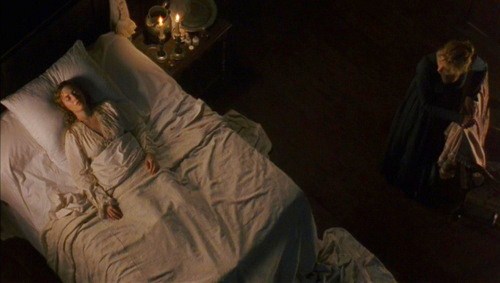
http://www.jasna.org/persuasions/on-line/vol30no1/images/thompson-ss-1995-sickbed.jpg
Marianne Dashwood near death after getting caught in the rain
If, by some miracle, our protagonists make it to the altar, keep your fingers crossed they survive childbirth. One never knew when a delivery could go wrong—the first, the tenth, it made no difference. Today we fret over pain; then they fretted over having their affairs in order. 

And when mommy survived, there was no guarantee her baby would, though. Okay, he makes it to the next day . . . maybe to age three . . . yes, age ten! Oh no, smallpox! Or scarlet fever. Or an infected scratch. There were a multitude of mortal options available. 
https://i.ytimg.com/vi/48Kr_YvhhOs/maxresdefault.jpg
Ross Poldark carrying his daughter's coffin
I THANK THE DEAR LORD that I was born in this era, where such illnesses are but a distant memory, that I can get wet in rain and not sign my death warrant. 

In recent years, there has been further progress. Gina Kolata expounds on the phenomenon of dropping rates of certain diseases ("A Medical Mystery of the Best Kind: Major Diseases Are in Decline")—and here's the kicker: experts have no idea why. 

Fascinatingly, this is not the first time diseases have declined for unknown reasons. Stomach cancer used to be the big bad wolf, then no more. TB was a major killer. Why they faded is still a "happy mystery." 

This sort of information always cheers me. No offense to the medical field, but I'm rather scared of you people. You are, after all, human, and can as easily misdiagnose as correctly diagnose. Without conscious effort, many ailments have ceased their threat. 

I like knowing that it is not up to man's control.  

Thursday, November 10, 2016

One at a Time

On the his first episode on M*A*S*H, Major Charles Emerson Winchester III pompously intones, "I do one thing at a time, I do it very well, and then I move on." 
 http://www.mash4077tv.com/images/misc/spotlight/125_winchester_tapes.jpg
It turns out, the fathead was right. If I supposedly "multi-task," incompetency reigns. 

I can't listen to a shiur and surf Facebook. I can't text and maintain a conversation. Preparing too many dishes at one time rarely ends well. 

There are many who claim they can multi-task. Note that they claim. Try reading this story without distraction. Can you? Will you recall what you have read? Will you have processed it?
Earlier research out of Stanford revealed that self-identified “high media multitaskers” are actually more easily distracted than those who limit their time toggling.
So, in layman’s terms, by doing more you’re getting less done.
Perhaps you are familiar with the person who is always busy, yet doesn't seem to accomplish anything? 
But monotasking, also referred to as single-tasking or unitasking, isn’t just about getting things done.
Not the same as mindfulness, which focuses on emotional awareness, monotasking is a 21st-century term for what your high school English teacher probably just called “paying attention.”
I have learned, at my work, to complete each task one by one. Then I don't come back, spend a minute remembering where I left off, then forget that one vital action necessary to prevent my having to start it all over again. 
As much as people would like to believe otherwise, humans have finite neural resources that are depleted every time we switch between tasks, which, especially for those who work online, Ms. Zomorodi said, can happen upward of 400 times a day, according to a 2016 University of California, Irvine study. “That’s why you feel tired at the end of the day,” she said. “You’ve used them all up.”
The term “brain dead” suddenly takes on a whole new meaning.
Multi-tasking is not productive at all, because not only are the jobs not done right, one is rendered unproductive in the process. 

There is pleasant satisfaction in a job well done and complete, von Pfetten writes. That reminded me of the "debt snowball method," paying off the smallest debt first even though that seems contradictory to financial savvy. When those in hock are able to cross off an item from their list, they tend to be so galvanized by that signal of progress that they throw themselves wholeheartedly into further headway. 

Kids, of course, tend to interrupt mono-tasking. In cases where tackling one job at a time is difficult, just try to do it whenever possible, like reading offspring a book while the phone is elsewhere, the article recommends. 
“Practice how you listen to people,” Ms. McGonigal said. “Put down anything that’s in your hands and turn all of your attentional channels to the person who is talking. You should be looking at them, listening to them, and your body should be turned to them. If you want to see a benefit from monotasking, if you want to have any kind of social rapport or influence on someone, that’s the place to start. That’s where you’ll see the biggest payoff.” 

Friday, November 4, 2016

TGIF

    • Nam nulli tacuisse nocet, nocet esse locutum: "It is harmful to no one to have been silent, but it is often harmful to have spoken."—Dionysius Cato; and so

      Monday, October 10, 2016

      Books on Change, II

      https://www.getflashnotes.com/wp-content/uploads/2015/05/willpower-book-cover.jpg
      These two delve into the science of self-control: Why it is important, how much we have of it, how it is fueled. 
      They posit a theory that humans are social for survival purposes, and in order to get along, one needs TONS of self-control. We can't all do whatever we want and expect to have pleasant familial/neighborly interactions.

      They say, up front, that it is impossible to alter more than one behavior at a time, so don't go there (as our mussar seforim insist). This New Year should not begin with more than one item that requires fixing. Whether it is an unhealthy behavior like smoking or a toxic behavior like impatience/screaming, only one can apply at a time. 

      The brain does not have separate categories for willpower; there is only one well to draw from, no matter the application. If one exhausts the supply by not killing a co-worker, for instance, h/she may come home that evening and fight with the spouse over a mildly annoying quirk. 

      Additionally, one must we well-nourished and well-rested in order to have self-control since—get this—it feeds on glucose. Many who commit criminal acts have been found to be hypoglycemic (ergo the "Twinkie Defense"). That's why implementing self-control can often be exhausting; it sucks the life out of you by plowing through your physical energy supply. (Before you get excited, the best sources of glucose are from sensible proteins and vegetables, not Oreos.)

      Deliciously, a lot of their scientific conclusions are echoed by our rabbanim, as heard in this shiur (cheat sheet: instead of telling oneself, "I will not eat that kakosh," say instead, "I'll have kakosh later." That fools the brain into a form of satiety, and, when the opportunity to kakosh arises, one won't necessarily even want it anymore. For reals). 

      Cool, huh?

      The book is jammed with more awesome revelations, like self-control leads to good self-esteem, not participation trophies.  

      Wednesday, October 5, 2016

      Books on Change, I

      To get you in the fasting spirit, here's Rabbi Daniel Glatstein

      Ah, New Years Resolutions. How they suck. 

      Most of us would like to change for the better. But it's so darn hard. So I shall share books I have read recently that I found rather illuminating on the subject. I believe that if we know how our brains and bodies work, we can work with them. 

      The Power of Habit: Why We Do What We Do in Life and Business by Charles Duhigg examines the science of habits, how they operate, and how they can be changed. 

      He brings a number of examples from businesses to personal addictions (he was not very sympathetic to gamblers and the like), and how bad habits were overcome by altering one minor detail which resulted in a chain reaction. 

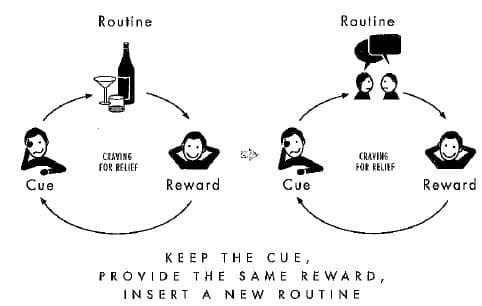
      Habits work like so: 

      1) Cue. 
      2) Routine. 
      3) Reward. 

      To change a habit, one has to pinpoint what the cue is; then the mindless routine can be replaced. REPLACED. Not ignored, not overcome, but REPLACED. (Sur mei'ra v'asei tov. It's not enough to stop a behavior; one must be active in doing better as well.)
      http://examinedexistence.com/wp-content/uploads/2015/03/habit-replacement.jpg
      I was hoping he would provide a simple cause and effect when it came to, say, overeating (cough cough), but no such luck. I had to figure it out myself. And I did. 

      Since most days of the week I arrive home at dinnertime, my routine is usually

      1) Walk through door. 
      2) Eat. 
      3) Be nourished and satisfied. 

      However, that cue is the same on Friday afternoons when I come home early, or following Sunday outings, or even applied to siblings' front doors. 

      So I consciously attempted to replace the routine: Drink a glass of water. Most of the time I'm thirsty anyway, and I feel that same pleasant nourishment and satisfaction when I get hydrated. 

      The whole book is quite fascinating, even though I provided the cheat sheet. 

      http://topfamousquotes.com/images/author/201507/charles-duhigg-quotes-3.jpg

      Tuesday, August 30, 2016

      It's a Big World Out There

      During the war in Gaza, my Facebook feed was clogged. Yes, I know the world media sucks and they are being totally unfair. I agree with you. Preaching to the choir and all that. That being the case, must you people keep sharing the obvious with me?  Go tell someone who, maybe, needs to told?

      The way Facebook is set up, Frank Bruni reminds us ("How Facebook Warps Our Worlds"), is that it keeps tabs of what you like and then suggests other things you might like. 

      Sounds harmless . . .  in theory. 

      By constantly providing us only the information that appeals, our view is narrowed. It's like shopping for dresses whilst being adamant on only one label. There are many dresses out there. Many many many pretty, flattering frocks that differ from one another, but can still potentially suit. If not you, then someone else.

      Come to think of it, my FB feed is rather monotonous. How many times can Sean Bean as Boromir be used in a meme? A million freakin' times.
       http://www.mememaker.net/static/images/memes/4350897.jpg
      Maybe that's why I love the op-ed sections of the newspaper. I can read about all sorts of topics I didn't know existed. I can agree, disagree, or snort in derision. But along the way, I am reminded of this vast, diverse, fascinating world beyond Jean-Luc Picard face palm witticisms.
      https://blogger.googleusercontent.com/img/b/R29vZ2xl/AVvXsEg1M58BFWBKVaoPuCRKD34xe1sxeBi5Tz5ovcxVbSO9mAgUeVgrqRWiYDK6Uw6PNbl-xzBEWmj56_VTS_2aFtwmLGsD-hlKJCcvk05nJQB4KAoLDJ3MajvjXpTVQrIY-FJbfsgNS4lAYfOl/s1600/322358-picard-facepalm.jpg

      Tuesday, July 19, 2016

      Serendipiter

      As we learn in school, a great number of inventions and innovative thought were mistakenly stumbled upon, if not results of actual error. Some were discovered when messing about with something completely unrelated; others weren't even really looking for anything in the first place. 

      The definition of "serendipity" is "luck that takes the form of finding valuable or pleasant things that are not looked for." (That flies in the face of that romantic film that translated it as something more akin to fate.) Pagan Kennedy's "How to Cultivate the Art of Serendipity" explains that serendipity is not something that happens, but rather something that can be achieved.
      In 1754, a belle-lettrist named Horace Walpole retreated to a desk in his gaudy castle in Twickenham, in southwest London, and penned a letter. Walpole had been entranced by a Persian fairy tale about three princes from the Isle of Serendip who possess superpowers of observation. In his letter, Walpole suggested that this old tale contained a crucial idea about human genius: “As their highnesses travelled, they were always making discoveries, by accident and sagacity, of things which they were not in quest of.” And he proposed a new word — “serendipity” — to describe this princely talent for detective work. At its birth, serendipity meant a skill rather than a random stroke of good fortune.
      Dr. Erdelez agrees with that definition. She sees serendipity as something people do
      I'm a firm believer in "Seek, and ye shall find." The saying doesn't go, "Seek, and ye shall find what ye was seeking." Ye shall find—something
       http://image.slidesharecdn.com/reboot90-travel-serendipity-5362/95/reboot90-travel-serendipity-24-728.jpg?cb=1180789243
      Being open-minded is, of course, a necessary prerequisite. Sometimes I get stubborn, focusing on only one desirable outcome, and because of that I don't get very far. It's when I'm consciously amenable that I delightfully uncover a new outlook, new method, or a new thingamajig.
      Some she called “non-encounterers”; they saw through a tight focus, a kind of chink hole, and they tended to stick to their to-do lists when searching for information rather than wandering off into the margins. Other people were “occasional encounterers,” who stumbled into moments of serendipity now and then. Most interesting were the “super-encounterers,” who reported that happy surprises popped up wherever they looked. . .
      You become a super-encounterer, according to Dr. Erdelez, in part because you believe that you are one — it helps to assume that you possess special powers of perception, like an invisible set of antennas, that will lead you to clues.
      Doctors and scientists often find the cure or come upon an epiphany while actively researching something completely unrelated. If one is going with the focus, "I am analyzing A for the strict reason of discovering a connection to B," one is cutting out the rest of the alphabet. There is so much out there to know. 

      If I flatter myself, I am, at most, an "occasional encounter." What fun I could have if I was a "super-encounterer"!   

      Tuesday, April 5, 2016

      Paradise?

      "Kiddo, what is this?" 

      "My report on the family!" 

      "I gathered that. But who's family?" 

      I managed to squelch my feelings of violence towards my (beloved) niece. I had carefully, thoroughly dictated to her our history. She had chosen to ignore it. Her paper was pure fiction. 

      Like her insertion that my grandparents were longing for the opportunity to migrate to the "goldene medina." 
       http://imgc-cn.artprintimages.com/images/P-473-488-90/87/8772/4GXT300Z/posters/benjamin-schwartz-in-america-the-streets-are-paved-with-gold-and-everything-else-is-stuff-new-yorker-cartoon.jpg
      "Dearest, that was a popular term at the turn of the century, when the Jews of Poland and Russia were fleeing pogroms and starvation, not when Zeidy and Babi came much much later. They certainly never used that phrase . . . stop texting and listen to me!" 

      After the war, my mother's parents had returned to their hometown. She was born there, and recalls a happy childhood (in vivid detail). After Zeidy and Babi had rebuilt and established a pleasant life, a more intense crop of communists arose. 

      They didn't leave because they dreamed for years about going to America. They had a lovely home, plenty of food, and nice neighbors. They didn't fantasize about a magical country with streets paved with gold that would make all their problems disappear. (I rewrote her report just to protect the family name. I don't intend for that to become a trend. Oh, Jane Austen? Okay, maybe one more.) 

      Tara Zhara's "America, the Not So Promised Land" attempts to scrape away that gleaming veneer from nostalgic history. 
      Contrary to popular imagination, 30 to 40 percent of immigrants from Europe before the First World War ultimately returned home. For many this was always the plan. But others returned disappointed and disillusioned. They found little reward for their hard work, lack of support in times of illness and old age and questionable moral values in an ego-driven society. . .
      As European migrants were recruited to replace the plantation labor of freed slaves, some feared that they would be no better treated. Emigration, they insisted, was more likely to deliver migrants to a new form of slavery than greater freedom.
      Not all Jews thought it was grand, either: 
      In 1912, a letter signed “the unlucky one” reached the editors of Forverts, a Yiddish daily newspaper in New York. The writer was contemplating a return to Warsaw after 22 miserable years in America: “All these years I’ve struggled because I never made a living. I know English, I am not lazy, I’ve tried everything and never succeeded.” Now that his children were grown, he just wanted to go home.
      “It seems strange to me that I must go away from the free America in order to better my condition. But the chances for me are still better there,” he insisted.
      None of my grandmother's aides had any intention of staying indefinitely in America. The financial condition in Hungary has been so bad in the last few years that with whatever they save up, they can go back and live like queens. Marika gleefully shopped for clothing and pots, sending it all home to her new apartment in a charming seaside town. 

      Yes, America is awesome. (The shopping! It's just so delicious!) Yet we can get a little narcissistic. Not everyone wants to be here, not everyone thinks it outshines their home countries, nor do they want to be here indefinitely.    

      Friday, September 11, 2015

      Random "This Morning" Vids

      If there is a story in the morn' that piques my interest, I bookmark it, figuring I'll stick it into an appropriate post, but that leaves too many random details to keep track of. So, here they go in one shot: 


      3) For gut health, embrace germs (I've read a book of hers on keeping the boch happy, and I miserably nibble on crystallized ginger nearly every day). 

      4) Who said adults can't still color? (I like coloring with the kinfauna. It's very relaxing.)

      Friday, August 28, 2015

      TGIF

      1) The viral video of teenage Jewish boys saving the world (or a planted Spongebob decoy). 


      2) Voldemort gets funky. Click on the CC for the lyrics.

      Tuesday, December 30, 2014

      And Again

      Rabbi Yisroel Reisman finds GPS to be a wonder. No matter how many wrong turns one makes, a voicea female one, yet!dispassionately states, "Recalculating." No impatience, no annoyance. Simply a bland "Recalculating." 
      http://runninggrooveshark.com/wp-content/uploads/2013/08/recalculating-1.jpg
      I thought of this as I read "To Siri, With Love," by Judith Newman. Newman's son is autistic. Siri is his dearest friend. She could not be more thankful. 
      Gus had never noticed Siri before, but when he discovered there was someone who would not just find information on his various obsessions (trains, planes, buses, escalators and, of course, anything related to weather) but actually semi-discuss these subjects tirelessly, he was hooked. And I was grateful. Now, when my head was about to explode if I had to have another conversation about the chance of tornadoes in Kansas City, Mo., I could reply brightly: “Hey! Why don’t you ask Siri?”
      Children can be persistent, autism aside. Adults can be annoying, too. Sometimes it takes every ounce of self-control to maintain a calm register as I'm repeating the same statement for the fifth time. "Recalculating," I remind myself. "Recalculating. I am a mellow GPS, cruising down a highway . . . " 

      What I found amazing is that Siri is not only a fount of information for the tirelessly inquisitive, she expects proper behavior, and so reinforces politeness. 
      She is also wonderful for someone who doesn’t pick up on social cues: Siri’s responses are not entirely predictable, but they are predictably kind — even when Gus is brusque. I heard him talking to Siri about music, and Siri offered some suggestions. “I don’t like that kind of music,” Gus snapped. Siri replied, “You’re certainly entitled to your opinion.” Siri’s politeness reminded Gus what he owed Siri. “Thank you for that music, though,” Gus said. Siri replied, “You don’t need to thank me.” “Oh, yes,” Gus added emphatically, “I do.” 
      Since Gus doesn't speak clearly, and Siri's voice recognition is not the best, Gus is forced to enunciatean exercise which will certainly benefit him when he wants to communicate with humans.
      “See, that’s the wonderful thing about technology being able to help with some of these behaviors,” [William Mark] added. “Getting results requires a lot of repetition. Humans are not patient. Machines are very, very patient.” 
      I firmly believe that most things are neutral in nature; it's how people utilize and perceive those things that makes them either positive or negative. While technology tends to train social individuals to turn inward, for socially-impaired souls, it can provide the magic link to the outside world by teaching communication skills. 
      http://cnet2.cbsistatic.com/hub/i/2008/12/30/5ae00ac8-f4d6-11e2-8c7c-d4ae52e62bcc/6dc266d3a8130a1dd232b2c6838b8486/Levi_iPhone-1.jpg
      Yet, patience is a virtue, and through patience, as Mr. Marks said, there will be results. So I am trying to let the GPS and Siri teach me a lesson or two.     

      Sunday, December 21, 2014

      Sunday Links

       http://static01.nyt.com/images/2014/12/21/fashion/weddings/21VOWS-2/21VOWS-2-facebookJumbo.jpg
      And, a Jewish store's weekly rush to feed it's clientele before Shabbos arrives: "As Long as Light and Custom Allow." 

      Sunday, September 28, 2014

      Die Hardly Working


      For those of us out there who still have overactive imaginations.