Showing posts with label Science. Show all posts

Friday, June 8, 2018

P'ru U'r'vu

"Get married to someone who isn't tall," she said before I even had a chance to say that I wasn't in the market for height. "Then you'll at least have kids. Before you know it, you'll be 30." 

I was 23 at the time. I have to say, I am very, very happy I rolled my eyes at her "advice."

Women worry a lot about their "biological clock," especially single women. If "declining fertility" wasn't terrifying enough, then there are those gloomy "predictions" regarding birth defects. 

Luke recently discovered Adam Ruins Everything, and I must say he is refreshingly soothing. (Check out his video on expiration dates and low-fat foods.) 


Come to think of it, regarding people I know, the myths don't apply. Babi had a miscarriage during her first marriage, pre-war; post-Holocaust, she married again at 32, and swiftly proceeded to have children, including twins at the age of 38 (that was without medical intervention. Don't think they had that in her Hungarian town). 

Fertility issues and birth defects aren't a guarantee of age, at least not to what I've heard in real life. 

So, single ladies and "elderly" newlyweds? Leave it up to God. From what I hear, He doesn't outsource this job to anyone else.

Monday, October 10, 2016

Books on Change, II

https://www.getflashnotes.com/wp-content/uploads/2015/05/willpower-book-cover.jpg
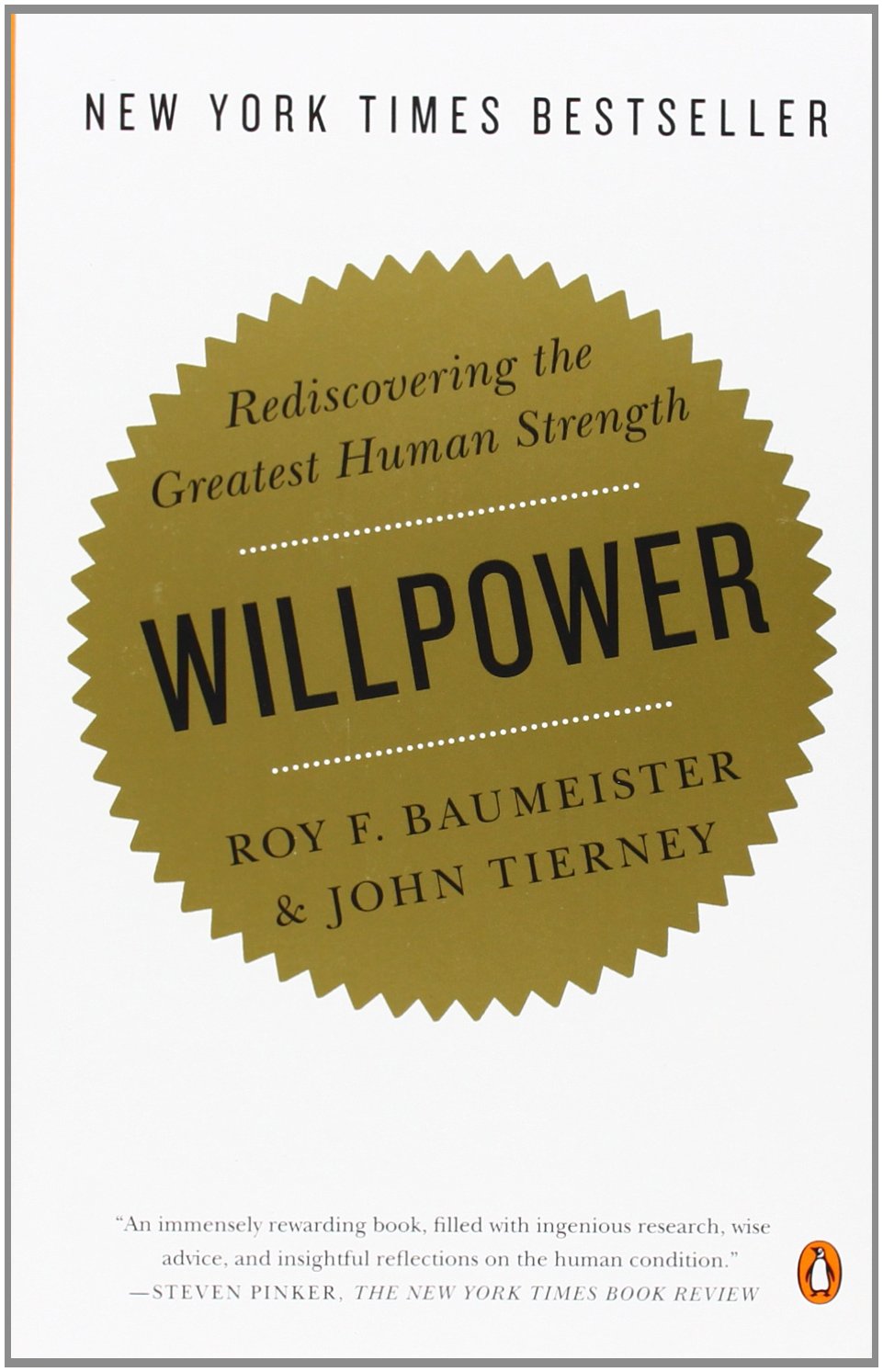
These two delve into the science of self-control: Why it is important, how much we have of it, how it is fueled. 
They posit a theory that humans are social for survival purposes, and in order to get along, one needs TONS of self-control. We can't all do whatever we want and expect to have pleasant familial/neighborly interactions.

They say, up front, that it is impossible to alter more than one behavior at a time, so don't go there (as our mussar seforim insist). This New Year should not begin with more than one item that requires fixing. Whether it is an unhealthy behavior like smoking or a toxic behavior like impatience/screaming, only one can apply at a time. 

The brain does not have separate categories for willpower; there is only one well to draw from, no matter the application. If one exhausts the supply by not killing a co-worker, for instance, h/she may come home that evening and fight with the spouse over a mildly annoying quirk. 

Additionally, one must we well-nourished and well-rested in order to have self-control since—get this—it feeds on glucose. Many who commit criminal acts have been found to be hypoglycemic (ergo the "Twinkie Defense"). That's why implementing self-control can often be exhausting; it sucks the life out of you by plowing through your physical energy supply. (Before you get excited, the best sources of glucose are from sensible proteins and vegetables, not Oreos.)

Deliciously, a lot of their scientific conclusions are echoed by our rabbanim, as heard in this shiur (cheat sheet: instead of telling oneself, "I will not eat that kakosh," say instead, "I'll have kakosh later." That fools the brain into a form of satiety, and, when the opportunity to kakosh arises, one won't necessarily even want it anymore. For reals). 

Cool, huh?

The book is jammed with more awesome revelations, like self-control leads to good self-esteem, not participation trophies.  

Wednesday, October 5, 2016

Books on Change, I

To get you in the fasting spirit, here's Rabbi Daniel Glatstein

Ah, New Years Resolutions. How they suck. 

Most of us would like to change for the better. But it's so darn hard. So I shall share books I have read recently that I found rather illuminating on the subject. I believe that if we know how our brains and bodies work, we can work with them. 

The Power of Habit: Why We Do What We Do in Life and Business by Charles Duhigg examines the science of habits, how they operate, and how they can be changed. 

He brings a number of examples from businesses to personal addictions (he was not very sympathetic to gamblers and the like), and how bad habits were overcome by altering one minor detail which resulted in a chain reaction. 

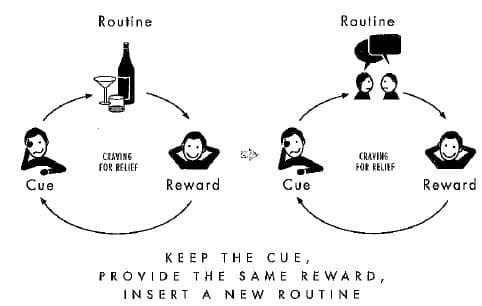
Habits work like so: 

1) Cue. 
2) Routine. 
3) Reward. 

To change a habit, one has to pinpoint what the cue is; then the mindless routine can be replaced. REPLACED. Not ignored, not overcome, but REPLACED. (Sur mei'ra v'asei tov. It's not enough to stop a behavior; one must be active in doing better as well.)
http://examinedexistence.com/wp-content/uploads/2015/03/habit-replacement.jpg
I was hoping he would provide a simple cause and effect when it came to, say, overeating (cough cough), but no such luck. I had to figure it out myself. And I did. 

Since most days of the week I arrive home at dinnertime, my routine is usually

1) Walk through door. 
2) Eat. 
3) Be nourished and satisfied. 

However, that cue is the same on Friday afternoons when I come home early, or following Sunday outings, or even applied to siblings' front doors. 

So I consciously attempted to replace the routine: Drink a glass of water. Most of the time I'm thirsty anyway, and I feel that same pleasant nourishment and satisfaction when I get hydrated. 

The whole book is quite fascinating, even though I provided the cheat sheet. 

http://topfamousquotes.com/images/author/201507/charles-duhigg-quotes-3.jpg

Monday, August 22, 2016

Sprout!

Beware, unsuspecting audience: I am now on a sprouting kick. 

Since I am rather impressionable, the internet doesn't have to say much to get me to think I have been eating my grains and beans wrong all these years. 

Supposedly sprouting reduces starches and makes the nutrients easier for the body to absorb. If you've got cheesecloth (a necessity for those who cook chicken soup), then you can sprout.

I sprouted mung beans, then cooked them. The taste was much sweeter and pleasant than when un-sprouted, and they were pretty good then too. 
http://panihatiarogyaniketan.org/wp-content/uploads/2015/05/img_5731.jpg
Via panihatiarogyaniketan.org
Not all grains or legumes sprout—like standard barley and millet (the latter I learned myself). But quinoa does, quite quickly, actually.

There is a basic system to sprouting. 

1) Initial soak. 
2) Rinse and drain two times daily. 
3) Sprouting times vary. 

Quinoa requires only 30 minutes to 2 hours of initial soaking, while dried beans and grains (like wheat berries) need an overnight drench. 

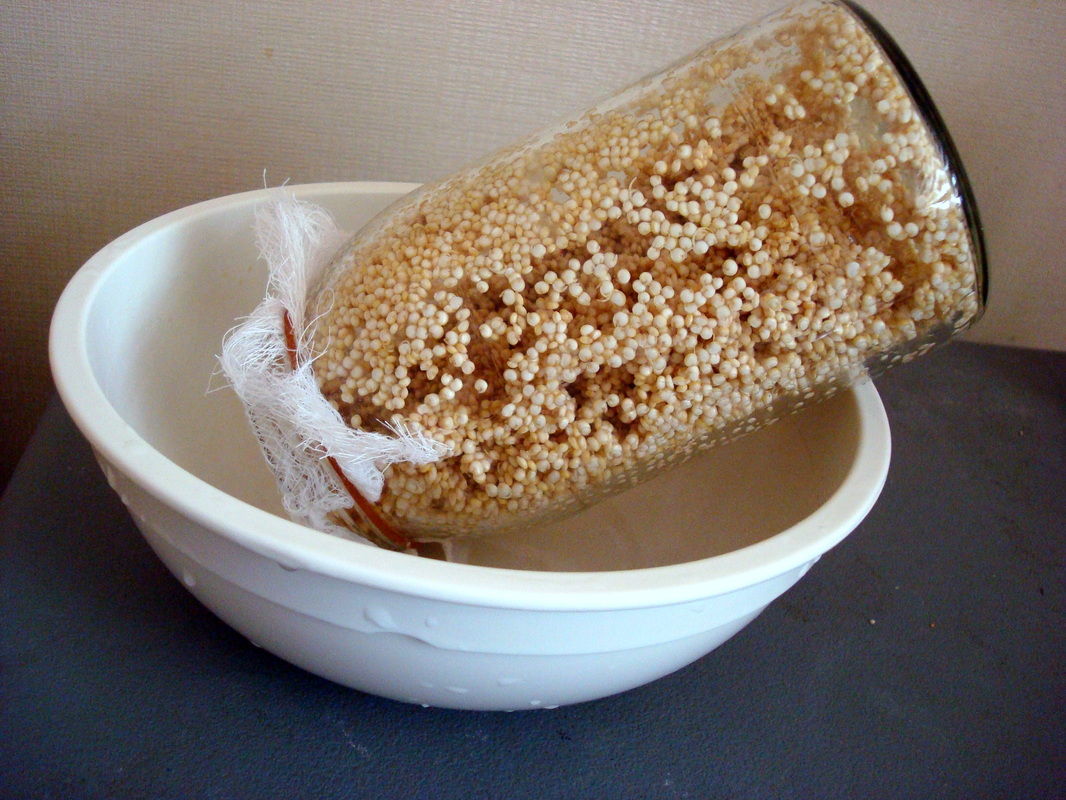
Any container will do. Place desired seeds, grains, or legumes into a jar or tupperware or glass. Cover with cheesecloth (there are sprouting lids available that I may purchase) and secure in place with rubber band (or if using a ball jar, can use the ring top). Pour water through the cheesecloth for the initial soak. 

The next morning (8 hours or so later) pour off the water, rinse again through the cheesecloth, then invert the jar so the liquid can drain off. Takes less than a minute.
http://kaletothequeen.weebly.com/uploads/1/2/6/8/12681747/8810462_orig.jpg
Via kaletothequeen
Come back 12 hours later or so and repeat. Rinse, drain, invert. 

I've also made alfalfa sprouts for Ma, despite my scar-worthy childhood memory of a beautiful, innocent, whole-wheat egg salad sandwich contaminated by those sprouts. To this day she insists that topping my sandwich with sprouts was the greatest expression of love. I had spent a half-hour picking out every single sprout. 

These are expressly for her. 
https://blogger.googleusercontent.com/img/b/R29vZ2xl/AVvXsEifVaGavXO8uBTKG_UZ9JcK-FuXfy0mIXZ6CZNniecdZ3fY53jH8PBAWXOLkd7ucWr13iG44A8o6JTSTQIDOgJssOyh4HbFwfe1rfr0hJHv3VxITsgaNnWWSinb7eNzYXTKC_cfegvGRrnS/s1600/DSCF6632.JPG
Via whataboutpie.blogspot.com

Tuesday, August 9, 2016

Shame We Believe In

"I can't do that," she said. 

I had been telling her about some of my healthy eating practices (she asked; I did not volunteer), but she was shaking her head in the negative. 

I already know from my own experience that when I have decided I "can't" do something, then I don't even bother to try. It's called "limiting beliefs," a term I heard from Esti Hamilton (she's got a series on the topic, check 'em all out). 

Many moons later I see this gal. "By the way," she grins happily, "I've been doing what you told me about." She looks great, if I may say so myself. 

According to scientists, addiction is not an illness like schizophrenia and cancer. There IS choice involved. I have just finished reading Charles Duhigg's fascinating The Power of Habit, and one chapter deals with addiction, specifically gambling. In "Can Shame Be Useful?", the authors address gambling addictions, but use the same term: habit. 

Whenever I read stories of addicts who turned their lives around, it was usually kick-started by a light bulb moment: I can't go one like this. I can be better. I'm letting my family down. I can't believe I did THAT to feed this addiction. 
 http://www.annemoss.com/wp-content/uploads/2016/04/Rock-1.jpg
It's rarely from a place of back-patting. 
So under what conditions does shame end up prodding people into correcting their course? Alternatively, when does intense self-criticism make matters worse by further fueling an addiction (for example, drinking even more to mute the pain of those shameful feelings)?
An important influence appears to be whether people buy into the notion that a habit is under or out of their control. . . 
They found that study participants who were vulnerable to experiencing shame were less inclined to engage in corrective actions when they believed their mistakes were not fixable, such as when they had no opportunity to apologize to someone they’d offended. In contrast, participants were more inclined to engage in positive behaviors when they thought their errors could be repaired.
The lesson is that shame can act as a spur to amend self-inflicted damage when people perceive that damage is fixable and manageable. In light of this finding, comparing addiction to a purely biological disorder, like cancer, might backfire, leading people to see their habits as unalterable.
I have said "I can't do that" plenty of times. Then years later, waddya know, I AM doing it. Not with effort and thought, but mindlessly and automatically. A good habit.  

Can I alter the Earth's axis? No. Can I insist that someone like me? No. Can I prevent the haze of humidity that is supposed to hit this week? No. 

Can I be more thoughtful? Act deliberately, not instinctively? Can I change my bad habits? 
 https://upload.wikimedia.org/wikipedia/commons/1/12/We_Can_Do_It!.jpg
With some elbow grease and "can"s, yup.     

Tuesday, July 19, 2016

Serendipiter

As we learn in school, a great number of inventions and innovative thought were mistakenly stumbled upon, if not results of actual error. Some were discovered when messing about with something completely unrelated; others weren't even really looking for anything in the first place. 

The definition of "serendipity" is "luck that takes the form of finding valuable or pleasant things that are not looked for." (That flies in the face of that romantic film that translated it as something more akin to fate.) Pagan Kennedy's "How to Cultivate the Art of Serendipity" explains that serendipity is not something that happens, but rather something that can be achieved.
In 1754, a belle-lettrist named Horace Walpole retreated to a desk in his gaudy castle in Twickenham, in southwest London, and penned a letter. Walpole had been entranced by a Persian fairy tale about three princes from the Isle of Serendip who possess superpowers of observation. In his letter, Walpole suggested that this old tale contained a crucial idea about human genius: “As their highnesses travelled, they were always making discoveries, by accident and sagacity, of things which they were not in quest of.” And he proposed a new word — “serendipity” — to describe this princely talent for detective work. At its birth, serendipity meant a skill rather than a random stroke of good fortune.
Dr. Erdelez agrees with that definition. She sees serendipity as something people do
I'm a firm believer in "Seek, and ye shall find." The saying doesn't go, "Seek, and ye shall find what ye was seeking." Ye shall find—something
 http://image.slidesharecdn.com/reboot90-travel-serendipity-5362/95/reboot90-travel-serendipity-24-728.jpg?cb=1180789243
Being open-minded is, of course, a necessary prerequisite. Sometimes I get stubborn, focusing on only one desirable outcome, and because of that I don't get very far. It's when I'm consciously amenable that I delightfully uncover a new outlook, new method, or a new thingamajig.
Some she called “non-encounterers”; they saw through a tight focus, a kind of chink hole, and they tended to stick to their to-do lists when searching for information rather than wandering off into the margins. Other people were “occasional encounterers,” who stumbled into moments of serendipity now and then. Most interesting were the “super-encounterers,” who reported that happy surprises popped up wherever they looked. . .
You become a super-encounterer, according to Dr. Erdelez, in part because you believe that you are one — it helps to assume that you possess special powers of perception, like an invisible set of antennas, that will lead you to clues.
Doctors and scientists often find the cure or come upon an epiphany while actively researching something completely unrelated. If one is going with the focus, "I am analyzing A for the strict reason of discovering a connection to B," one is cutting out the rest of the alphabet. There is so much out there to know. 

If I flatter myself, I am, at most, an "occasional encounter." What fun I could have if I was a "super-encounterer"!   

Tuesday, June 14, 2016

Do No Harm

I am fascinated by history. If one analyzes a situation with the long view, one can see patterns. 
https://s-media-cache-ak0.pinimg.com/originals/e8/c3/58/e8c3584604dd1d13f6cdb736aef7574f.jpg 
Like the pendulum swing. Society accepts one extreme, and then rebound to the other; eventually, it slows and settles into the center.


The past fifty years or so, science did away with nature. Butter was shunned for margarine. Dairy was fiercely de-fatted (I want my childhood years, sentenced to skim milk, back). Every minor complaint can be "fixed" with medication or surgery. 

Butter is back. Fatty dairy is back (I'm making up for lost time). As for being "fixed"? 

A few years ago I was seized by a violent sinus infection. I inched into an ENT's office, tears in eyes. He scribbled up, along with antibiotics, a prescription for Vicodin. 

"Um, that's okay," I demurred. "I watch House." 

He looked at me in scorn. "Why should you suffer if you don't have to?" 

I gingerly picked up the prescription. I did not use it. 

Doctors happy-pen method with opiods have led to addictions and overdoses, and now they are considerably cutting back; sufferers will have to suffer.

In general, the policy for vigilant medicine and treatment is easing off. The required annual checkup is off. Screenings and tests that were once necessary are now under the "Weeeell . . ." category. Even treatments for certain conditions or illnesses are found to be not as vital as once thought.

"Are Good Doctors Bad for Your Health?" by Ezekiel Emanuel highlights the current quo: 
One of the more surprising — and genuinely scary — research papers published recently appeared in JAMA Internal Medicine. It examined 10 years of data involving tens of thousands of hospital admissions. It found that patients with acute, life-threatening cardiac conditions did better when the senior cardiologists were out of town. And this was at the best hospitals in the United States, our academic teaching hospitals. As the article concludes, high-risk patients with heart failure and cardiac arrest, hospitalized in teaching hospitals, had lower 30-day mortality when cardiologists were away from the hospital attending national cardiology meetings. And the differences were not trivial — mortality decreased by about a third for some patients when those top doctors were away.
Truly shocking and counterintuitive: Not having the country’s famous senior heart doctors caring for you might increase your chance of surviving a cardiac arrest.
He cites an Israeli study: 
This is not the only recent finding that suggests that more care can produce worse health outcomes. A study from Israel of elderly patients with multiple health problems but still living in the community tried discontinuing medicines to see if patients got better. Not unusual for these types of elderly patients, on average, they were taking more than seven medications.
In a systematic, data-driven fashion, the researchers discontinued almost five drugs per patient for more than 90 percent of the patients. In only 2 percent of cases did the drugs have to be restarted. No patients had serious side effects and no patients died from stopping the drugs. Instead, almost all of the patients reported improvements in health, not to mention the saving of drug money.
And people wonder why I'm afraid of doctors
Despite often repeating the mantra “First, do no harm,” doctors have difficulty with doing less — even nothing. We find it hard to refrain from trying another drug, blood test, imaging study or surgery.
We forget the body's capacity for healing. It doesn't always always need help. But today, with so much within human control, we forget that we don't always have all the solutions. 
https://getrawenergy.co/wp-content/uploads/2014/10/Each-patient-carries-his-own-doctor-inside-him.png
People say there is a "shidduch crisis." Which means, it has to be fixed! But what if we can't? Has any sort of new initiatives actually changed the marriage rates? If anything, it seems as though divorce—"marriage mortality"—is on the rise. 

A new book (Hoping to Help) analyzes the effectiveness of volunteers nobly assisting in third-world countries. It's not always wonderful. 
Students may take advantage of the circumstances to attempt tasks well beyond their expertise. Seasoned professionals may cling to standards of practice that are irrelevant or impossible to sustain in poor countries. Unskilled volunteers who do not speak the language may monopolize local personnel with their interpreting needs without providing much of value in return.
So who did I think of? 

Shadchanim.

It really is unpleasant trying to politely fend off the misplaced fervor of a bullying matchmaker who barely knows you yet insists you "must" go out with someone. Yes, they say they are "trying to help," but how is this helpful? Congratulations: My bowels clench every time I receive an e-mail or phone call from someone chirpily claiming to be a "shadchan."
https://blogger.googleusercontent.com/img/b/R29vZ2xl/AVvXsEhg7feT8CyniOc4yUEj21uzdyDPnCZLPzJGklJ7TxqeRHHbW36VJpR5tZ0j-wUO3JZtzuw1hw9IH-0a7JzjxRkuMNP9TgyCjnhqvFNotd2ukt5r9gtrOgL8CPzK1sGCSWxK0OtGrrqgQtI/s1600/094-mulan-i.jpg
Do no harm. Like Chevi says.    

Thursday, June 2, 2016

iPeople

It's been a while since I had an anti-phone rant, right? Well, let's make up for lost time: 

We have—rubbing hands together in glee—Sherry Turkle's "Talk to Each Other, Not Your Phone"; Jonathan Franzen's review of her book, Reclaiming Conversation; Tony Schwartz's "Addicted to Distraction"; Amy Cuddy's "Your iPhone Is Ruining Your Posture—and Your Mood"; and a CBS News story, "What makes us happy and healthy?" (it has to do with giving our loved ones undivided attention).
 https://cdn-webimages.wimages.net/0513cc8b78e189764489179f91611c505b0859-wm.jpg
First Turkle, who has written extensively on the subject of how technology is destroying the quality of our relationships. This article is addressing the feedback she received regarding another article of hers that I already linked. One comment she received was that if an interaction is boring, why shouldn't one seek entertainment elsewhere? 
I have heard this objection before: In order for conversation to earn its right to be attended to, it needs to be compelling and novel. This way of thinking incorporates a view of conversation as a transactional tool: It has to accomplish something or provide new information. So, if these are your values and you find yourself in a conversation, there is pressure to be interesting and to perform. With that kind of pressure, it is not surprising that so many of us find it more relaxing to interact on screens. There, where we can edit and revise, we imagine that we are less likely to be dull and more likely to seem interesting.
Middleton offers his view of human conversation as a critique of my thesis; I see it as evidence of why we find ways around conversation. It holds conversation up to a standard that inhibits us from talking with spontaneity, from letting conversation develop naturally. Yet these are the kinds of conversations in which intimacy and empathy thrive.
In order for true connection to happen, there will be some emptiness, a lull, silence. Embrace it. Be freakin' bored, it won't kill you. 
According to this view, when you are engaged in talk, you are interested in hearing how another person approaches things — her opinions and associations. In this kind of conversation — I think of it as “whole person conversation” — if things go quiet for a while you look deeper, you don’t text another friend. You take the moment to read your friend more closely or look at something you haven’t attended to before. Perhaps you look into her face or pay attention to to her body language. Or you simply allow the silence.
On to Franzen on Turkle: 
The people she interviews have adopted new technologies in pursuit of greater control, only to feel controlled by them. The likably idealized selves that they’ve created with social media leave their real selves all the more isolated. They communicate incessantly but are afraid of face-to-face conversations; they worry, often nostalgically, that they’re missing out on something fundamental.
The potential detriment to children, in particularly, is the most alarming. Without conversation, they don't develop empathy, nor do they learn the means to deal with hardship, like bullying. Eek. 
 http://pop.h-cdn.co/assets/15/40/980x490/landscape-1443799206-gettyimages-142322603.jpg
Schwartz relates his struggle to detach from technology. When he was unable to focus on a book, he realized he had to cut back on email and web surfing. With his daughter's assistance, he went cold-turkey (except for texting).
During those first few days, I did suffer withdrawal pangs, most of all the hunger to call up Google and search for an answer to some question that arose. But with each passing day offline, I felt more relaxed, less anxious, more able to focus and less hungry for the next shot of instant but short-lived stimulation. What happened to my brain is exactly what I hoped would happen: It began to quiet down. 
That was for vacation. He's back to work, which means, of course, he has to deal with emails and internet. But now he's able to control how much time he devotes to it.

Cuddy was the one who taught us that standing tall makes you feel awesome; so slouching over an iPhone can make you pretty bummed. Also premature hunches cannot be that appealing (but that's just my note).
http://i0.wp.com/www.sopitas.com/wp-content/uploads/2015/12/phone_2799032b.jpg?resize=620%2C387
iHunch.
I'm not so much of the DOOM outlook. I believe when something new comes on the scene, those who grew up without it don't know how to deal with it responsibly, as opposed to those who were born with it in hand. Print books are back to the point that bookstores are reopening, and e-book sales are decreasing. The novelty of ignoring real people will wear off soon. I hope.         

Tuesday, January 5, 2016

I Don't Mean to Be Grim

From my miserable historical-fiction reading, I am exceedingly grateful to be living in this century. This is how stories used to go, by the way: 

Once upon a time, everybody died. 

And I mean everybody. No one was spared. From the moment babies drew breath, they were ticking time bombs. To quote Epictetus, "As you kiss your son good night, whisper to yourself, 'He may be dead in the morning.'" (Got that one from Resilience.) 

Meaning, the idea that infants are matter-of-factly thriving well into adulthood is a gift we should be merrily celebrating. 

Let it be known that I do not wish to be flippant regarding death. Yet we seem to have an unhealthy approach to the matter when those who have lived long, full, spectacular lives are still clung to frantically by their loved ones, their inevitable ends gruesomely extended. 
 http://img.medscape.com/thumbnail_library/dt_150803_chemotherapy_elderly_senior_800x600.jpg
I once heard from a woman the beautiful tale of her father's passing. He refused to go to the hospital or a home; she cared for him under her own roof. He died holding her hand, smiling. 

Deborah Lutz's article says it all: "See Death as a Triumph, Not a Failure." 

The Victorians looked at death differently than we do now. 
The Victorians recognized that death’s presence was woven into the texture of life, giving that life one of its essential meanings.Religion, of course, played a role in this attitude. Evangelical revivals early in the 19th century reinvigorated the tradition of the good death, in which God called believers to him. 
There is even a Talmudic example, perhaps, of "death's presence giving life meaning":
At the wedding feast of Mar the son of Ravina, the sages present turned to Rav Hamnuna Zuti and requested: "Let master sing for us." Most probably to the surprise of those present, who expected a cheery song or jovial ditty, Rav Hamnuna Zuti complied with a mournfully lament: "Woe to us that we are destined to die! Woe to us that we are destined to die!" 
As for "the good death," consider Beth's demise in Little Women. A triumph indeed. 
By the beginning of the 20th century, however, these views of the dead body began to change. Doctors and scientists acquired a deeper understanding of bacteria and disease; death became medicalized. God hadn’t called the individual to him; rather, a malady had overtaken the body. Rather than dying at home, the sick were carted off to hospitals.
In addition, fewer people believed in the afterlife. No longer a triumph, death became a failure — of the physician’s skill, of the patient’s will. It was to be avoided at all costs. The mass death of the Great War, which left so many bodies missing, exploded or rotting on the ground, further undermined the view of the corpse as a meaningful stage of life. Cremation grew in popularity as a way to “cleanse” with fire the last shameful disintegration.
What we have lost is not only a savoring of ephemerality, but also an appreciation of the way that time marks the body. We try too hard to keep the terminally ill alive because we can’t admit to finality. . .
. . . the philosopher Walter Benjamin’s lament in the 1930s about death still rings true. By avoiding the sight of the dying, he felt, one misses the moment when the meaning of a life is completed and illuminated in its ending. The denial of death then leads to the demise of the art of storytelling. He called his contemporaries “dry dwellers of eternity” because they “live in rooms that have never been touched by death.”
We are not immune, us now liberated Jews. We think now the same way—stay alive, no matter the cost. Even though Rebbe's maidservant was praised for ending his suffering.     

Wednesday, May 13, 2015

Hail the Gut

I don't like him. 

This effusive man in his 50s is all smiles and compliments; others are beaming at him in acceptance. He seems friendly, my head says approvingly. I twitch my lips into a polite grin, but my eyes do not match. 

Since his eyes don't match. They shift from side to side with a feral gleam, and I'm becoming nervous. My stomach burbles worriedly, nudging me to move along, like an impatient toddler. 

Don't be silly! my brain rebukes my belly. You are just giving in to your prejudices. But I don't want to be familiar with him, to be on first-name terms; I slowly recede backward into the crowd, intestines unclenching in relief while the gray matter sighs in exasperation. Melodramatic, it sniffs.

A few years later he is banned from the shul for inappropriate conduct. Told ya, the breadbasket triumphantly declares.   

One day I receive an e-mail containing the profile of a potential date. His education sounds intelligent, his photo unantagonizing, but reading between the lines as he describes himself my tummy begins to percolate. He's like that other pitiable guy you went out with, it warns. See, there is a vacancy in his gaze

Pshaw, my cerebrum scolds. You always smugly say so how "open" you are. How can you be "open" if you have nothing concrete to say "no" to? Because your midriff is complaining? It could be what you ate for lunch.

But my boch is nearly sobbing with tension. Don't! Don't say "yes"! Look into it! Please!
https://tithebarn.files.wordpress.com/2010/09/gutreaction.jpg
I look into it. "No, no, he's really not for you, he's a little . . ." my source hurriedly and swiftly dissuades me.

An acquaintance's engagement is merrily announced online, complete with photo of the couple. He looks nice, but there is an unpleasant gurgling in my middle. He isn't good enough for her, it churns. Something isn't right

My brain silences my bowels with a You're just jealous. I must be. Why else would I wish this angelic girl any ill will? 

But her marriage is undone within the year. And it's all on him.

As a Spock-fan, I've never really given that sensation in my innards much credit. "Go with your gut"? What sort of human hokum is that? Logic! Reason! Facts! There lies true enlightenment!

Yet how come my gut got it right? The Vulcan eyebrow droops.    

Yes, there have been times when my tum kept mum when it should have piped up. There were times, mostly in my childhood, when my gut overreacted needlessly. But in the wisdom that comes with age (snort), I'm taking my my belly's hysterics seriously.

One of the definitions of "gut": "used in reference to a feeling or reaction based on an instinctive emotional response rather than considered thought." 

But research has shown there are as many nerves in the gut as there is the brain; Brené Brown testifies that the gut reaction is based on actual rational conclusions; the burble and grumble is just its way of getting the message across.

I do consider myself a rationalist, but it's all about balance. Heart, soul, and faith needs brain to function.      

Thursday, April 30, 2015

The "Sensitive" Get Their Day

In my years of observation, it became quite clear that all children are not created alike. Some simply bounce, physically and emotionally, off of hardship; others possess such fine skin that the merest tap, physically and emotionally, leaves a bruise. 
http://a.dilcdn.com/bl/wp-content/uploads/sites/8/2012/03/2d291acbb9a9603db71f571038019f47.jpg
Via babble.com
Scientists have pinpointed that tendency to genes ("The Downside of Resilience" by Jay Belsky). The latter group of children, while naturally predisposed to getting crushed, can be saved through support and nurturing; all is well! However, the former group keeps on keepin' on with or without any outside help. No matter what care is provided, the end result will be the same. 

When my neighbor's son went off the derech, Ma asked the family guru how it happens. He replied that some children are very sensitive; in this case, perhaps he could not tolerate perceived hypocrisy in his upbringing.

Belsky's long-view hope, in light of this study, is to channel funds to target the most vulnerable and in need of help, while providing less expensive measures to the ones who will be fine in any case. 

In our world, such genetic sequencing anytime soon is not likely to happen. Perhaps, we can realize that there are those who can't simply "laugh it off." The more resilient can often be quite blasé about the sensitive's thin skin; they cannot be tougher, any more than the tough will suddenly become susceptible. 

There are children who crave structure and consistency, and suffer for lack of it; there are others who are mellow any which way. Being able to differentiate between the two types is the challenge, I suppose, of l'chanoch yeled k'darko.

Tuesday, January 27, 2015

Touchy-Feely

B'H, I live near to all my family. I have not had to deal with the pain of separation; I can see and touch my nieces and nephews on a regular basis. Uh, and their parents, too. Yeah, um, right, they're also important. 

If there were 10,000 miles between us, would Skype provide the same experience? Is it the same to kiss a screen, rather than to kiss the actual cheek? 
http://www.8bitdad.com/wp-content/uploads/2012/05/skype-hug.jpg
Via 8bitdad.com
Richard Kearney notices that technology has replaced the tactile sense ("Losing Our Touch"). But it's not so simple. 

In the ancient world, Aristotle favored touch as the most superior sense, while Platonists argued that sight won. The latter position is what has held sway, especially now with our reliance on screens. 
The move toward excarnation is apparent in what is becoming more and more a fleshless society. In medicine, “bedside manner” and hand on pulse has ceded to the anonymous technologies of imaging in diagnosis and treatment. In war, hand-to-hand combat has been replaced by “targeted killing” via remote-controlled drones. If contemporary warfare renders us invulnerable to those who cannot touch us, can we make peace without a hand to shake? (Think of Mandela-de Klerk or Begin-Sadat).
Moreover, certain cyber engineers now envisage implanting transmission codes in brains so that we will not have to move a finger — or come into contact with another human being — to get what we want. The touch screen replaces touch itself. The cosmos shrinks to a private monitor; each viewer a disembodied self unto itself.
Dovid HaMelech was spattered in the blood of his enemies, and yet, he was a soulful poet, whose works are invoked to appeal to the Heavens. Without touch, Kearney says, there is no empathy. We don't feel for others. The flesh is not just flesh. 
. . . soul becomes flesh, where it belongs.  
Babi has dementia. Conversation with her is no longer possible. Luke adamently told Ma to hold her hand, since touch will still get through. 

So Ma did. She sat next to Babi, rather than her usual spot opposite, which would be in her line of vision. She grasped her hand. She squeezed gently. 
http://christchurchreformed.com/cms/wp-content/uploads/2012/10/elderly-holding-hands1.png
To her surprise, Babi squeezed back.      

Tuesday, December 30, 2014

And Again

Rabbi Yisroel Reisman finds GPS to be a wonder. No matter how many wrong turns one makes, a voicea female one, yet!dispassionately states, "Recalculating." No impatience, no annoyance. Simply a bland "Recalculating." 
http://runninggrooveshark.com/wp-content/uploads/2013/08/recalculating-1.jpg
I thought of this as I read "To Siri, With Love," by Judith Newman. Newman's son is autistic. Siri is his dearest friend. She could not be more thankful. 
Gus had never noticed Siri before, but when he discovered there was someone who would not just find information on his various obsessions (trains, planes, buses, escalators and, of course, anything related to weather) but actually semi-discuss these subjects tirelessly, he was hooked. And I was grateful. Now, when my head was about to explode if I had to have another conversation about the chance of tornadoes in Kansas City, Mo., I could reply brightly: “Hey! Why don’t you ask Siri?”
Children can be persistent, autism aside. Adults can be annoying, too. Sometimes it takes every ounce of self-control to maintain a calm register as I'm repeating the same statement for the fifth time. "Recalculating," I remind myself. "Recalculating. I am a mellow GPS, cruising down a highway . . . " 

What I found amazing is that Siri is not only a fount of information for the tirelessly inquisitive, she expects proper behavior, and so reinforces politeness. 
She is also wonderful for someone who doesn’t pick up on social cues: Siri’s responses are not entirely predictable, but they are predictably kind — even when Gus is brusque. I heard him talking to Siri about music, and Siri offered some suggestions. “I don’t like that kind of music,” Gus snapped. Siri replied, “You’re certainly entitled to your opinion.” Siri’s politeness reminded Gus what he owed Siri. “Thank you for that music, though,” Gus said. Siri replied, “You don’t need to thank me.” “Oh, yes,” Gus added emphatically, “I do.” 
Since Gus doesn't speak clearly, and Siri's voice recognition is not the best, Gus is forced to enunciatean exercise which will certainly benefit him when he wants to communicate with humans.
“See, that’s the wonderful thing about technology being able to help with some of these behaviors,” [William Mark] added. “Getting results requires a lot of repetition. Humans are not patient. Machines are very, very patient.” 
I firmly believe that most things are neutral in nature; it's how people utilize and perceive those things that makes them either positive or negative. While technology tends to train social individuals to turn inward, for socially-impaired souls, it can provide the magic link to the outside world by teaching communication skills. 
http://cnet2.cbsistatic.com/hub/i/2008/12/30/5ae00ac8-f4d6-11e2-8c7c-d4ae52e62bcc/6dc266d3a8130a1dd232b2c6838b8486/Levi_iPhone-1.jpg
Yet, patience is a virtue, and through patience, as Mr. Marks said, there will be results. So I am trying to let the GPS and Siri teach me a lesson or two.     

Thursday, December 18, 2014

"Open My Eyes, to Behold Thy Wonders"

When we become absorbed with the the complexities and intricacies of this world, we often forget at the "wow" of it all. Then one day, maybe there is nothing better on, so I "make do" with a science show, then I gape and gasp and go "No waaaaaay! So cooooool!" for an hour. 

I heard this stupendous shiur on torahanytime.com by Esther Wein called "Iyov, Akeidah of the Mind," given on 11/20/14. I must say, if anyone is struggling with anything, this shiur certainly comforted me. She delves into Sefer Iyov, how Hashem responds to his main question: "Why?"

Hashem's response is to tell him, in detail, about the mastery of His creation, how Iyov cannot measure it or comprehend it all. It doesn't seem to be an answer to his pleas to understand his suffering, but it is. So to as Hashem created it all, so to He cares for it all. All is well. 

Knowest thou the ordinances of the heavens? Canst thou establish the dominion thereof in the earth?

http://images.fineartamerica.com/images-medium-large/heavens-breath-16-marsha-charlebois.jpg
"Heavens Breadth 16" by Marsha Charlebois
Canst thou send forth lightnings, that they may go, and say unto thee: 'Here we are'?

Who hath put wisdom in the inward parts? Or who hath given understanding to the mind?

Who can number the clouds by wisdom? Or who can pour out the bottles of heaven, When the dust runneth into a mass, and the clods cleave fast together?

Wilt thou hunt the prey for the lioness? Or satisfy the appetite of the young lions, When they couch in their dens, and abide in the covert to lie in wait?

If one sees the majestic in the everyday currents of life, that can provide the comforting balm of security and trust. 

Robin Rinaldi, in "The Mystery in the Machine," describes her grief as she pines for a child. She fantasized: 
My husband and I gaze at the black screen as the grainy image of a fetus emerges, its head nearly as large as its tiny sea horse body. And then, a thumping sound, echoing like a signal picked up from deep space. My husband looks from the screen to me, and I can see in his eyes that he finally understands what I have instinctively known for years — that all of our ambitions, world travels and spiritual practices never brought us this close to the mystery.  
But it was not to be. She did not have a child, that intellect-defying gift that forces us to realize our place in this vast and unknowable universe. However, her heart began misbehaving, and she went in for an echocardiogram. 
“That looks like a sonogram machine,” I said.
“It is,” she said, smiling. “An echocardiogram is just a sonogram of your heart.”
. . . Then she turned the sound on.
There were clicks, lots of clicks, as if she had pried open a grandfather clock, and also a surge of liquid flowing wildly between pauses. Like water rushing over a falls in gusts.
“Those are your valves,” she said. “They open and close several times with each heartbeat.”
“And that liquid sound is the blood?”
“Yes, blood filling and leaving each ventricle.”
She saw the tears gathering.
“I’m telling you,” she said, putting her free hand on my arm, “I’ve been photographing the human heart for 20 years. It’s made a believer out of me.
“It’s amazing,” I said. “I mean . . . what starts it? What keeps it beating?”
“That’s the million-dollar question,” she said. “But something had to create this.” She snapped another image as my valves clicked open and shut like miraculous little dams.
I think we can be myopic as to the "amazing" there is in our world. There is just so much of it, all over. We just have to make a point to see it.
 . . . I do know one thing: I didn’t need a baby to get me any closer to the mystery. We couldn’t escape the mystery if we tried.  

Friday, October 24, 2014

Guest Post: Luke is Taking All My Screen Time

Science is (yet) another of Luke/Eilu v'Eilu's interests. You have been warned.

(For those who require clarification, Stephen Hawking, theoretical physicist and cosmologist, has already claimed that based on his calculations, God does not exist. If I have it right, he states that the field of science was initially created to comprehend God, but now we know better and no longer require that "construct.") 

Mr. Hawking is perhaps the most intelligent individual to grace this universe. He and people like him seek to prove the unprovable. 

But, the ever-changing definitions of the physical realm have absolutely nothing to say regarding that which is purported to exist beyond our finite universe. Our minds and definitions of the phenomena that surrounds us are limited to the current rules that we believe govern our finite physical realm. 

We cannot prove the existence or lack thereof of a supreme being that is beyond physics and beyond time. In a hundred or perhaps a thousand years new ways of thinking will perhaps transcend the limits of our current understanding. 

How can we arrogantly say that we know everything there is to know when every generation new discoveries comes to light and trump our old ones? The discovery of the Hercules-Corona Borealis Great Wall or the Higgs boson clearly test the limits of our understanding. 
https://blogger.googleusercontent.com/img/b/R29vZ2xl/AVvXsEh8k9tK1XkdRiTZFffUaJOZOSjXGPHzn_LWTmebAdM7qNm-ItUH_aLGf7sOzi7MWG9q855OpS_WtgOE4p2iBrmOKJqxEOU4N0Bh_PBjdk_9cCAEBQ0OxZAJBX5FeF59f5oqBTd-SxMm1wo/s640/ScreenMemo-20131125-183010.png
The irony is that within our finite universe exists a infinite system of numbers that were developed as a direct result of the two groups of digits—that were developed over four billion years simply by chance?—that we use to grasp the physical, and yet our minds somehow think that we can define the things that we can’t grasp, that which exists just beyond those limits that we ourselves conceptualized.
http://www.feandft.com/wp-content/uploads/2013/07/Stephen-Hawking.jpg
Hey, he said it, not me.