Tuesday, July 15, 2014

Snake Eyes

I read this quote in an article about risk and chance ("Playing the Cards" by Brooks Haxton):
Einstein said that “the Old One,” his name for the ultimate cosmic power, “does not throw dice.” The logical crux of this statement for an agnostic like Einstein might have involved some gamesmanship. But Einstein’s refusal to accept a way of thinking that devalues the idea of consequence and choice has always struck me as admirable.
Judaism has an understanding with seeming chance, mostly in terms of "throwing lots"; even our ultimate villain, Haman, knew about this bond, and attempted to manipulate the concept for his own ends, even unintentionally naming the resultant holiday, Purim. 

On Yom Kippur, two literal scapegoats were brought before the Kohen; a lot was thrown, decreeing which would have a noble end as a sacrifice to Hashem, while the other would be unceremoniously shoved off a cliff.
 http://thesestonewalls.com/wp-content/uploads/2010/06/Aaron-Scapegoat.png
I found this article on the OU website tying together the two seemingly disparate holidays. 

Lots, or dice, are the essence of caprice: no rhyme, no reason. One day, flying high, then slip on a banana peel and down he goes. The subjected one, inexplicably, is tossed into security and grandeur. No matter how one claims control, we are all subject to the seemingly chaotic whimsy of the universe. "Mensch tracht und Gott lacht."  
 
It is in lots that many cultures see the divine, the order that is emitted from turmoil. It is when we throw the dice that we abdicate from our ability to choose, placing the outcome in the hands of a higher power. It is not that we ignore God when we employ the anarchy of lots; we remove our biases by abiding by a decision from the truly unprejudiced. We throw together a dizzying array of variables, give a shake, and toss out a simple solution. Is that not where we see the Eibishter most clearly?

We can choose to see only chance. Or we can choose to see only "the Old One."  

Monday, July 14, 2014

Dressing for Men: Yarmulkas!

The yarmulka design selected (or kapuls, as they are referred to in my house) is usually an individual decision based on religious identity, separate from the fashionable realm. 

But I still believe that, overall, there should be some protocol in place (you can take the girl out of Hungary . . . )

The standard kapul has a dome-design, to hug the back of the head.  (Take, for instance, the term for Israeli anti-rocket security, the Iron Dome: Kippat Barzel.)

However, I notice that a number of men scooch the kapul forward from its designated, rounded spot to the flat part of the head, then attempt to clip it down, somewhat unsuccessfully. This is sometimes done in a weak attempt to shield a receding hairline. 

The kapul was not made to be flattened. It doesn't like it. It rebels. It bunches, it fights the clips, it becomes . . . unflattering. 

For the gentleman who is trying to shield his bare scalp, I have some sad news: Clipping the kapul there merely attracts attention and identifies the wearer as insecure. The major bummer about hair loss, and I sympathize: Resistance is futile. 

Alternative: Opt for close-cropped haircuts, which renders thinning hair less obvious, and still wear the kapul where it should be worn, at the dome of the head. Otherwise, develop a hat fetish.  

While the dome design is necessary for kapul wearing, sometimes it goes too far. 

There is a kapul catching on now whose physique is rather disturbing . . . it is stiff and peaked, not mimicking the soft curve of the head but stands to attention a trifle disconcertedly.
 https://blogger.googleusercontent.com/img/b/R29vZ2xl/AVvXsEg0w7dgwQjw9bY4G6XAB9lWl3O4ALM-7wYxbW9D2oR8HcNIVWR67hSSPVXooUBmoiLtl55TYLd5liF_Fgromc6dNXZ-Ww8teXsYcFMoGGd0HH7qIHwmNWLSpU-J7OHwG0enRkMfFwK7UTRL/s1600/kippah.jpg
Wearing such a kapul turns one into . . . a Conehead. 

http://upload.wikimedia.org/wikipedia/en/9/93/Coneheads_Poster.jpg
This can probably be blamed on the design. 
 
The more segments there are in a fabric yarmulka, the wider the base, the lower the height, the snugger the fit. Even five-part yarmulkas are sometimes insufficient for those with large heads; they need the six-part. 
http://www.tiferes.com/image/cache/data/four_rim-650x650.jpg
Only 4 segment here. Nope.
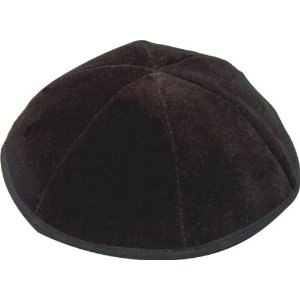
http://www.kippahz.com/_images/products/ws3/wedding_kippah/black_velvet_kippah.jpg
1, 2, 3, 4, 5, 6! We have a winner!
(Because the suede yarmulkas are flatter by design, four segments are sufficient.)
http://ecx.images-amazon.com/images/I/41yNAKMMQlL._SY300_.jpg 
Knit yarmulkas, also known as kippah srugas (kippot sruga? kippot serugot? Dikduk is not my best subject), do not have this concern, being segment free.  
http://upload.wikimedia.org/wikipedia/commons/1/19/IDF_soldier_put_on_tefillin.jpg
Best. Picture. EVER.
I was invited to a wedding where the couple had recently become religious, meaning most of the guests were a blend of gentile and Jew; I have a feeling the former outnumbered the latter. The venue's complimentary yarmulkas were not the usual white satin "conehead" variation, but the sufficiently segmented black velvet. 

I have to say I was having a really hard time trying to differentiate tribe member from polite observer. All the men looked so natural in the black velvet kapul, even the one with distinct Nordic roots. The secular grandfather was the only one who looked awkward, his white peaked yarmulka fresh from a pocket, doomed to perpetual creasing.

I'm partial to the black velvet. It's subtle, doesn't need clips to stay on (unless the wearer is 3), and it takes a lot more than the slightest puff of wind to knock it off. The knit versions are usually the safest in terms of chic fit, but can often require clips. However, with the black knit, since it tends not to draw attention to itself, a larger size that will hold to the head without assistance is a viable option. 

To summarize: A yarmulka should curve companionably to the dome of the head, but not add extra height. It should seem as though it is not trying too hard; it should be worn effortlessly.
http://jewbellish.com/wp-content/uploads/2013/12/obama1.jpg
Nice fit.

Friday, July 11, 2014

Happiness Without Reference

School years were tough. Not academically; I'm what my mother calls a "professional student." What was hard for me, in retrospect, is that one is thrown into a classroom of girls, and chances are that a large chunk of them is not one's type, and the ones that could potentially be one's type are usually all too aware of the "ranking system." 

When 12th grade ended and I was finally released into the wild, I reveled in my freedom. The morahs weren't the worst, really; whatever inaccuracies they attempted to impart were casually undone by my parents every night. Rather, no matter how I tried or didn't try, I never really found my niche amongst this haphazard selection of classmates I had no say in. 

As it turns out, not being reliant on others for happiness is the way to go. Instead of being slavishly devoted to whatever goodwill others' may or may not choose to grant me, I have found personal contentment and self-esteem. 

If someone my age attempts to insult me, I no longer know how to take it. I haven't had to humor or cajole social acceptance for years. I respond sharply, casually cutting the conversation short, because I have no desire to share the company of she that can belittle me. If someone older than me attempts to insult me, I respond as politely as I can, casually cutting the conversation short, etc.

There is one segment from Laura Munson's book that stuck with me. 
My twelve-year-old daughter comes in crying because one of her best friends won't talk to her. It's been going on for weeks, she says, and she can't stand it anymore. It's eating her alive. She needs advice.
And I tell her all of this. The theory, that is. The stuff about suffering . . . 
And she gets it. She's suffering because she has chosen to base her personal happiness on things outside of her control . . .
What if someone told you that when you were twelve years old? What if you'd spent your whole life understanding that we have a choice?
One of my favorite scenes in Pride & Prejudice is when Lady Catherine, fearful that Darcy plans to marry Elizabeth rather than her own daughter, bears down on Longbourn to browbeat her into submission. 
At one point, Lizzie states: 
". . . I am only resolved to act in that manner, which will, in my own opinion, constitute my happiness, without reference to you, or to any person so wholly unconnected with me."
How often do we let those who are "wholly unconnected" to us dictate our peace of mind? Why do we care? Why do we let the seemingly gleaming lives of others tarnish our own?

I choose not to be on the lower end of a friendship. I choose to spend my money the way I want to spend it, not how others do. I choose to dress the way it suits me, as opposed to any unflattering trends. 

For too long I projected unhappiness onto an external cause. But why should I abdicate a personal right to others?  

Thursday, July 10, 2014

You've Got Too Be Carefully Taught

Q: You were on the Mets when they were known for having a hard-drinking clique of players called the Scum Bunch. You’re a very religious man. Did that keep you out of trouble? 

MW: No question about it. When you’re younger and you get a little freedom, you always want to test the water. But there’s something in the back of your mind that corrals you, and that could be nothing but your faith and what God has instilled in you. It starts with your parents — your parents can only teach you. They can’t force you to learn it.

The above is from an interview with Mookie Wilson, a former Mets outfielder (fear not, my brothers raised me right; I am a Yankees fan). Mr. Wilson is currently training to be a minister. 

The Sh'ma states: "And you shall teach them diligently to your children, and you shall speak of them when you sit at home, and when you walk along the way, and when you lie down and when you rise up." 

Hashem knows our limitations as parents. We cannot force our children to follow in His ways, in our own ways. We can only do as much as we can, which is to tell them, to teach them, to talk about our beliefs casually and constantly. 
http://www.vosizneias.com/wp-content/uploads/2011/05/shema.jpg
Via vosizneias.com
Like Mr. Wilson says, "Your parents can only teach you. They can't force you to learn it."

When I'm babysitting, I usually get roped into reading a few too many Berenstain Bears books, so by the time I finally execute the final tuck-in I'm ready to make a run for it. 

"We have to say Sh'ma," the little one insists. 

I figure the main phrase is sufficient, but the 4-year-old informs me, "We also say 'V'ahavta.'" 

They don't know yet what they are diligently saying. But they were taught, and they learned, and in time, they will learn more, please God.

As Frederick Douglass said, "It is easier to build strong children than to repair broken men."   

Wednesday, July 9, 2014

Across a Crowded Room

"You see," the shadchan said eagerly, scooching forward in her seat, "I think the mistake was that the singles' event was too large. That's why no dates happened afterward. Do you think we would have more success if we made it smaller, like ten or fifteen each of boys and girls?" 

I wasn't here (at the shadchan's request) to give free advice about mingling. If she didn't think she had anyone in mind, I would have preferred if she said so. She's supposed to be a shadchan, not an event planner. 

"Look, you have to understand," I began. "If you organized a smaller event, would it be fun? Probably. Would any shidduchim happen as a result of it? I don't think so." 

She blinked in surprise. 
<
"None of us are wide-eyed youngsters anymore. We've all been rejected before, we've all been hurt before, and very few of us are willing to put ourselves out there just to be shot down. What happens? You'll ask the guy, 'So, any girls you like?' and he'll say, 'Let them tell you first.' You ask the girl, 'So, any boys you like?' and she'll say, 'Let them tell you first.'

"The only thing that really works is approaching each side with a suggestion and pushing them to go on a date. There's less . . . bruising the ego that way. We have our pride, we want to keep some dignity. Redting a shidduch preserves that more. We aren't offering ourselves up so obviously, repeatedly, only to be hurt." 

She was distinctly not happy with me when she rose to hustle me out the door. I understand, redting a shidduch is not easy. 

That's why shadchanus is on the table; to thank the shadchan for the effort. (There should be effort).   

Tuesday, July 8, 2014

Heigh Ho, Heigh Ho

Ma always says that it is the greatest bracha when a man (in this case, Ta) enjoys his work. My childhood was never marred by any sort of complaints regarding job frustration; following supper, Ta would peacefully consume the newspaper, no aggravation in sight. 

Since youngsters tend to accept their reality unquestionably, it was only when I was older that I heard of dissatisfaction in the workplace. As I date now, I make a point to be aware if the bachelor in question is grumbling about his day, or refers to the state of his employment with contentment.
https://blogger.googleusercontent.com/img/b/R29vZ2xl/AVvXsEiUEJsyoOxTsD63y4zFobNbD-6Fy34Z7cJNf19AwpD0rah7YqA33SBuEkN-eUZzuDTQIxnqpciwOWUNJRH77y6-Lv35Cjpb8EPA2My3oxg5sAapK_OHcfjGz-4_lriC3hJBKD57iTWRipY/s640/HeighHo2_shadowwall.jpg
The charity world is bursting with volunteers, Aaron Hurst reports in "Being 'Good' Isn't the Only Way to Go," because many people feel no "meaning" at work. But, "meaning" isn't guaranteed in the non-profit world. "Meaning" comes from engagement. 
Their findings reinforced previous research that had demonstrated that the ways individuals viewed work might be more tied to their personality traits than to the work itself. They infuse their work with purpose learned from past experiences. How they view work may largely be driven by the role models they had growing up. Some see it as merely a chore in their lives, while others view it as the core of life.
Many articles I have been reading lately, regarding secular topics as well as Jewish philosophy, are encouraging effort no longer for a future goal, but for its own sake. 

The family motto: "Keves baboker, echod." (The pasuk really goes, "Es ha'keves ha'echad ta'aseh baboker.") The service in the Bais HaMikdash was repetitive, the same litany. When did the repetition in our lives, our daily service to others, began to lack meaning? 

Vacuuming the rug can have meaning, if we make a point to see it.  

Monday, July 7, 2014

The Set of Her Shoulders

I was having a discussion with my aunt about the importance of dignity, how one carries oneself and so advertises oneself to the world. 

"Did you ever hear this story?" she asked me. 

She is but a few years Ma's junior. When she first entered Bais Yaakov, my mother was a couple of grades higher. In those days, Bais Yaakov (in Williamsburg) didn't have a uniform. 

Since it was my aunt's first day, Ma went to visit her little sister to see how she was. As soon as she entered the classroom, the roomful of girls shot to their feet, at attention. They had thought Ma (now quite bewildered) was the morah. 

I've been coming across articles of "older" women opining the current state of "youth-worship," that by turning 50 suddenly all of femalekind is rendered invisible. I can certainly attest that Ma is rarely ignored or mistreated, and if she is, that error is corrected most swiftly. I have learned from her how frosty silence paired with stately carriage will bring most transgressors to their knees. 
http://whatcherylsaid.files.wordpress.com/2014/03/dignity-1.jpg
What is her secret? In essence, it begins with self-respect and respect of others (only when that consideration is swatted aside does the cold disdain come into play). 

The first component is physical appearance. Age-appropriate, quality garments tucked, zipped, buttoned properly and a light dusting, perhaps, of makeup. But that is still not sufficient. 

It is one's bearing. As P.G. Wodehouse puts it in Not George Washington
She is not what I would describe as exactly a type of English beauty. You know the sort of beauty I mean? Queenly, statuesque, a daughter of the gods, divinely fair. Her charm is not in her features. It is in her expression.
Comportment is the true guarantor of respect, divorced from DNA given looks. I have met so many individuals who are stunning to behold, but their behavior is so childish and immature that they vanquish any shred of others' esteem.

Even those who have been bequeathed difficult features, such as, say, a rather large nose, can magically transform that awkward appendage into a majestic accessory, based on demeanor and posture alone. 

I have been consciously regulating my stance for some years; straitening my back, decorously tucking in my elbows, walking with a serene and smooth gait, tilting my chin with military precision. At a charity dinner where I was the only frum individual at the table, a frei Yid shot me a glance of approval. "You have poise," he marveled. 

Well, cookie, it doesn't just happen.   

Friday, July 4, 2014

Battle of the Bulge: The Apple Test

I mentioned this story before, but it is really applicable here. 

When I was a kid, and probably bored, I went whining to Ma that I was hungry. 

"Have an apple," she said. 

"Ma," I said as patiently as I could, "I don't want an apple. Maybe those cookies . . . ?" 

"Have an apple," she repeated. 

I stomped out out of the kitchen in a huff, snack forgotten. 

It seems Ma was really, really ahead of her time. 

Dr. Oz (yes, I know his name is "Mud" at the moment, but let's not throw out the baby with the bathwater) advocates that if one feels hungry, the first reaction should be, "Would an apple take care of my hunger?" If not, then that is not hunger, it is merely an unsubstantiated craving. 
The Apple Test for All Hunger Types
http://www.recapo.com/wp-content/uploads/2012/12/apple_hunger_test_.jpg
Whether you’re a Sensory, Emotional or Habitual Hunger Type, much of the difficulty here is the question of whether or not you are really hungry. Lots of people struggle with this – and I’ve got the perfect trick to get to the bottom of it.

Pick fruits and vegetables you like – apple, carrots, tomatoes, cherries – whatever floats your boat. The next time you are thinking you are hungry – ask yourself, “Will an apple handle my hunger right now?” If you are really hungry – even if an apple isn’t exactly what you want – it will seem as good an option as any and you will welcome it. 

If however, you are eating for some other reason, then you will turn your nose up at that apple or carrot and say, “I am hungry for a burger…” In such cases, you are probably not really hungry but eating for some other reason. The apple test is a quick and dirty way for folks who struggle with these different hunger types to respond to hunger instead of something else.
One the keys to food discipline is being able to differentiate between a craving and hunger. Sure, there are times when something less than nutritious catches my eye (like a bobka oozing chocolate at a shul kiddush) but I don't kid myself that it looks attractive because I am "hungry." It's chocolate bobka, not rocket science.

"My, that melon over there should do instead . . ."     

Thursday, July 3, 2014

Mitleid

I've been trying to quantify the difference between sympathy and empathy. People like it when others feel the latter, but not the former. 

When I got the news that the boys were dead, I felt like I was kicked in the gut. I crawled home, shivering in the summer heat, huddled inward, my face haggard. I blinked blankly at anyone who was able to smile, only able to summon a cheerful "thank you" to the pharmicist by sheer will alone.

My thoughts were, simply, thus: OhGodOhGodOhGodOhGod . . .

These families are now sitting shiva, and possibly hundreds, if not thousands, will be coming to be menachem aveilim.

Menachem aveil, today, tends to defeat the original purpose. For the visitor, since it can be supremely awkward, they often succumb to that primitive fight-or-flight response, blurting out the most inappropriate of comments. Also, bare acquaintances somehow feel obligated to come, placing even more pressure on the mourner to be a gracious host, rather than being free to grieve. 
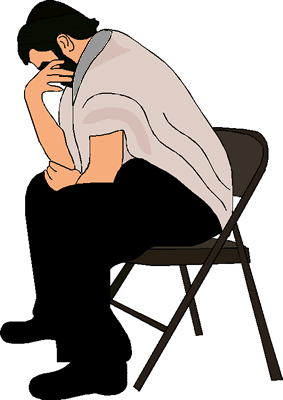
http://www.jewishmag.com/150mag/shiva_ettiquete/title.gif
Via jewishmag.com

David Brooks' "The Art of Presence," and Rabbi Eliyahu Finks' "Fixing Shiva" are two articles that really are must-reads prior to entering a house of grief. 

First a Brooks' highlight (read both pieces in their entireties, please): 
I’d say that what these experiences call for is a sort of passive activism. We have a tendency, especially in an achievement-oriented culture, to want to solve problems and repair brokenness — to propose, plan, fix, interpret, explain and solve. But what seems to be needed here is the art of presence — to perform tasks without trying to control or alter the elemental situation. Allow nature to take its course. Grant the sufferers the dignity of their own process. Let them define meaning. Sit simply through moments of pain and uncomfortable darkness. Be practical, mundane, simple and direct.
The whole point of the shiva week is to provide a structured, safe time for mourners to lament. Ergo, it is not the time of platitudes: "They are in a better place," and the like. The mourners are sad. Let them be sad. Don't demand that they must make peace with the situation right now just because the visitor feels uncomfortable.

Only the mourners can say platitudes like that. The visitors can't. 

The Rabbi Fink highlight, for me, is the story of Rabbi Yosef Tendler on a shiva call. The point of the story is that Rabbi Tendler remained silent the whole time. He hugged his student, he listened to the mourners, and he quietly departed.

Rabbi Fink echoes Brooks identically, in that our society has "Bob the Builder" Syndrome: "Can we fix it?" "Yes we can!" 
http://birthandbabynetwork.files.wordpress.com/2011/07/bob_the_builder1.jpg
Death can't be fixed! At best, death can be, eventually, calmly accepted. Our job, when sitting down with mourners, is to help them to do that; not to succumb to our own fears, but rather to open our hearts and plumb the depths for shared experiences. Raw, visceral emotion can be scary. But don't be afraid, for the aveil's sake.

Lehavdil, there was an episode of Will & Grace ("Bed, Bath, and Beyond") where Grace, expecting a marriage proposal, is actually dumped instead. She takes to her bed, where Will tries every which way to get her out and into the sunshine. She refuses his efforts, crawling back into her room. He enlists Karen and Jack, who feel that same desperate need to make Grace move on. 

After they attempt to physically manhandle her out from the apartment to rejoin humanity, she fights back: 

I'm not like any of you. I just handle things differently, so, please, just let me go back to bed and deal with things the only way that I know how.

She climbs back into bed, at which point they all trail in, acknowledging that since they never truly mourned the disappointments in their lives, the way Grace is, they had never truly moved on. Mourning has a purpose, and a time, as Shlomo HaMelech said.

The next morning, Grace awakens, smiling, and rejoins humanity, on her own speed. 

Don't make going menachem aveil about you. Go only if you think the mourner will appreciate your presence. Don't talk until they do, and only respond, if necessary, with the most carefully selected of words. Feel their pain, no matter how frightening it may be. 

I want to remember, the next time I am menachem aveil, that feeling of being kicked in the gut and that same litany of OhGodOhGodOhGodOhGod . . .        

Wednesday, July 2, 2014

Forces For Change

About A Boy, "About A Girl"

Young Marcus, a sweet but nerdy boy raised by his free-thinking mother Fiona, has a crush on a classmate, Hannah. But having spent his childhood in a number of different locales, including Kenya, he is clueless about the various hierarchies in school, as well as the fact that he is an outcast.

Hannah is having a birthday party which Marcus has not been invited to, until Fiona (without his knowledge) begs Hannah's mother to include him. Once Fiona's friend Dakota (another mother in the school) and the man-child next door, Will, learn of this, they bolt to Hannah's house to extract Marcus, knowing the kiss of death that is the "pity invite."
https://blogger.googleusercontent.com/img/b/R29vZ2xl/AVvXsEgZiB5kjWAiBFNYM-GZqrb9PGN09r0zcBO3Q0wknV4GqsKuQUTnkqlOQU5lgsCLDV8iWfgiOqR1oM9BSmjaPIM0lBk5X1k2B5rbiQYd4T7Y4SW0vSADZQ60aq-DQASyE6S1JjoAEDMFglg/s1600/About+A+Boy+-+Episode+1.04+-+About+a+Girl+-+Promotional+Photos+(5)_595_slogo.jpg
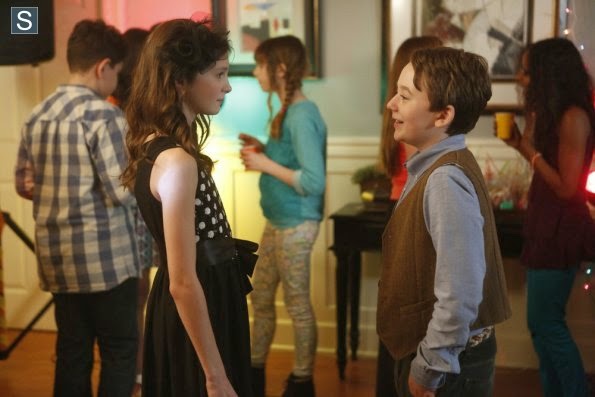
Marcus intends to dance with Hannah, boasting his skill in ballroom, while Fiona and Dakota corner Hannah in the bathroom.

Fiona: Hannah, darling, you are a very popular girl, and as such, you wield a lot of power, probably more than you know. Our lives comes down to a series of choices. Now, you can either choose to take the high road and be the heroine, or you can choose to take the low road and be part of an ugly society divided by lines of popularity, which is dreadful. Do you understand?

Hannah: I just want to get back to my party.
https://blogger.googleusercontent.com/img/b/R29vZ2xl/AVvXsEgWEl4pMPXUApr3ANE3ugsT0wXgj20B7oaUNaFD9O5eiw_nS0V9HQbUgnrdRiH8LDT2wbNBtrbjwiGbMehS_1Zu7ocgLaVpDJip0UEKNDzKIrW5z5u1pcVk11TE9cWhSeDE-HKfTsy2rFs/s1600/About+A+Boy+-+Episode+1.04+-+About+a+Girl+-+Promotional+Photos+(8)_595_slogo.jpg
Dakota: Okay, listen up, princess. When I was your age, I was you. And did I always make the best choices? Meh, rarely. The truth is, I destroyed a lot of people—

Fiona: What Dakota is trying to say, is that you can choose right now to do a mean thing, or do a good thing. And choosing to dance with Marcus would be choosing to do such a wonderful thing for someone, and you have the power to make a difference.

Hannah: I'm gonna scream.

Dakota: You're bluffing.

Hannah: (smirks, raises an eyebrow) AAAAAAAAAAAAAH!

Will had been desperately trying to get Marcus to leave voluntarily, but Marcus is adamant about dancing with his beloved. Fiona reaches the room when Marcus is walking up to Hannah, and she buries her face in Dakota's shoulder.

Fiona: Oh God, tell me when it's over.

Marcus politely asks Hannah if she would like to dance, Hannah's friends sneering and laughing around her. Hanna's face initially contorts, but she looks up and sees Fiona and Dakota. She thinks a moment.

Hannah: Okay, here's the deal. One dance, and that's it.

Marcus: (with a chivalrous flourish) I would be honored to dance with you.

Marcus then wows the crowd with his expert waltzing and twirling of his partner. Even Hannah's "mean girl" posse watches with an admiring eye.
https://blogger.googleusercontent.com/img/b/R29vZ2xl/AVvXsEjIpgefwm2oOo4va0HqZ-pt4fhimFhGxdV7K74TPDEoi5OTEHqVmLNSO8yWgazJIEGOeUcFl2APkL9ZqeCkEHv75bTwobHratkY4DHHCwu8CDC77wdSQegZteZ2Lz0GMSVCzjlqpKo9GsTg/s1600/About+a+Boy+1x04+%E2%80%93+About+a+Girl+-+Marcus+Hannah.jpg
I must say I got a little teary. In one minute, the perspective of an entire group of cruel children was changed based on the choice of one girl.

How much power do each of us have, that we can use, to change so much?