Wednesday, December 16, 2015

I Believe in You

When we had first met, all those years ago, I thought she was amazing; brilliant, bright, bursting with sassy self-respect. I was smitten. 

As we first embraced, and then came to be disillusioned with, the dating scene, I noticed a difference. While I am thankful for my family support system who do not believe that I am doing anything "wrong," her family was telling her to get therapy. I was hurt and horrified for her, yet she matter-of-factly questioned herself. I knew that it was simply she had not met the right man for her; she didn't. 

The last time we met the girl I had always admired was a shadow of her vivacious self. Doubt had robbed her of the intellect I had adored. Her eyes darted in worry.

Rabbi Yisroel Reisman said in his Navi shiur entitled "The World's Worst Shadchan," (it's a great shiur, it really pays to pay to hear it) he said our community has a tendency to "blame the victim," meaning "older" singles. It isn't right, he said, that we cause those who are suffering to suffer even more. 

Do you know how many times I have had to deflect a mean comment, simply because I am single? Apparently everybody else who has a difficulty can't help that, but singles can.

The last time we met she was low, the lowest I had ever seen her at. It is not right, it is not right that those who just need a little amount of bucking up, not much, just a little, are left to feel as though they are lonely freaks, when they have so much to offer. 

Quite some time later, I was giddy to hear she was engaged. Not only that, he's great. He looks like the guy I had always known she would end up with; someone who is worthy of her, and she of him.     

Tuesday, December 15, 2015

Another Luddite Rant

The kinfauna are growing up, becoming hulking, terrifying teenagers, all with—oh dear—phones in their undisciplined hands. 
 http://www.iab-community.be/wp-content/uploads/2013/06/2013-03-people-smartphones-f.gif
To be clear, my annoyance is not with cells themselves, but how people act around them. I know I have done stupid things because I was looking at a text, like almost walking into traffic. Idiot idiot idiot, you are not allowed a smartphone. 

Take that sort of mindlessness and hand them a car. Whoop de doo. 

Because of the novelty of phones, too many people allow them to take over their lives. So the next generation, the children who were born in to this current techie existence, need ground rules, which Bruce Feiler provides in "How to Manage Media in Families" and "Hey, Kids, Look at Me When We're Talking." 

After he lists all the ways parents can monitor their children's phone and media, he writes: 
One surprising thing I heard about these agreements: They should include restrictions on the parents, who are the most egregious technology abusers of all. Ms. Schofield Clark’s daughter insisted on the clause, “When I have something to say, Mommy has to close the laptop and listen.”
Her son added a rule. Beginning when her children were young, Ms. Schofield Clark took their photo with Santa every Christmas. She forced them to do it when they were teenagers, then posted the photo on Facebook. Within seconds, her otherwise hibernating 14-year-old son came bolting from his bedroom. Their agreement now includes the plank, “If Mom wants to post a photo with a kid in it, she needs to ask.”
Parents can't be annoyed if their kids ignore them when using technology if they do the same thing. It's called being a role model.

In his second article, Feiler discusses the worry that children today are lagging in deciphering face-to-face interactions. I, for one, am relieved that Shabbos enforces a day of no phones and yes shul to demand social dexterity. 
http://www.orazion.org/wp-content/uploads/2015/10/shabat-minyan-2.jpg
Sharon Turkle's "Stop Googling. Let's Talk" has more terrifying data to prove her point. Because of the imminent possibility of "more interesting" distractions, conversations aren't invested in. Deep, fully present, vulnerable talk is where empathy happens. 

On the flip side, with phones we are never alone. But empathy also needs alone time. 
The capacity for empathic conversation goes hand in hand with the capacity for solitude.
In solitude we find ourselves; we prepare ourselves to come to conversation with something to say that is authentic, ours. If we can’t gather ourselves, we can’t recognize other people for who they are. If we are not content to be alone, we turn others into the people we need them to be. If we don’t know how to be alone, we’ll only know how to be lonely.
It takes a tremendous amount of effort to see oneself, almost as though it is a separate entity. That cannot be done without removing distractions and plunging into the abyss.
http://www.ufunk.net/wp-content/uploads/2012/10/cell-lock-up-smartphone-prison-1.jpg
This actually exists!
Turkle is also aware that phones aren't going anywhere, but we should be more proactive in limiting their influence. Packing it away, going out without it . . . believe me, it is quite freeing. 
Friendships become things to manage; you have a lot of them, and you come to them with tools. So here is a first step: To reclaim conversation for yourself, your friendships and society, push back against viewing the world as one giant app. It works the other way, too: Conversation is the antidote to the algorithmic way of looking at life because it teaches you about fluidity, contingency and personality.
Human connection isn't here to entertain us; it is here to bind us, even in times of boring silence.     

Monday, December 14, 2015

Battle of the Bulge: The Charming Dinner Guest

When it comes to temptation, there are few areas that still wield power. Through force of will, I've managed to crush a number of bad habits. 

While food shopping, only the produce section calls my name, which means, in turn, that the house is only stocked with the waist-friendly and the heart-healthy. Even if there is a squirreled away gift box of chocolates, I don't even desire to look for it. I wait for what really makes me dance (Shavuous cheesecake).

 http://wisebread.killeracesmedia.netdna-cdn.com/files/fruganomics/imagecache/605x340/blog-images/kid_with_produce.jpg
Eating out never was a family pastime, and if I am ever tempted I reckon that the price of the meal could have been put towards new shoes, which I would own and enjoy for years as opposed to the 30-minute bliss (and 30-day workoff) of anything off the menu.

Of the last lingering dragons to slay, there remains this: The Shabbos meal invite. 

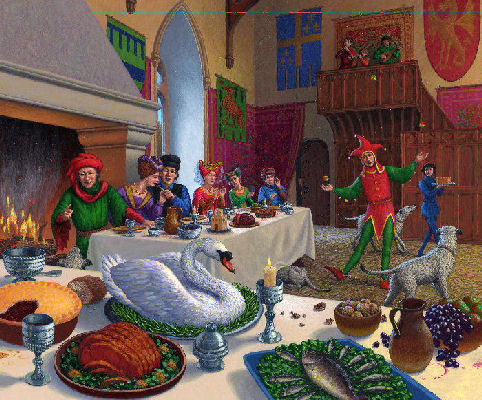
Platters and bowls of the often salt-infused tasty and trans-fattening is placed before me, and here's the thing: Once I am in eating mode, I can keep on going, refilling my plate repeatedly and constantly munching. 
 http://www.annesharpillustration.com/People/Feasting.jpg
Meaning, I return home moaning, groaning, and self-loathing. 

Many a time, before such outings, I would give myself a stern talking-to. Don't overeat. Savor the food. Don't feel compelled to eat anything out of politeness. All for naught. 

I stumbled across this quote by Antoine de Saint-Exupery: 

A goal without a plan is just a wish.

I didn't get to this point in the Bulge Battle by wishful thinking; I had a system of attack. I to plot a clear guideline. 

I winnowed it down to two main tactics: 

1. Chew SLOWLY and THOROUGHLY. Chewing slowly means that 

  (a) I have to daintily put down my flatware between bites;

  (b) My stomach has the necessary minutes to register food; and

  (c) I can stretch my portion all the way to the next course, leaving little time for further sins. 

2. No seconds. NO SECONDS. No matter what. Even if it's salad. Even if it's vegetables. Make up the plate and THAT IS IT.

Marching along to my hosts, I chanted to myself: Chew slowly, no seconds. Chew slowly, no seconds. Chew slowly, no seconds. 

I chewed slowly. I took no seconds. I sailed home triumphant, having relished my appetizer, main, and dessert, while my boch was only slightly stretched. I felt civilized again just a few hours later. 
http://memecrunch.com/meme/YXLO/huzzah/image.png?w=413&c=1 

Thursday, December 10, 2015

My Bad

"I'm sorry, Luke, I made a mistake." 

"Lea? Did . . . you . . . just . . . apologize?" 

I blinked. "Uh, yeeeeeaaaaah? Wow, so I did." 

My family upbringing doesn't have an overt approach to apologies. We usually won't say, out loud, the word "sorry." It's more subtle. The sheepish grin. The begging eyes. The sudden, unwarranted charming disposition. And that works for us. We know the agony that is asking for forgiveness, and we would prefer to allow the other to save face, knowing he/she will try to avoid that boo-boo in the future.
Laura Zigman's "I Can't Apologize (Sorry!)" explains the phenomenon of "a nonapologist's apology."
“Here’s how I apologize,” Amy Dickinson, who writes the “Ask Amy” syndicated column, told me. “After a conflict, I just let things simmer down. Then I give a nudge. A little poke. Basically I telegraph to the other person that I’m fine now. I’m no longer in that bad place. It’s time to move on. If, after my charm offensive, the other person still has a problem with me, I’ll say, ‘I’m sorry you’re upset.’ ”
Sure, childhood shame can be blamed as the root of the inability to apologize, but really, how long can adults cling to that excuse? The other option is being a narcissist. 
Guy Winch, a psychologist and author of “Emotional First Aid: Healing Rejection, Guilt, Failure, and Other Everyday Hurts,” explained lack of remorse to me this way: “Apologies involve an admission of wrongdoing, and people with fragile self-esteem — like narcissists whose self-esteem is high but also brittle — can be highly resistant to apologizing as they feel it is threatening to their egos.” (I’m sorry, am I the narcissist in this equation?)
Apologizing isn’t fun. But neither was kale, until some brilliant publicist/food gentrifier got a hold of it.
All about the spin, eh?

I always liked to think my aversion to apologies was because I'm very hard on myself in general, and adding fuel to the flames would push me over the edge. I'm still hard on myself, but maybe I'm getting a little better at acknowledging that I'm human, albeit in progress. I haven't reached the pinnacle yet.

So, I apologized! Once, out loud and everything.       

Wednesday, December 9, 2015

Tradition!

That song was so off. Tevye lumps together mitzvos with minhagim into one category, whereas only the latter applies. I suppose "Commandments!" is less catchy.

To our benefit or detriment, Fiddler on the Roof is for the rest of the world an image of orthodox Jewish life. 
I know a non-Jewish woman who expects all aspects of Judaism to perfectly mimic Fiddler, to the point that a man's Shabbos bekechel should be patched and worn. She calls shadchanim or any female over 50 (because they must also be matchmakers) "Yentas." Such as, "She will be your Yenta."

R2 adores "If I Were a Rich Man" strictly because of the mooing cow at the end.  "Moo the cow!"
As a kid I was terrified of the Dream scene, and even now, after seeing it, I can't bear the dark. The kinfauna handle it better than me, actually. 
I once saw a clip of Zero Mostel as Tevye, and he was terrible. Not heimish at all. His "bida bida bida bum"s were more like "hipa hipa hipa pum"s.

I saw Alfred Molina on Broadway, and he was  nearly as good as Topol (nearly as good, but Alfred Molina can play anything). Time magazine had a review, and I always remember this bit:
But when his third daughter chooses a husband outside her religion, he can debate no more. "There is no other hand!" he cries. From Mostel's mouth, it was a howl to the heavens; Molina spits it out abruptly, angrily. He's not suffering for all Jews; he's one man drawing an ethical line in the sand.
Topol's Tevye had a similar reaction. He roars "No! No! No!" and angrily stomps away, closing his ears to his daughter's weeping. I always found it interesting how Tevye, an unlearned man, was able to accommodate his other daughter's unorthodox (not unobservant, but non-PC) marriages, knowing of no halachic reason to say no, whereas here he is firm. 

Here is my favorite, "Sabbath Prayer." My family doesn't bensch the children every Friday night, but many families do. It never fails to make me sniffle.

Tuesday, December 8, 2015

Potatoes + Brooks = Bliss

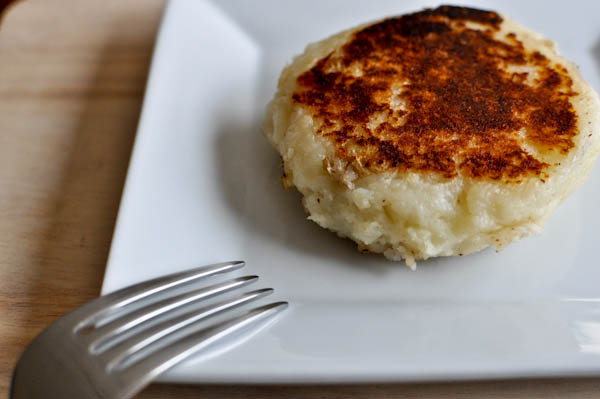
We can't have a Jewish holiday without a recipe, right? This past week in Dining, Joan Nathan shared her recipe for Mashed Potato Latkes with Dill and Shallots.

A little backstory: Mashed potato latkes, a.k.a. Chremslach, were always a Pesach specialty in my house, dipped in sugar (not anymore, cough cough). I was never really crazy about latkes, especially with the tedious amount of prep; for chremslach, the potatoes are painlessly boiled, rather than grated, squeezed, and prayed over that they don't turn brown. 
http://www.howsweeteats.com/wp-content/uploads/2010/11/potato-4.jpg
Via howsweetitis.com
Latkes always seem to fry unevenly, burned on one side and and raw on the other. 

But why must I be a slave to tradition? I can have chremslach whenever, right? Nathan's potatoes are baked, which means there is no excess water to be drained, and the batter is prepared calmly in advance. I'm also a sucker for dill and shallots.

However, Nathan breads her latkes. That's really not necessary. Potatoes can stand on their own two feet.  

Now, I am hopelessly behind on my David Brooks' links. Savor them slowly. 

Monday, December 7, 2015

Deanna the Condescending Twerp

Star Trek: The Next Generation, "The Loss" 

Deanna Troi is half-Betazoid, a telepathic species; that manifests in her as empathic ability, knowing what others are feeling (as opposed to specific thoughts). She utilizes this "super-power" as Counselor, the ship's psychologist; because she knows what others are feeling, it always gives her a one-up in any situation. 

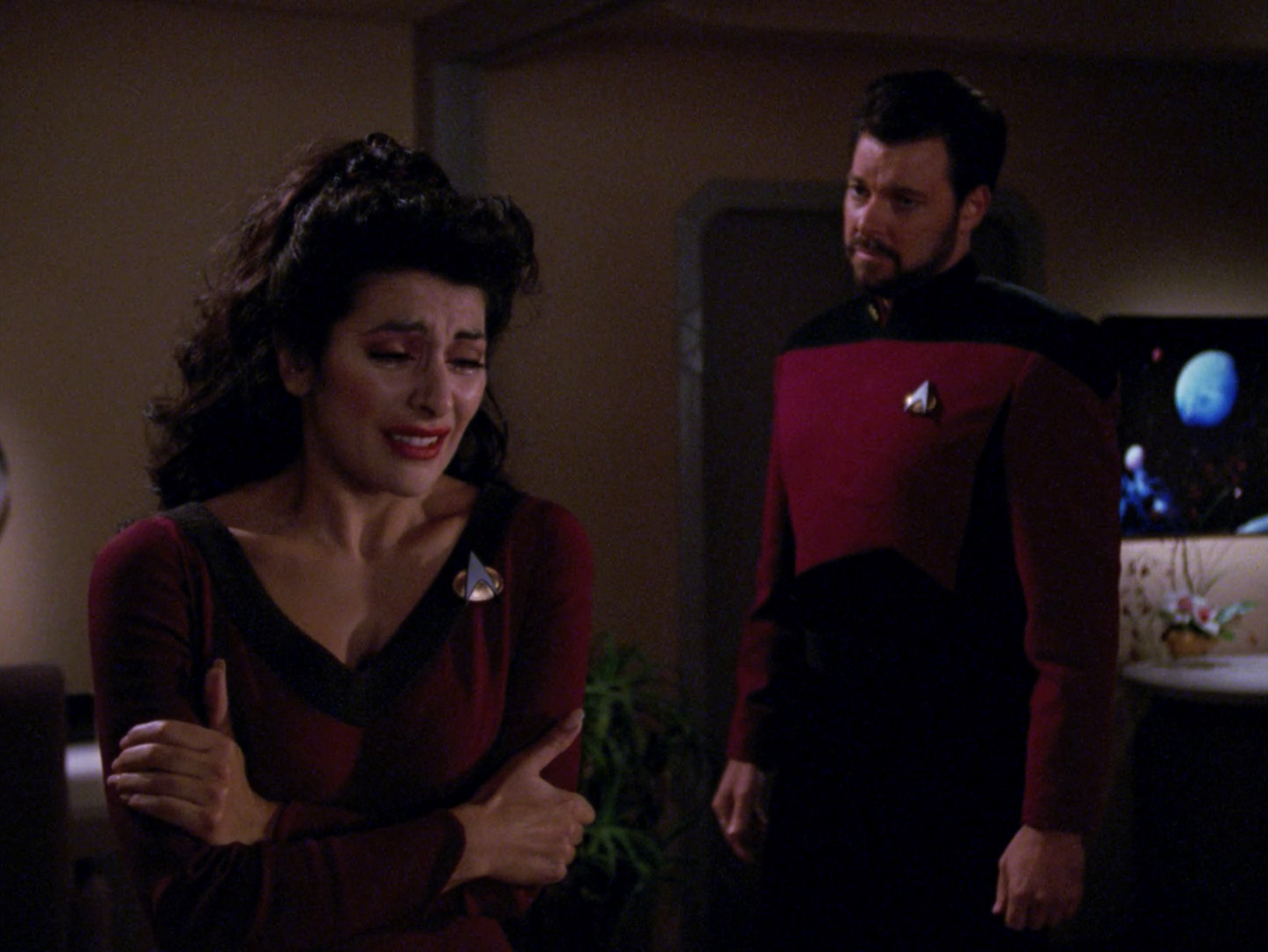
In this episode, some odd space patterns generated by a two-dimensional species robs Deanna of her empathic abilities. The constantly smooth, calm, wise Counselor goes absolutely to pot. She screams, she rages, she sobs at the loss. 
http://www.startrek-hd.de/wp-content/uploads/2015/05/das-kosmische-band-hd5.jpg
Commander Riker, her on-again-off-again boyfriend who is usually a reliable source of manly understanding, is oddly unmoved.

Troi: I look around me and all I see are surfaces without depth. Colorless and hollow. Nothing seems real. 

Riker: I'm real.

Troi: No, you're not! You're a projection. With no more substance than a character on the Holodeck.

Riker: I don't believe that. 

Troi: You have no idea how frightening it is for me to just be here without sensing you, without sharing your feelings . . . 

Riker: That's it, isn't it? We're on equal footing now.

Troi: What do you mean?


Riker: You've always had an advantage, a little bit of control over every situation. It must have been a very safe position to be in. To be honest, I always thought there was something a little too aristocratic about your Betazoid heritage. It's as if the human aside wasn't quite good enough for you.

Troi: That isn't true.

Riker: Isn't it?

I was taken by this episode. The considerate Deanna Troi, unmasked as a condescending know-it-all who believes herself surrounded by sub-species! Physician, heal thyself. 

Deanna Troi, the counselor for those who have experienced loss, can't help herself. If anything, her true, petty self emerges. 

It is very easy, from a distance, to say what yenem should do. And perhaps, when we are unhinged by sorrow, we require the assistance of someone emotionally unattached. 

But wouldn't we want someone to truly understand? For that's what we seek: empathy, not sympathy.

Wednesday, December 2, 2015

XOXO

I was flipping through a People magazine in my dentist's waiting room when his previous appointment emerged, a frazzled African-American mother with three kids. One boy, around 8, was obviously a special needs child. Out of the hubbub of his clamoring siblings, he headed straight at me. He gazed frankly into my eyes and bluntly asked, "Can I give you a hug?" 

In today's "Stranger-Danger!" society, and being an aunt myself of young children, I was hesitant. "Ask your mother first if it's okay," I answered. 

"Mom, can I give her a hug?" 

Mom, dealing with the other two, distractedly answered that a high-five was fine, which he took to be assent for his original request. He opened his arms. 

It was one of the best hugs I've ever had. His head tucked trustingly into my shoulder, his body a cuddly mass. I gave his back a couple of pats. He pulled away in the perfect time frame (one Mississippi, two Mississippi), and earnestly waved goodbye.
http://nerdist.com/wp-content/uploads/2015/01/012115_NationalHuggingDay_Baymax.jpg
I sailed forward into the dentist chair, fearing no Novocaine. 

Ma, like me, struggles with small talk. She and I are great at deep discussions, but meeting someone at shul or at a wedding and idly covering "so, what's doing" territory is awkward. Then, decades ago, she observed on a Brooklyn street her redemption: Physical contact. 

For us Jews, it's gender-specific, but it really works. "Hi!" Move in for a smooch (even though with women, it is more of a cheek-graze air-kiss). Fondly stroke an arm. Place a hand on a shoulder. All conversational crimes are absolved.

I've been making a conscious effort to be more lovey-dovey with the kinfauna—hair stroking, spontaneous kisses, stuffing-squeezings. I'm still surprised how they sigh happily and burrow against me, no matter their age. 
http://parentingmagazineonline.com/wp-content/uploads/2015/04/mom_hugging_child.jpg
The men on my father's side of the family are big smoochers. His male cousins kiss, hug, pinch cheeks. With those opening salvos, any tension just melts away. 

Give it a whirl. It does wonders.