Wednesday, February 3, 2016

"A Dudele"


When I first heard this (when aired on PBS), I did not realize the origins of "A Dudele." Apparently, it was composed by Rabbi Levi Yitzchok of Berditchev (1740–1809). He would sing it, it is said, before Havdolah.

Master of the Universe! !רבונו של עולם
Master of the universe, ,רבונו של עולם
I’ll sing a song for You. .כ׳וועל דיר א דודעלע זינגען
You, You, You, You … דו דו דו דו
Where will I find You? ?איה אמצאך 
Where will I not find You? ?ואיה לא אמצאך
Where can I find You? ?וווּ קאן איך דיר יא געפינען
Where can I not find You? ?אוּן וווּ קאן איך דיר נישט געפינען
You, You, You, You … דו דו דו דו
Wherever I go: You! !אז וווּ איך גיי – דו
And wherever I stay: You! !אוּן וווּ איך שטיי – דו
Just You, only You, ,רק דו, נאר דו 
again You, but You! !ווידער דו, אבער דו
You, You, You, You …  דו דו דו דו 
When something’s good: You! !איז עמיצן גוט – דו
When, G-d forbid, it’s bad: ay, You! !חלילה שלעכט – איי, דו
Oy, You, You, You, You, You, You, You … אוי, דו, דו, דו, דו, דו, דו, ,דו 
East — You; ,מזרח – דו
West —
You; ,מערב – דו
South —
You; ,דרום – דו
North —
You; !צפון – דו
You, You, You, You… דו, דו, דו, דו
In heaven:
You. .שמים – דו
On earth:
You. .ארץ – דו
Above:
You. .מעלה – דו
Below:
You. .מטה – דו
You, You, You, You… דו, דו, דו, דו
Wherever I turn, ,וווּ איך קער מיך
Wherever I go:  –וווּ איך ווענד מיך 
You, You… דו, דו 

Tuesday, February 2, 2016

Shoe Shopping

I'm a conflict-avoider. She isn't. 

"Sometimes you have to have conversations," she insists. "That way you can see the issue from another person's point of view, put yourself in their shoes." 

"But why do you have to have a conversation in order to do that?" I respond. "Can't you just put yourself in their shoes?" 
 http://izquotes.com/quotes-pictures/quote-before-you-criticize-someone-you-should-walk-a-mile-in-their-shoes-that-way-when-you-criticize-jack-handey-296418.jpg

Maile Meloy's "Whose Side Are You On" explains that he can write for children because he was a child once. Many are surprised at his vocation, since he is not a parent. But what should being a parent have to do with it?
But most of my friends who write for kids don’t have them, and neither did some of the best children’s book writers ever. Theo­dor Geisel — Dr. Seuss — didn’t even like kids. “You have ’em, I’ll amuse ’em,” he’s supposed to have said. Maurice Sendak had none. Neither did Tove Jansson, Tomie dePaola, Ezra Jack Keats or Margaret Wise Brown. The great children’s books editor Ursula Nordstrom said, “I am a former child, and I haven’t forgotten a thing.” It’s not a requirement to have children in order to write for them. You just need to have been one, and to remember what it’s like.
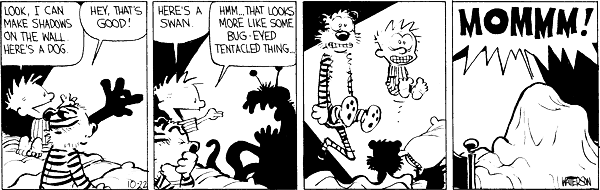
I was a tween when the first nephew arrived in my life. As I had entered adulthood kicking and screaming, I clung as much as I could to my fuzzy childhood memories. It granted me an edge, an understanding in some ways the adults could not relate to. How could they have completely forgotten about the monsters under the bed?
http://calvinethobbes.free.fr/images/monstersunderthebed.gif

Ma allowed me to train her in the fine art of toy buying. She has gotten so good that I don't need to go with her anymore. I know which stuffed animal in my room goes with which child when they sleep over. Giraffe for A, "Bouncy Bear" for B, "Kallah Bear" for C, all of the above, and then some, for D. Appropriate blankie distribution is a whole other matter entirely.

But I am also the tough disciplinarian, because I know it is this narrow window that they must learn how to behave. Too soon, cookie, no one will find your tantrums cute. The world will not accommodate them.

Children's needs are simple. Don't make them complicated. Good food and good sleep is 80% of the work. They really don't act up all that much if they have enough rest. Like me. 

More recently, I am trying to see things also from other adults' perspectives, especially in cases when I feel slighted or belittled. It's often not personal, rather an "offsetting of pain," to quote Brené. That allows me to move on, and not wrinkle.     

Monday, February 1, 2016

Consequence

Rabbi Jeremy Kagan: 

It says in Parshas Noach: 
 וַתִּשָּׁחֵת הָאָרֶץ, לִפְנֵי ה

and

וַיַּרְא אֱלֹהִים אֶת-הָאָרֶץ, וְהִנֵּה נִשְׁחָתָה:  כִּי-הִשְׁחִית כָּל-בָּשָׂר אֶת-דַּרְכּוֹ, עַל-הָאָרֶץ

Then:

וְהִנְנִי מַשְׁחִיתָם, אֶת-הָאָרֶץ

"The world was destroyed before Hashem"; "Hashem saw the earth, and it was destroyed, for all flesh destroyed His ways on earth." Then Hashem says, "And behold, I shall destroy them with the earth." 

Rabbi Kagan continued, "Any good seminary girl will say,"—at which point he squeaked in a feminine falsetto—"'The world was destroyed spiritually!' But it is more than that."

The sins of that generation were theft, immoral relationships, and idol worship. What all these three sins have in common (he didn't have time to explain how idol worship works into it, but it does tie up) is "What is mine is mine, and what is yours is mine." Which means the world was without boundaries. 

Hashem then said, "You want to live a life without boundaries? So to the world will be without boundaries!" And water was released from its bonds, flooding the earth. 

http://www.surfertoday.com/images/stories/tsunamiwave2.jpg

I heard a similar concept from Rabbi Daniel Glatstein. The Churban wasn't a punishment, it was a consequence (in general, there is no schar v'onesh in this world, by the way). We were goofing off on the avodah. We weren't respecting it. Hashem says, "Look, if you don't want to serve Me, don't do Me any favors! You think I need your service? Don't bother!" And so destroyed the Bais HaMikdosh.  
 https://upload.wikimedia.org/wikipedia/commons/b/b7/Francesco_Hayez_017.jpg

I think we forget to what extent we shape our reality. We can create those consequences that we find so bewildering. Like I previously posted: 

. . . one Shabbos in shul, my brain activity went into hyperdrive. 

It is a repetitive message of Rabbi Yisroel Reisman that "Bishvi li nivra haolam": "For my sake, this world was created." Meaning, even if one has been shoved into a seemingly "unfair" position, one has to analyze her own behavior. 

For instance, it is a constant aggravation of mine that shul attendees tow along underage children who are incapable of maintaining the necessary silence to permit others meaningful prayer. Usually I would be mentally cursing out the parents as they halfheartedly shush the high-pitched squeaks and squeals of their young. 

But then, that fateful day, I recalled Rabbi Reisman's point. If I did not choose to discipline myself sufficiently to devote true kavana to my davening, why would Hashem provide me with ideal praying surroundings? I have idly daydreamed through many a shacharis; am I deserving of a shriek-free environment?

Do we self-sabotage by not giving our all in the first place?   

Friday, January 29, 2016

The Nucleus of the Universe

Rabbi Binny Freedman:

A person may lose faith with G-d because he prayed for something personal, and “it just didn’t happen — G-d wasn’t listening.” When was the last time you heard someone say, “I have been praying for world peace, and it just isn’t happening so I don’t believe in G-d”? If the center of your universe is yourself, there is little room for G-d.

Thursday, January 28, 2016

Too Old for This


I like old things
Things that go slow
Antiques and such
So you know what I know
I'm an old soul
That's the way I like to go
I'm thankful for the bumps, yeah
I like to feel the road


These lyrics occurred to me as I read Dominique Browning's "I'm Too Old for This." Browning is in her 60s (I think) and she exquisitely describes all the things she is letting go of, all that she chooses to embrace (I couldn't bear to cut and paste this piece. Read it whole.) 

In my quest for self-discovery, I had realized some time ago I am an "old soul." And there are moments when I think, "I'm too old for this." Too old to be insecure in a crowded room by myself. Too old to care what someone else thinks of me. Too old to think that under the ageless sun, there is such a thing as "new." 

Why must I wait until my 60s to think I'm too old for this?

Confidence, you know you want it all
Believe in yourself
Even after the fall
I wish I knew that one
A long long time

Confidence, you know you want it all
Believe in yourself
Even after the fall
I wish I knew that one
A long long time tell you all how 
 

Wednesday, January 27, 2016

Favorite Books: "The Elegance of the Hedgehog"

In all honesty, I usually avoid New York Times' Bestsellers. I found The Da Vinci Code to be rather laughable, never mind the tackiness of Fifty Shades of Gray (I read the former, not bothering with the latter). 

I had heard the name The Elegance of the Hedgehog, but I did not read it until it was heavily recommended by my sister-in-law. I had found the name a tad off-putting, thinking it was about some sort of blithering philosophy, over-bloated with its own importance. However, nearly as soon as I began, I was scrabbling about for spare bookmarks as Muriel Barbery's prose knocked my socks off. 
http://www.azquotes.com/picture-quotes/quote-madame-michel-has-the-elegance-of-the-hedgehog-on-the-outside-she-is-covered-in-quills-muriel-barbery-39-19-49.jpg
The book, while very, very deep, is not lacking in humor. I suppose that is a talent of the French (or is it anyone non-American?): to transmit thinking concepts while not taking themselves seriously. 

The protagonists are relative loners, content in their own company with their own thoughts. I like characters like that; capable of maintaining fascinating conversation with their ownselves without being narcissistic. 
http://ecx.images-amazon.com/images/I/51Sxk-xPxYL._SX320_BO1,204,203,200_.jpg
By the time I was done, my copy was stuffed chock-full of paper scraps, marking a multitude of fabulous insights.   

My sister-in-law's next bestselling must read: All the Light We Cannot See.   

Thursday, January 21, 2016

It Pays to be Nice

One of the fun concepts of Sho-Gun is that the Japanese are inordinately polite. A daimyo could be telling his samurai that he should commit seppuku, but they will be awfully civil about it. No screaming. No name-calling. A lot of "Please" and the honorific of "-san." 
https://i.kinja-img.com/gawker-media/image/upload/d9r3eocsklztsxsanvao.png
"Being nice" is relative. My nice is not your nice. Heck, forget about nice—feigning decency is too much to ask. B'H I don't have this problem, but many suffer in intolerably stressful work environments, Christine Porath reports in "No Time to Be Nice at Work." What I find upsetting is not only is there such bad behavior is supposedly professional environments, but even employees feel that being nice is a sign of idiocy.  
Many are skeptical about the returns of civility. A quarter believe that they will be less leader-like, and nearly 40 percent are afraid that they’ll be taken advantage of if they are nice at work. Nearly half think that it is better to flex one’s muscles to garner power. They are jockeying for position in a competitive workplace and don’t want to put themselves at a disadvantage.
Why is respect — or lack of it — so potent? Charles Horton Cooley’s 1902 notion of the “looking glass self” explains that we use others’ expressions (smiles), behaviors (acknowledging us) and reactions (listening to us or insulting us) to define ourselves. How we believe others see us shapes who we are. We ride a wave of pride or get swallowed in a sea of embarrassment based on brief interactions that signal respect or disrespect. Individuals feel valued and powerful when respected. Civility lifts people. Incivility holds people down. It makes people feel small.
I believe that those who think nice = stupid are insecure. They do not believe they are worthy of being treated nicely, and so feebly attempt to boost their own egos but putting others down. Judgement on you, bro, not on me. 
Incivility often grows out of ignorance, not malice. A surgeon told me that until he received some harsh feedback, he was clueless that so many people thought he was a jerk. He was simply treating residents the way he had been trained.
Ah-ha. Sure. His mother never taught him to be nice? 
Technology distracts us. We’re wired to our smartphones. It’s increasingly challenging to be present and to listen. It’s tempting to fire off texts and emails during meetings; to surf the Internet while on conference calls or in classes; and, for some, to play games rather than tune in. While offering us enormous conveniences, electronic communication also leads to misunderstandings. It’s easy to misread intentions. We can take out our frustrations, hurl insults and take people down a notch from a safe distance.
I hate texting since I feel that without the nuanced delivery of tone and body language, there can be major misunderstandings. At least read texts over before you send them (a nicety my niece found laughable). 

If you're looking at your phone, you aren't looking at anyone else. 
Although in surveys people say they are afraid they will not rise in an organization if they are really friendly and helpful, the civil do succeed. . . What about the jerks who seem to succeed despite being rude and thoughtless? Those people have succeeded despite their incivility, not because of it. . . . Sooner or later, uncivil people sabotage their success — or at least their potential. Payback may come immediately or when they least expect it, and it may be intentional or unconscious.
The impolite win the battle to lose the war. 
Given the enormous cost of incivility, it should not be ignored. We all need to reconsider our behavior. You are always in front of some jury. In every interaction, you have a choice: Do you want to lift people up or hold them down? 

Wednesday, January 20, 2016

Unsinkable Molly Brown

The Unsinkable Molly Brown is loosely based on the life of Margaret Brown, who was actually known as Maggie to her friends.
https://upload.wikimedia.org/wikipedia/en/thumb/d/d6/The_Unsinkable_Molly_Brown.jpg/220px-The_Unsinkable_Molly_Brown.jpg
Since the movie rides roughshod over Maggie's true life experiences, I'll just stick to the premise of the movie.

It opens on a scene of a small baby babbling away happily in a cradle being washed downstream, giving Molly the title of "unsinkable" even in infancy (that did not happen in real life). 

Even when bullied by her brothers, with her face in the dirt, Molly screeches that she will never, ever give up, never. As the song below attests.


She strikes out on her own, and there are quite a few disturbing scenes of sexist behavior, which Molly casually sloughs off. Eh, it was the '60s (and it takes place at the turn of the century).

Eventually, she ends up in a magnificent house in Denver, shunned by her equally nouveau riche neighbors for her lack of delicacy. But her coarseness charms, oddly enough, the nobility of Europe.

Which leads to the number below.


Her husband, Johnnie, is played by Harve Presnell, but I seem to mix him up with Howard Keel. They both look and sound alike— fabulous booming, manly voices. 
http://media.modbee.com/smedia/2009/07/01/11/113-Harve_Presnell_hat.embedded.prod_affiliate.11.jpg
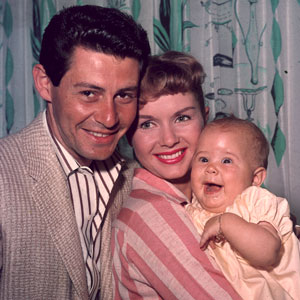
Since the plot is in no way accurate, don't use it as an historical reference. Debbie Reynolds exudes insane amounts of energy as she flails across the screen, probably to prove her worth as she was the third choice for the film. 

I adore Debbie Reynolds, until today, and not only because she's Princess Leia's mother. 
http://images.eonline.com/eol_images/Entire_Site/2010824//300.EddieFisher.DebbieReynolds.Carrie.tg.092410.jpg
There's Carrie!
It is not the best musical, in terms of plot or character development or feminism, but it is vibrant, with breath-taking views of Colorado, and enough feverish dancing to keep me watching. 

Tuesday, January 19, 2016

The Real Alphas

What exactly is a macho man? Probably the biggest tip-off to me that a man isn't is when he bellows and struts. To me, true machismo is internal, reserved dignity, contained strength. 

Even macho as we think of it in the wild isn't. Carl Safina enlightens the animal lovers in "Tapping Your Inner Wolf," which explains that contrary to popular and mistaken belief, alpha dogs aren't full of posturing bluster. Instead: 
“The main characteristic of an alpha male wolf,” the veteran wolf researcher Rick McIntyre told me as we were watching gray wolves, “is a quiet confidence, quiet self-assurance. You know what you need to do; you know what’s best for your pack. You lead by example. You’re very comfortable with that. You have a calming effect.”
The point is, alpha males are not aggressive. They don’t need to be. “Think of an emotionally secure man, or a great champion. Whatever he needed to prove is already proven,” he said.
For survival purposes, it just makes sense. The tribe that makes it is the one with effective leadership and team skills. The alpha male is top dog because he gets the job done. 
 http://proprofs-cdn.s3.amazonaws.com/images/QM/user_images/1452023/1951931854.jpg
McIntyre spent years observing wolves. The one labeled "super wolf" fought his enemies like heck to protect his kin, yet was the most affectionate to the little ones. He even pretended to lose in their wrestling games. 
Strength impresses us. But kindness is what we remember best.
Human males and wolves are oddly similar in their roles, although wolves are more reliable as fathers. Wolf packs, also, are not patriarchal; there are also alpha females in the group who call equal shots.

So alpha males and alpha females work together, as partners. Cool.