Wednesday, February 15, 2017

The Dinner Party

Ah, entertaining! We don't do it often enough. When we do, we tend to go a wee bit overboard, so the idea of doing it regularly is a tad overwhelming. Invariably, I forget to bring in the cucumber salad. This time I remembered the salad, but forgot the cookies. My beautiful, beautiful cookies. 

The efforts came out (mostly) so pretty I had to take pictures. 

Ma's pan-cooked salmon, which is how she makes it every week for Shabbos. It was served with a dip composed of mayo, dried dill, and a few cloves of roasted garlic, as well as the almost forgotten cucumber salad and my niece's favorite, tomato salad. 
This one you know already, the Spanish eggplant dip. It was brought out together with the fish, then lingered on the table all night long.
Chicken soup, of course. It's a basic tenet of the faith.

The veal chops were a success, despite being accidentally over-simmered. (The trick is that fish should err on the side of undercooked, while meat can braise away.) It was made by hobbling together a few googled recipes for "pan-cooked veal chops with mushrooms"—by us, meat doesn't get put into the oven unless absolutely necessary. 
For our heimishe guests, out came the old country: kaposztás tészta (cabbage and noodles). However, my local store did not have—gasp—the large square egg lukshen that is tészta (Manischewitz definitely makes 'em), so bow ties were used instead. (Mind, if it wasn't for company, I would have reached for the whole-wheat pasta.)
The other main was my new, improved love, stuffed pepper (töltött paprika). It's so photogenic, I don't know which shot came out pepper—I mean better. Aren't they gorgeous? Or is it just me?

This ended up being more for me than for the guests, but I didn't mind. It was a pleasure to eat it.

Other sides that I neglected to photograph were pan-roasted vegetables (carrots, parsnip, and Brussels sprouts), cauliflower kugel (which stays so stubbornly bland I ended up chucking in nutritional yeast and a head of roasted garlic for flavor, and it totally worked), oven-roasted beets that no one ate (although they were so amazingly sweet! Without any sweetener added!), sautéed sugar snap peas with shallots and sun-dried tomato. 

Dessert was the forgotten cookies, macadamia nuts (the KING of the nuts!), brownie topped with cashew cream (also hammered together from a multitude of recipes). 

Yeah, we totally made too much. No worries, we lived on it for the next week and change. 

Tuesday, February 14, 2017

The Phoenix

How we define ourselves is rather important. Yet plenty of us don't know who we ourselves are, oddly enough, or place emphasis in the least important of areas. 

If I would have to identify myself, the top of the list is not "interest in sci-fi." It's more like the low, low bottom. But someone reading my blog may think I sleep beneath the glow of crossed lightsabers or a Klingon bat'leth. Er, no. 
http://i.dailymail.co.uk/i/pix/2015/07/23/13/2AC5A81200000578-0-image-a-67_1437653112628.jpg
Then there is how we choose to identify ourselves. There is a lady I know, very pleasant, very intelligent, but her only—and I mean only—conversation is her recent, mild medical inconvenience. Nothing serious, mind you, but she is really incapable of talking about anything else. Only about her visits to the dermatologist to treat an annoying rash. When I see her, I find myself casually turning around and scurrying away in the opposite direction.

What about something more serious? Like cancer?

Debra Jarvis, a hospital chaplain who survived cancer, proclaims "Don't Call Me a Cancer Survivor." When she was sick, she was baffled how people assumed her illness would become her identity, predicting she'd promote "pink" awareness. But she had her own personal reaction to her situation, that had little connection to the disease itself.

Yet why should trauma, over which one has no control, become identity? My grandparents didn't identify as "survivors." They had been shoved into a horrific situation and made it through. But that agonizing year did not define them; that's not how they introduced themselves to strangers. "Hello, nice to meet you, I'm a survivor." 

Identity is inside out, not outside in. It's how I choose to react, what I choose to enjoy, what my natural talents and interests are. 

Jarvis tells over how a fellow cancer survivor couldn't get out of the loop of telling everyone her story, even when finally in the clear. She liked the attention that her sickness brought her, but didn't realize that by harping on the past, she was pushing others away (like my clueless lady friend). Jarvis bluntly told her she had to "Get off her cross."
You may think I was a little harsh with her, so I’ll add that I was speaking out of my own experience. Years before, I was fired from a job I loved. Afterward, I wouldn’t stop talking to everyone I met about my innocence, the injustice, and the betrayal until, just like with this woman, people were walking away from me.
I realized I wasn’t processing my feelings—I was feeding them.
But with any resurrection story, we know that you must die before you can be reborn. Jesus was dead for a whole day in the tomb before he rose. For us, being in the tomb means doing our own work around our wounds and letting ourselves be healed. We have to let our old story go so that a newer, truer story can be told about who we are.
What if we lived in a world without survivors? What if people decided to claim their trauma as an experience instead of taking it on as an identity? It could mean the end of being trapped by our wounds and the start of defining ourselves by who we are becoming.  

Monday, February 13, 2017

Chicken Soup for the Kishkes

Like kale (which I can't warm to) and turmeric (I dose myself with it), bone broth is the trending all-healing elixir of life (although there are nay-sayers). Jews and their chicken soup go together like Gene Kelly and dance, so all that's needed is a minor tweak in the preparation. Maybe not so minor. 

Around the time I decided to attempt bone broth, I read this article ("The Golden Bowl") about new and improved chicken soup by Julia Moskin. Cooking soup for hours isn't necessary, she admonishes. Chicken skin is made mostly from collagen, not fat, so don't remove it before. (And I get really excited about collagen! But not so excited to use chicken feet. I'm still scared of those.)

I tried hers first, barely simmering it for exactly 90 minutes. I had used chicken bones and turkey legs; the meat from the legs hadn't quite reached the fallen-off-the-bone tender state that I expect. The soup was quite flavorful (I used only a sprinkle of salt and relied on red pepper flakes and bay leaves), though. 

The next attempt was bone broth. Most recipes involve simmering for at least a day; some grudgingly allow a few hours minimum. Mine went for ten. Not a beef eater, and unwilling to wrangle with so much fleishig-ness, I relied on my go-to, chicken and turkey bones (I find turkey bones has insane taste. "Insane" as in "good.")

So, I chucked into the official chicken soup pot: 

1 package chicken bones
1 package turkey bones
1 HUGE onion (Spanish onions have been gigantic lately)
2 stalks celery 
2 carrots
2 turnips (I like turnips. Would have put in parsnip too, if I had it)
2 bay leaves
generous sprinkle of red pepper flakes
generous sprinkle peppercorns
filtered water to cover   
https://s-media-cache-ak0.pinimg.com/736x/4a/6a/d6/4a6ad68d9d27dbcb213de9a5078cdc7b.jpg
Via Pinterest.
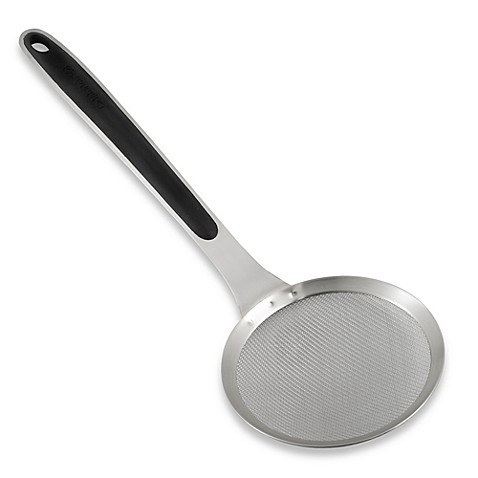
I brought it to a boil, then lowered it down to a simmer, to what Moskin refers to as "smiling" (I don't like using a violent flame). When nastiness came to the surface, I skimmed it off with the discontinued but fabulous Calphalon skimmer. It looks like this: 
https://s7d9.scene7.com/is/image/BedBathandBeyond/5553114263462p?$478$

After a couple of hours, I removed the vegetables with the trusty skimmer before they got too mushy (and ate them all). Alternatively, one can put in vegetables towards the end. Or in the middle. (Another idea to repurpose chicken soup vegetables: Ronnie Fein's Chicken Soup Burgers.)

After almost four hours, I removed, in shifts, the bones and tugged off the meat. Butchers aren't so careful with getting everything off the carcass, and absolute bounty came off. Then the bones went back into the pot. 

The meat I ate too (and put the rest aside for next few days' lunch. Like I said, bounty). If planning to freeze the broth for Shabbos, one could hold on to the meat for when the soup it done and add it back to the containers. 

It continued to percolate; I added another bay leaf at one point. I turned it off after ten hours so I would not have to stay up past my bedtime to pack it away, although I "could have" left it on the flame all night. But I wasn't brave enough for that. Maybe if I used the blech? Hmm, that's an idea. 

While Ma would use cheesecloth, I held the dope skimmer over containers as I ladeled in the broth. All the gunk and little bits of bone remained behind. 

The results? Yummy, nourishing, and hopefully as gut-healing as they claim. 
http://www.paleoonthego.com/assets/images/chicken-bone-broth-2.jpg
Via paleoonthego.com
The next time I used chicken bones, turkey wings, and turkey legs, removing the meat after a few hours, then returned those lovely bones back to the stock. 

Even though I worked from two supposedly antithetical premises (cooking soup for short and cooking stock for long), I was able to learn from both how to broth.  

Wednesday, February 8, 2017

Accept the Inevitable

"If you take raw garlic daily," I had told her confidently, "you don't get colds." 
http://bed56888308e93972c04-0dfc23b7b97881dee012a129d9518bae.r34.cf1.rackcdn.com/sites/default/files/imagecache/standard/garlic_cloves_chopped_310.jpg
I expected too much of that garlic. It kept me hale and hearty through a trip overseas (I usually return with a leaky nose), through a week (and change) of jet lag, but then . . . 

Leaving work on a Friday afternoon with a song in my heart (and stuck in my head), I couldn't understand why nervous preoccupation gradually edged out my cheeriness. 

The cause? A suspicious rippling in my belly. (A gut feeling! Get it?) A stomach bug cometh, I realized with dread. No. No! I would not accept this quietly! I was going to fight! 

Three times that night, I downed raw chopped and aerated garlic. The next morning I awoke smug—the queasiness and pangs were gone. 

Except now I had a fever. Ha ha. Well, some more garlic then, eh? 

I hobbled about wrapped in a blanket for the rest of the day. I felt crummy, but I have felt crummier. 

Sunday dawned fresh with promise. Except my nose was oddly drippy. Allergies, I thought confidently. My room just needs a thorough vacuuming, that's all. It can't be a cold. I garlicked like mad! 

It was a cold. Good thing I stocked up on Kleenex lotion tissues the prior week. I fished out the neti pot and knocked back echinacea. And raw garlicked some more. 

I must admit that while it was definitely a cold, it was a mild one. My head didn't feel stuffed with cotton wool, my throat didn't hurt, I coughed but a few times. 

My nose was rubbed raw—a Rudolph honker can't ever be avoided—and I did terrorize passerby with a few violent sneezes.  
https://media.npr.org/assets/artslife/books/2010/09/ah-choo/common-cold_wide-258ac39578320d1b0eb6587ba176503ebdbe5bda.jpg?s=1400
I was meant to be sick. No wiggling out of it this time.  

Tuesday, February 7, 2017

Mesorah

For many of us veterans of the frum school system, "funny" or "bizarre" stories of misinformed educators abound. Like when they misquoted sources or outright invented halacha to validate personal chumras. 

When I returned home at night, there was often casual deprogramming following these incidents. "Ma, Ma! My morah said that—" "Ta, Ta! My morah said that—" Between the two of them I managed to emerge 12th grade pitying, as opposed to resenting, my teachers. Bless them, but to grant themselves security for their wobbly nerves they drew lines where none were needed. 

Mesorah was the go-to at home. Mesorah is everything. Hey, if we got it, why not stick with it? There is a comforting security when you do what your grandfather did, knowing he did what his grandfather did. 
http://richardmcbee.com/images/writings/contemporary_jewish_art/Bezalels_Legacy/Rembrandt_Jacob_blessing.jpg
Jacob blessing the children of Joseph, Rembrandt
There is always room for improvements in halacha, of course. Yet showing the kinfauna how it's done by us is first and foremost. Then we can turn to the newly available old texts. (According to the Maharam M'Rutenburg, we "have to" bring in the newspaper on Shabbos. Really.) 

Wajahat Ali mentioned us folk in his article about raising Muslim kids today.  
One potential route in producing “superior Muslims” is to follow the model of Orthodox Jewish Americans and invest tremendous resources and time to create enclosed schools or home schooling co-ops for our communities.
The "superior Muslims" comment was from his friend: 
Hina Khan-Mukhtar, a mother of three in the Bay Area, said the only way is for us to transform into “Super-Muslims,” minus the cape. “In America, you can’t be a mediocre Muslim,” she said. “You have to be the best of the best, and you have to show your kids that you have a ‘superior product’ that you are offering them. There are so many ‘-isms’ calling for their attention and for their loyalty — individualism, atheism, materialism, extremism. Islam needs to trump them all.”
That means parents really have to bring their a-game. While we do send our kids to private schools, but I made it out sane and informed only because of my parents.
Unfortunately for my children, I excel in mediocrity. This Ramadan, I opened my fasts at home with a date and some takeout food. I usually prayed Maghrib, the evening prayer, by myself in the family room. My wife, a full-time doctor, supermom and pregnant with our second child at the time, did her best to join me, but her schedule left her exhausted.
Ali explains how the available options for Muslim community life don't quite fulfill him and his wife. Yet they want their children to be as attached to Islam as they are.
We’re trying to retain so much of the good we inherited from our parents, throw away the rotten parts and improvise along the way. .  . The sources we don’t trust: shady, unqualified imams and right-wing religious material published overseas.
Instead, we’re turning to our peers and our collective best judgment as well as centuries-old traditions.
At home, my wife and I now deliberately pray in front of the kids. I prostrate toward Mecca and recite the Arabic verses out loud.
Ali adores the Islam he was raised with (his mesorah), yet knows it won't survive with misinformation (morahs with an agenda). When kids find out that something isn't true about one thing, they start questioning the whole enterprise. Luckily my folks were always on call to clarify and explain.    
http://elishira.com/wp-content/gallery/artwork/painting-elisheva-shira-a-mothers-morning-blessings.jpg
Elisheva Shira, elishira.com
The Sh'ma says so, flat out: "You shall teach them diligently to your children, and shall talk of them when you sit in your house and when you walk by the way and when you lie down and when you rise up." Parents gots to be constantly talking about it. 
Two weeks ago, during my night prayers, my son came up next to me, bowed and turned his head and smiled. There is no compulsion in religion, nor should there be. It’s up to him and Nusayba to embrace or reject the faith and our traditions. My job is only to plant the seeds with care.

Monday, February 6, 2017

How to Travel II

Every single time I've walked off a plane I've felt like death. This time, I marched off like a human being. The secret? Don't eat.   

Hold on, hold on, I'll explain. 

I'm a suicidal eater; if they put it in front of me, I'll take it, so the first time I heard this was a revelation. It was from a cousin of a cousin, who goes to Israel regularly for her father's yartzheit. She's also like me, happiest at home. On earth. As in the ground. 

I experimented with the idea, which was to refuse supper but accept breakfast. Nope, still felt like death. On this past trip I only sipped water. 
http://www.chocolatesuze.com/wp-content/uploads/images/4261.jpg
Not for me, thanks.
I hopped off with such energy and verve—both coming and going—that I scared myself. 

Maybe because one's body is going at 500 miles an hour, one achieves a state of suspended animation. Maybe airplane food is prepared by the devil. All I know, I felt dope, an experience which has never yet happened. 

But the body is no machine, and after sailing over my threshold upon my return I got the shakes. Oh, jet leg, you sneaky thing. Dizziness, world-twirling, disorientation, the works. 
http://stmedia.startribune.com/images/ows_143351815867233.jpg
For the sake of my skin, I avoid the sun. To be honest, the sun sucks the life out of me. My brother-in-law, I joke, is solar-powered; he drapes out beneath that yellow orb for hours and arises refreshed. I can't move if exposed to strong sunlight for less than ten minutes. 

Yet like a hungry flower, I planted myself in the sunny kitchen, drinking it in. My symptoms eased along with the exposure. My office desk has no window, which I think set back my recovery. If circadian rhythms are out of whack, your body will be coaxed back into shape from the sun's rays. 

I also took melatonin . . . when I remembered to. 

I still required the ministrations of my acupuncturist to fix me up, but for those leery of needles . . . 

Friday, February 3, 2017

TGIF

Some Poems Don't Rhyme linked this TED talk by Guy Winch, and I've already listened twice to his soothing, comforting voice twice.

Thursday, February 2, 2017

Words Words Words

It's a miserable talent to be able to see the topic of "shidduchim" everywhere. Like this article, specifically about race ("Why Calls for a 'National Conversation' Are Futile"), that notes action is not a guaranteed result from talking. 
I've been listening to shiurim lately that mention hishtadlus. Hishtadlus doesn't change—it stays the same. One does their (reasonable) part, and sometimes there are immediate payoffs. Doing "more" hishtadlus, however, is not what is necessarily called for as a response to a seemingly "failed" attempt. 

I always exit calmer after a visit with the family guru. Hishtadlus, he says, is simply how we react to a situation—nothing more. Golly, I love the man. 

A lot of talk is about fomenting the correct action to subvert the current situation, instead of recognizing our own piddling humanity. 

Like shidduchim (I'm getting so sick of that word). "It's because there is no place for singles to meet." Really? With all the "events" and Shabbos meals and mingling in college hallways? "Boys are too picky." That's a generalization. "Girls are too picky." So's that one. "Mothers are too picky." Oh, God gets around them, too, belieeeeve me.
A national conversation involved a large portion of the public talking about both important and frivolous stuff more or less at the same time. The term has since taken on a lofty, moralizing weight. Now the belief in a national conversation is a belief in positive outcomes, in correctives, in shoulds. 
What is the "should" that is the basis of our hysteria? That no one "should" be over 23 and unmarried. When looked at it that way, that seems kind of ridiculous, doesn't it? Okay, let's make it more reasonable: no one should be over 30 and unmarried. I dunno, still a ridiculous premise to get hysterical about, don't you think?

There are people out there who are dealing with waaaaay more serious situations that need help that can actually be given. No matter how much a someone hopes to be my shadchan, she can't force that. Yet I can easily provide tzedakah to assist a needy kallah with buying household essentials. No talking needed, either.  Action done.
The country can’t stop talking about race, because racism won’t let us change the subject. But there’s room to alter how the conversation is facilitated, to strip away the loftiness and self-congratulation. What Barack Obama seemed to be urging in 2013 is precisely what tends to go missing, still, from all of this national conversing: empathy. . . because empathy isn’t a realization you come to by having a conversation with the nation. It’s a conclusion you reach first in conversation with yourself.
Ah, that word: empathy. What is constantly irritating about the conversation surrounding this manufactured "crisis" is how there's always enough blame to go around. Instead of individuals recognizing the Eibishter's Hand in their (and others') lives, they opt for a scapegoat to shove off the cliff.

Everyone should take it easy, on themselves and everyone else. Single people should try breathing again; it's wonderful. Married people don't have to feel guilty, nor should they point fingers at singles' supposed fault. 

It comes down to this: If you have an idea that seems possible (I mean taking personality, background, what-they-say-they're-looking-for, etc. into consideration) then suggest it. Don't call yourself a "shadchan"! Just make a phone call, as a friend. That's all the talking/action that's needed.   

Wednesday, February 1, 2017

The Twilight Zone

"You may think that in 'real life,'" she said grandly, "but this is the 'shidduch world.' And there are rules." 

I didn't have the heart to tell her. She isn't in the "shidduch world"; her oldest is not yet of age. But I'm the ten-year veteran, cookie, and here's a little tip: 

There are no rules in the "shidduch world." The "shidduch world" is CHAOS. 

A rule would be, say, "Shidduchim must be redt first to the boy." That was an old-world one that went out of style along with doo-wop. Most suggestions are casually chucked at me first, followed by the chirping-cricket silence of the dropped ball or refusal.

There are, however, hundreds of self-styled "shadchanim" who, sadly, exploit their false standing to tyrannize singles. My current un-favorite: They want more pictures. 

"Your pictures don't do you justice." 

"Really? I think they do. They passed, with flying colors, the Hungarian parent panel, which is no simple matter. Plus, I'm not on the search for someone who's only interested in how I photograph. If a guy won't go out with me because my photo isn't stunning 'enough,' he's not for me. I'm uncomfortable in the first place with giving out pictures—rather untznius, don't you think?—so just redt it already, thank you." 

"This is the shidduch world—" 

No, it's not the "shidduch world," it's your own bochsvuras, your personal opinion, which is quite another matter—and does not apply to the entirely of singlekind. 

The so-called "shidduch world" does not have the power to negate Jewish values and Jewish law. Not fashaming people is an actual rule in black and white. Being hurtfully "honest" is verboten. The Eibishter makes matches, not humans. Everyone, everyone, has someone for them, who will find their quirks adorable (at least initially).

Whenever I hear of an engagement, the first thing I ask is "How did they meet?" Very, very rarely (if ever?) do I hear "a shadchan with a database." Most often it is friend, sibling, uncle, aunt, Babi, cousin. The people who know us, love us, and sell us, without embarrassment, manipulation, or threats.

If we refuse to let the "shidduch world" to dictate bad behavior, it would get with the program. I don't negotiate with terrorists, and I'm keeping my dignity.