Tuesday, January 31, 2012

Freeeeeedom!

"Why don't you get a smartphone like everyone else?" 

Why don't I? Despite my verbosity I have difficulty adequately expressing my aversion to cellphones, texting, and the like.  

Pico Iyer puts it much better. 
In barely one generation we’ve moved from exulting in the time-saving devices that have so expanded our lives to trying to get away from them — often in order to make more time. The more ways we have to connect, the more many of us seem desperate to unplug. Like teenagers, we appear to have gone from knowing nothing about the world to knowing too much all but overnight. 
More and more services are being offered for not having technology available. 
Distraction is the only thing that consoles us for our miseries,” the French philosopher Blaise Pascal wrote in the 17th century, “and yet it is itself the greatest of our miseries.” He also famously remarked that all of man’s problems come from his inability to sit quietly in a room alone.
Rabbi Dr. Abraham Twersky speaks on this topic. He explains what it means if one cannot handle silence and stillness. Listen to it all the way through; it is very informative.
Even half a century ago, Marshall McLuhan, who came closer than most to seeing what was coming, warned, “When things come at you very fast, naturally you lose touch with yourself.” Thomas Merton struck a chord with millions, by not just noting that “Man was made for the highest activity, which is, in fact, his rest” 
To be unoccupied is to attain the pinnacle of humanity.
We have more and more ways to communicate, as Thoreau noted, but less and less to say. 
Considering my love for the English language, I refuse to succumb to the abbreviated lingo of the texting world, painstakingly inserting apostrophes and semi-colons into the rare textual communication.

The one time I became entangled in a texting back-and-forth was absolutely pointless and incredibly annoying. I was trying to spend time with the ones in front of me, but had to keep checking my phone and tap an obvious response.
Two journalist friends of mine observe an “Internet sabbath” every week, turning off their online connections from Friday night to Monday morning, so as to try to revive those ancient customs known as family meals and conversation. 
The 25 hours of Shabbos is not enough for me to cut myself off from buzzing and humming. I want to be able to hear my brain whenever possible. Would I be able to maintain this blog, oddly enough, without internet disconnection? I don't think so. 
A series of tests in recent years has shown, Mr. Carr points out, that after spending time in quiet rural settings, subjects “exhibit greater attentiveness, stronger memory and generally improved cognition. Their brains become both calmer and sharper.” More than that, empathy, as well as deep thought, depends (as neuroscientists like Antonio Damasio have found) on neural processes that are “inherently slow.” 
If my brain is constantly being distracted, could I be able to think before I speak? Could I be able to see other's pain and try to behave accordingly? Could I realize when I mess up, and ensure that I don't do it again? Being without a phone, I find, makes me more in-tune to others.

The author has never used a cell phone. His reasons? 
None of this is a matter of principle or asceticism; it’s just pure selfishness. Nothing makes me feel better — calmer, clearer and happier — than being in one place, absorbed in a book, a conversation, a piece of music. It’s actually something deeper than mere happiness: it’s joy, which the monk David Steindl-Rast describes as “that kind of happiness that doesn’t depend on what happens.”  
I like it that I can walk in fresh air without my pockets buzzing or music blaring in my ears. If I'm on the train and have finished my book, I like to look out of the window and hear the wheels in my mind turn, instead of waiting for a text. I make a point that if I enter a party and have no one to talk to, I won't whip out a phone. That keeps me open to meeting someone new. 

I like keeping my brain unoccupied and unstimulated so I can think. It is at those times, while my mind wanders from subject to subject, that I have had the most life-changing epiphanies. 

I shouldn't feel defensive if someone questions my choice to remain relatively unconnected. My usual response when someone asks why I remain cell-less is "I don't always want to be found."  

I regularly leave my phone at home, perhaps for the same rallying cry that had Scots daub their faces in woad and run screaming with axes at the English army. 
http://losangeles.bitter-lemons.com/wp-content/uploads/2010/03/braveheart.jpg
For freedom.

Monday, January 30, 2012

Get Thee to a Nunnery

She looks worried, and I'm not sure why. 

"Well, um . . ." she begins, "that guy I was telling you about? It seems that . . . " she wrings her hands. 

He said no? This reaction seems a bit overboard.

"He . . . he . . ." 

He's a serial killer?

"He got engaged." 

That's it? 

"Oh, how nice!" 

She looks at me suspiciously. 

For the most part, whenever I hear that someone got engaged, even if the guy was a potential date, I'm happy for them. After all, if he got engaged obviously I'm not his bashert, right? 

"But I'm so sorry," she continues. "Are you okay?" 

Um, I never met him before. Why should I care? 

"How about that other guy you mentioned?" 

"You're still on that?" she replies, a tad annoyed. 

Well, yeah. Just because a complete stranger got engaged doesn't mean my life is over. Picture it: sobbing of epic proportions in a darkened bedroom surrounded by empty ice cream tubs sticking to the floor as I mourn the loss of a guy I never met. 

Pass a spoon. So I can throw it at you.  

Friday, January 27, 2012

She is Hungarian! (Not)

When I first read the play Pygmalion I was in high school, and had already memorized My Fair Lady. It was then that I first came across the endnote that Eliza marries Freddy and the two live a happy life of shabby gentility. 

At first I was horrified - married to that idiot?  

It was years later that I finally realized: Professor Higgins is a meanie. 

I am never able to tolerate fictional or real relationships where one side is constantly mocked and mistreated. If two men court a woman, one all respectful adoration, the other snarky and making jabs at her expense, seriously, who truly cares for her? 

Pygmalion was based on a Ovid's artist of the same name who carves a statue of a beautiful woman. He "falls in love" with his own lifeless creation, finding real women unpalatable. After bringing a sacrifice to Venus (the goddess of love), she fulfills his wish to animate his beloved. 

And the two live happily ever after. 

Shaw's Pygmalion is built on that premise, but with a twist; Higgins takes this "squashed cabbage leaf" and by reforming her dialect, grants her a new identity in class-conscious England. He also treats her unkindly as his property, being his "creation."

In that last, stupendous showdown, Eliza proves her independence from him (even though he takes credit for that as well) and marches off, seemingly, to realize her own destiny separate from her Pygmalion. 

Shaw had it that she marries Freddy, who, while not the brightest bulb, worships her outspokenness and vitality. 

In the fabulous 1938 movie adaptation of Pygmalion, the ending is changed; the producers insisted upon a "happy" ending, where Eliza returns to Higgins, who realizes that he mourns her departure. Here's the full film; I highly recommend it. Thankfully it is closed-captioned. The great tell-off scene begins at 1:25:20 or so.  
This new ending takes the reworking to another hurtful level by having Higgins covering up his joy by callously demanding his slippers. 

As a child, of course I expected Higgins and Eliza to marry. When I watch it now, it is clear that if a bully like Higgins proposed to me, I would sock him in the nose first. 

Despite my disillusionment, My Fair Lady is a gorgeous film, of bright colors and vibrant songs and fabulous dialogue that does not get smothered in the music. 

Shaw's other themes, like the evolution of middle-class morality, are still explored (Morality did not exist, either amongst the wealthy, who did what they liked, and the poor, who couldn't afford it. With the rise of industry and the middle-class, they brought with them morality and religion, which was rather tiresome for the poor as well as the rich. Moving on.) 

Despite the fact that Eliza returns to be Higgins' whipping dog, I shall dwell on the film's merits as a musical. While Julie Andrews portrayed her on Broadway, she was not considered to be a big enough name for the film. 

This video dubs Andrews' voice over Marni Nixon's (Hepburn's dubbed singing voice). Oh, Julie. WHAT a voice. 
When I listen to Hepburn now, her voice distinctly bears an accent; I am no teacher of phonetics, but I can tell she is not a British-born. They should have gone with Julie Andrews, but I suppose Hepburn is all right. 

Thursday, January 26, 2012

Oh So Lonely

I have noticed that after men marry, if they find themselves alone they are frantic. If they were so unfortunate as to lose or misplace a spouse, they are swift to rectify that omission, not finding their new single state remotely attractive. 

There was an episode (entitled "Pasadena") of the short-lived Law & Order: LA, which was a knockoff the the John Edwards scandal. His wife dying, her husband had already lined up a replacement wife who was also pregnant with his child.  

The female ADA Price was perplexed, but Morales (Alfred Molina), says, "You're young; you don't understand. It's the one thing men fear most: being alone." 

Dominique Browning analyzes this phenomena. She finds herself now without a man, and she is giddy. 
. . . of course, if we were lucky enough to fall madly in love with someone again, we would gladly trade in our single ways and hitch up.
But the key word is “madly.”
Because many women, once released from marriage, seem to feel that it would take an act of madness to move back into a setup that involves not only housekeeping in all its manifold time-sucking beauty but also husband-keeping.
Men do seem to require a lot of maintenance. 

After falling on her driveway, with no spouse to assist her, she has an epiphany. 
Until I fell, I never understood exactly why men were so loath to remain alone. Surely it wasn’t just a sexist reliance on having a mate who did the shopping, cooking, nesting, scheduling and child-rearing? All around me were plenty of men who pitched in at least a little on all those things, men entirely capable of taking care of themselves.
Men do not want the security of dinner. They want the safety of someone who will have their back.   

My father went to be menachem aveil a widower. The man wailed, "What's going to happen to me? Who will take care of me?," despite the fact he was as rich as Croesus and could easily employ an army of people to ensure his well-being. He remarried in record time. 
Home is where I am supposed to be safe.
And that’s when the circuit breaker tripped. Men are hard-wired to feel danger all the time. I know there must be science around somewhere to back up this assertion, but seriously, that’s what makes a man a man. A man is on guard because that is his job.
Her perspective is that a man, as the quintessential hunter gatherer, expects danger, no matter the surroundings. Whereas women, as nesters, equate home with safety. 
We love our nests. We tend them, and in exchange we expect them to keep us snug and warm and serene and safe. Which, generally, they do. Because nests are reliable. 
But men know that even the home can fail them. Which is what she learned when she hit the driveway. 
Women do not walk around alert for danger. Nor do we feel that being alone is dangerous, except in the rare instances when we fall and crack our tailbones. Women are hard-wired to read the signals that keep us from danger, and, when confronted by trouble, we escape, fleeing into our homes. 
But who will help you up when the nest can't? 
Suddenly, everything I learned in the ’70s seemed refreshingly clear-eyed. A woman needs a man like a fish needs a bicycle.
Now I understand why a man needs marriage like a fish needs water.
At least, alone, it is quiet enough to hear myself think. But the guys may have a point. 

Wednesday, January 25, 2012

Genug Already!

It is getting incredibly tedious, but I it appears I am stuck in the roundabout of redting. 
https://blogger.googleusercontent.com/img/b/R29vZ2xl/AVvXsEjJYCOa5dR4i3tPvXLg_XDdkxPhabSO9U8jWzQ2xNWIxlqdSwQM2SHFdAejG6Mh5g2leBVxm81zmfAkrahYJ9ml_TfxLYqYgVr45nZnhy3BdhNgEnKaxCDAmUMvtEmHYBrTTRZHEs1ivqCP/s1600/RoundJamWeb.jpg
Every time the phone rings, it is for one of three guys: Ponda Boba, Greedo, or Bren Derlin.  

I am seriously considering developing a taste for alcohol. 

While Bren does not deserve any remarks, the first two do. It takes nearly every ounce of self-control not to break into Xena-whacking mode when someone coos that Greedo sounds like SUCH a catch, or that Ponda is SO nice.  

Wine, please? 


Rather, hit me over the head with the bottle. 

Tuesday, January 24, 2012

I Fried!

I had come across Busy in Brooklyn's recipe for cheese latkes, and decided I was going to make them for a family Chanukah brunch. This was major, since Ma doesn't quite trust me with the stove ever since I melted a Tupperware lid in 1998.

My nephew can't process gluten, and I thought I had a more pleasant alternate flour in the house (like almond meal), but I was stuck with garbanzo bean flour.  

I decided to try it anyway.

I whisked the flour, eggs, and cheese together, and tasted it. It was nasty; the bean flour tasted distinctly like bean flour.  

"I have to chuck this," I said with despair to Ma, who was prepping the fish. 

"You'd be surprised what sugar can do," she said.  

I added the sugar, a dollop of vanilla sugar and a dash of vanilla extract. The next taste was somewhat improved, but not amazingly so. 

"You'd be surprised what frying can do," Ma said. 

With despair, I warmed up the pan, unwilling to put good ingredients in the garbage. 

Luke arrived, arms laden with children.  

"Oooh, cheese latkes!" He plucked one, fresh from the pan, and popped it into his mouth. I winced. 
http://www-tc.pbs.org/food/files/2011/12/Cheese-Latkes-Wide-602x451.jpg
Via pbs.org
"Man, these are good!"  

My eyes widened in shock. 

The nephew with celiac disease loved it, and kept scurrying into the kitchen for more; he usually has to be begged to eat anything.  

Another nephew, scrawny from disinterest in food, crowed merrily that he could eat ten more plates of these. 

I stood for two hours, frying steadily; as soon as a latke was taken off the fire, it was claimed by greedy hands.  

When I finally sat down, the last latke was being fought over. 

And I felt great. There is such satisfaction in making something that everyone loves and is pretty nutritious, since garbanzo bean flour is high in fiber and protein, and I used the tamest of cheeses, cottage.

"Can you make this again?" the nephew without digestive upsets begs. 

"You betcha!" I assure him.  

Behold, future dates! I can fry!

Monday, January 23, 2012

Battle of the Bulge: Start Small

A few weeks ago the NY Times Magazine had a cover, "Do You Have to Be Superhuman to Lose Weight?" 

The story within, "The Fat Trap," related that it appears to be that when obese individuals lose weight, their body fights against it; eventually, they have to consume less to maintain the same weight as someone else, since their bodies are not happy about this drastic change. 

The study referenced took a control group of obese individuals and put them on a major diet, restricting their portions to specific shakes and two cups of veggies a day. For those who stuck with it, the average weight loss in ten weeks was 30 pounds. Then the subjects were taken off the diet; many regained the weight. 

I don't think that any means of successful weight loss will involve extreme starvation; people do not become unhealthily heavy overnight, so it cannot be they can remove that weight suddenly and keep it off. 

I would think that if one wanted to take control of their weight, they have to start small. Like no processed or take-out foods. Introducing less refined flours into their diet, and fruits and vegetables. And when they are victorious in healthy food habits, moving on to portion size.

If the body experiences gradual weight loss, the way it experienced gradual weight gain, maybe it won't react so strongly to loss of pounds.  

While I was not categorized as overweight (being tall has its perks for pound distribution), I implemented methods to control my eating. I would take up a step, and I managed to maintain it to the point where it became routine, rather than an effort. After nearly a decade, I've had to date a 20 pound weight loss, the most recent five pounds lost this year. 

I've been relaying how I did it, and I hope those who have weight issues out there will opt for a healthier means rather than shortcuts. For instance, on Dr. Phil there was a woman who had bariatric surgery, but she never actually dealt with her food addiction. Since she couldn't eat because her stomach would explode, she became a shopaholic.

Something that major will not be able to be solved by sudden, drastic measures; it has to be undertaken with patience and determination. As in many things in life.

Friday, January 20, 2012

Not A Cloud, But Darn Close

Sleeping used to involve a level of steps. 

I could only remain on either my left side or on my back. I can only fall asleep on my right side, see, and if I rolled too soon there than I wouldn't be able to fall asleep, since I can only do that when already dozing off. Then I would have to make sure to tip myself over the right side, since on my left side or on my back I would just remain in a state of suspended animation, not actual sleep.  

It's simple when one gets used to it. 

I began to notice that I was sleeping better in practically every other bed, including the ones that fold out of a sofa. Meaning, that my regular bed should cause me such problems is not normal. 

The few times I dared to sit on others' memory foam mattresses I nearly wept in comfort. Not willing to invest in an entire one, I searched for a mattress pad; my mattress itself is still in good condition.  

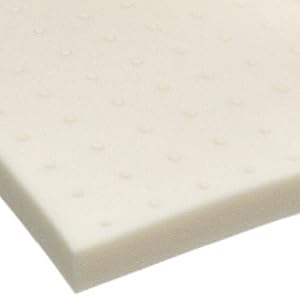
And found one that is really loved: Sleep Studio 2" Visco2 Ventilated Mattress Enhancer. I bought it, waited eagerly in the doorway and nearly did a cartwheel when it arrived. 
http://ecx.images-amazon.com/images/I/41ydpF7a3JL._AA300_.jpg
The hype is definitely worth it.  

I can lay down now on my right side without torpedoing my chances of sleep. I can remain in the same position for eight hours and I won't ache in the morning. My blankets remain perfectly tucked around me, instead of my flailing them on the floor whilst tossing and turning. 

I look forward now to the night, when I slide under the covers and unintentionally go "Aaaaaaaah." 

Now, on nights when the kinfauna (tips to Bad4) invade, it is not a surprise to walk into my bedroom to find my niece in my bed. 

"Get out!" 

She grumbles as she moves into the other spare bed, and I crawl into mine.  

"Aaaaaaaah." 

*Be aware that the mattress pad has a distinct smell of mint after unpacking it. That dissipates after a few days.

Thursday, January 19, 2012

Unthreatening Vegetables

Cooking shows, while being informative, can leave one with a flayed ego. 

Chefs condescendingly prattle about species of squash I never heard of, claiming it's available in the local market (not mine). They use spices like rosemary that I can't stand - even the name "rosemary" sounds like a female I wouldn't be able to stand in real life. They whip out alien contraptions which, they claim, is the only way to properly extract garlic.
http://glutenfreedomatlanta.com/wp-content/uploads/2011/09/barefootcontessa.jpg
Blah, Barefoot Contessa. Blah.
Tamar Adler strives to change that faulty image of dinner having to be a masterpiece. In her book, she educates the reader that recipes are not a given, that with the knowledge of how to properly boil water, one is a free agent. 

Many of today's generation have not witnessed home cooking first hand, she says, so they think home cooked is what the television personalities do oh-so-annoyingly.

The article made me consider my own approach to vegetables. 

Often, for a meal, when I have access to a stove, I just throw into a pan with some extra virgin olive oil, salt, pepper, and garlic powder any vegetable available. Sweet potato, mushrooms, parsnip, canned beans, frozen spinach, broccoli, or peas. For added oomph I saute an onion. The steaming resulting mess is absolutely delicious as well as nourishing; I can sense all those vitamins and minerals rushing throughout my bloodstream.

But it would seem my water boiling leaves much to be desired.

Wednesday, January 18, 2012

Feed Me

"Can you cook?" he asks casually. 

I pause in middle of twirling my pasta. Uh-oh. 

"I can cook," I attempt to explain, hoping a defensive note wasn't creeping into my tone. "It's just that when you live with an amazing chef like my mother, any of my efforts are kind of moot." 

He nods, and asks something else, but I have a feeling I just flunked the test. 

He is not first, nor the last, guy to ask. I try to dazzle them with my other hobbies - shopping ("Do you need a suit? You're a 42 Regular, right?"), painting ("Well I wouldn't say I was Michelangelo, exactly . . . "), super child-raising skills ("By the time my nephew was sent home he was not only potty-trained, he could make omelettes.")

He takes in all these tidbits with a pleasant smile, but I know that on his mental checklist, I have been crossed out. 
https://blogger.googleusercontent.com/img/b/R29vZ2xl/AVvXsEgfmAl8TeYrRovl-brbpjDqjL3z-OoIJMHwssd7wvqN9k7iKCmoY5rychBYPfJfsq3S-0we74NR-9gq7R4aZl7X3tKmWxPcChFegurGcCDZbfVHORkpJHdG7q79BVNM1m7fQhCHSQrjqsS1/s320/feeding+husband.jpg
Am I imagining it, gentlemen?