Thursday, January 24, 2013

Myth: Happily Ever After

Disney and Hallmark has a lot to answer for.

Our perception of love and marriage is quite skewed; many of us clutch to ourselves overblown and unrealistic perceptions of infinite bliss that accompanies couplehood.


hen you first meet a guy, you breathlessly rhapsodize, “He's the strong silent type.” After ten years, you shriek, “What are you, mute?!”


Wednesday, January 23, 2013

Careful Kitten Heels

You know the Yiddish saying, Nisht a'hair nisht a'heen ("Neither here nor there")? That is pretty much my objection to kitten heels: Pick a side. 

Are you a high heel or a flat on steroids? Make up your mind!

Whatever benefits gals seek from heels, kitten heels will not provide them. I just don't think they suit feet in general—they just end up looking larger.

It's sort of like the mid-calf skirt. By virtue of the fact that it is in "the middle," it is already unflattering. 

Some are down on flats, but really, a proper ballet flat is so pretty and sharp. Heels have to be, well, heels. 

To quote Rita Ora, current "it" girl: 
“Like the kitten heel, I hate,” Ms. Ora said, cringing. “Either wear a heel or don’t wear a heel, O.K.?
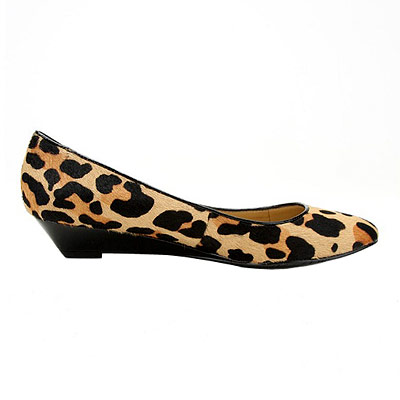
It really depends on the shoe, but if it around the 2" mark be very cautious; make sure it actually makes your foot look good. If it is any lower than that, opt for a flat or a wedge instead. 
http://img2.timeinc.net/instyle/images/2010/GalxMonth/03/031110-steven-blend-400.jpg
Steve by Steven Madden "Blend" Wedge

Tuesday, January 22, 2013

Battle of the Bulge: It's His Fault

I have discussed the importance of chewing, and my own recent discovery of the art. 

But from where did I learn such frantic consumption of food in the first place? 

Apparently, just by having siblings. George Howe Colt brings a myriad examples of celebrity families, and how the children would grimly fight over every morsel. 
Frederik Van den Stock
I'm the sort of eater that I save what I like the best for last on my plate. It has happened more than once that a fork will suddenly appear and skewer my hoarded stash. "Aaaaah!" I wail. "What, you weren't eating it!" mumbles the munching mouth. 

I started eating Shabbos meals in the kitchen.

Perhaps my rapid swallowing of yumminess that comes my way is from the trauma of having resources snatched from my grasp. 
We still eat as if we were in a race — my wife says she’d never met anyone who ate as fast as I do, until she met my brothers
But now the other competitors have flown the coop, leaving me with my bad habits. Now, I am finally free to enjoy, to savor, to slowly consume my supper while idly flipping through the paper, unafraid that my honestly gotten gains will have vanished if I step away from the table.

When they visit some of that anxiety comes over me again; I apportion myself too much sweet and sour chicken, zucchini kugel, and unstuffed cabbage, more than I could or should eat or want, looking furtively over my shoulder, darting to a dark corner to huddle over my meal. 

Another secret to staying slender . . . be generous.       

Friday, January 18, 2013

The World is My Runway

My inspiration for this idea comes from, oddly enough, Yitta Halberstam. She made it very obvious to me how one carries oneself can make all the difference. (She didn't realize her point while she was making it, but I am firm in my belief one can learn something from everyone.)

My conclusion from her article was that it is not the looks that we are born with that hold us back, it is how we present ourselves to the world. If someone is crippled self-consciously, even if she had been blessed with the best genetics can offer, she will then be less charming, less personable, less attractive. 

If someone doesn't feel that inner verve, then one has to adopt it externally. 

"Why are you so calm?!" a friend snaps. 

"I'm not calm; not by a long shot. My nerves are frayed inside. I just pretend to be calm." 

Like at times when I'm in the car with a dangerously driving date or, better yet, my Hatzolah member brother-in-law; my innards may be clenched to pieces but I smile serenely, unwilling to let him push my buttons, even when he steers with his knees. 

Confidence is less about actuality and more about how one acts. I make a conscious decision to walk with my back straight, my head held high, no matter what thoughts are going through my head. That affectation of security does wonders.   

I have become mistrustful of those who are insistent as to their qualities. "I'm confident," she says. "I don't care what other people think," he says. But from the way they behave, they aren't as confident as they would like to believe they are. 

Never mind about saying it. Just fake it, and walk that runway like you own it. Even if you are just getting some milk. 
http://storage.canoe.ca/v1/dynamic_resize/id/17128008/?size=400x400&site=blogs&authtoken=3ef318efc0d861959b4b4c43bdd7f1d6&quality=90
Don't plod. Don't slouch. Don't frown. 

Chin up. Eyes strong. Smile. 

And down that runway you go. 

Thursday, January 17, 2013

Less Brimstone, More Support

David Brooks cited a letter written by Nick Crews, a British father who could no longer stand to watch the undisciplined lifestyles of his children. He sent them a stinging e-mail, now referred to as "The Crews Missile." 

Captain Crews, while he does have a point, is not completely in the right; being in the navy means dad isn't around to be a father. Then he shipped his kids off to boarding school. My take: What did you expect, Daddo?

Brooks' disagrees with Crews' angle for another reason: haranguing does not encourage change. 
People don’t behave badly because they lack information about their shortcomings. They behave badly because they’ve fallen into patterns of destructive behavior from which they’re unable to escape. 
Crews had signed off his letter that his children should only contact him once they have worked out all their issues. That's not remotely helpful, Brooks says. 
It’s foolish to imperiously withdraw and say, come back to me when you have a plan. It’s better to pick one area of life at a time (most people don’t have the willpower to change their whole lives all at once) and help a person lay down a pre-emptive set of concrete rules and rewards. Pick out a small goal and lay out measurable steps toward it. 
Rabbi Yisroel Reisman once said the age of fire and brimstone ended with Yirmiyahu HaNavi. That's right, Churban Bayis Rishon. That was approximately 2,500 years ago.
 http://www.conversantlife.com/files/imagecache/blog_wizard/files/blog_wizard/Fire+and+Brimstone.jpg
Children learn from observation, Captain Crews. If a father is never there, what will they learn? Self-survival. Which can manifest as selfishness. 
Human behavior flows from hidden springs and calls for constant and crafty prodding more than blunt hectoring. The way to get someone out of a negative cascade is not with a ferocious e-mail trying to attack their bad behavior. It’s to go on offense and try to maximize some alternative good behavior. There’s a trove of research suggesting that it’s best to tackle negative behaviors obliquely, by redirecting attention toward different, positive ones. 
As an example, if one has an issue with overeating, I would not recommend starvation as a method; rather, replace bad foods with good ones, and eat as much as one likes. Eat apple after orange after banana, instead of chips then cookies chased down with soda. Now that behavior has been replaced by something healthier. Eventually the next step will be to cut back on portion size.

When it comes to bad habits, real change can be achieved only with support. That's the point of A.A.; even when strangers have got your back can one succeed. Crews didn't raise his children, then he is furious at their behavior and decides to cut off contact, leaving them more lost than ever.  

To quote Rabbi Reisman again, he asks why "friend," rayah, has the same root as rah, meaning "bad." Because a friend, a real friend, knows your shortcomings and still accepts you as is. That is why a new couple is called rayim ahuvim—they accept each other as they are, warts and all (initially, that is . . .)

Back to his observation on the end of fire and brimstone, change is from positive encouragement, which is especially needed in today's insecure society. We doubt ourselves constantly, as well as our ability to triumph over our lesser natures.  

Chief Rabbi Lord Sacks explains why Yehudah is the ancestor of our melucha, as opposed to Yosef, the tzadik.
Tamar is the heroine of the story, but it has one significant consequence. Judah admits he was wrong. “She was more righteous than I,” he says. This is the first time in the Torah someone acknowledges their own guilt. It is also the turning point in Judah’s life. Here is born that ability to recognize one’s own wrongdoing, to feel remorse, and to change – the complex phenomenon known as teshuvah – that later leads to the great scene in Vayigash, where Judah is capable of turning his earlier behaviour on its head and doing the opposite of what he had once done before. Judah is ish teshuvah, penitential man. 
In the same shiur about rayim, Rabbi Reisman says that Yehuda sent a goat to the woman with whom he had an "encounter" via a friend, rayayhu. Despite the fact that that incident was not Yehuda's best moment, he was honest with his friend as to the goat's purpose. He could have made up a story, claimed it was a belayed payment for rent, or something like that. But the only way this friend was truly rayayhu means that the friend knew all. 

It was then that Yehuda took the first step toward teshuva, when he has his friend by his side, not his brothers. 

Captain Crews thought he was being his children's pal, when he should have been a parent. He was no friend, in any sense of the word, then, nor is he one now. 

Wednesday, January 16, 2013

I Will END You

Before I launch into my post, kindly read this article from The Lakewood Scoop, entitled "There is NO Shidduch Crisis—Mazel Tov!" He pretty much echoes my sentiments, although I don't agree with every point. Thanks to Jewish Dating Chronicles for linking it. 

8D8 must be planning to take me somewhere really nice and exotic, I thought, as we cruised past three Starbucks and two hotel lobbies. 

He pulled up in front of 7-Eleven.  


In November, yet.


Why didn't I wear boots?

Tuesday, January 15, 2013

The Tao of Kermit

No matter what we claim, on some level, we care what others think. From childhood on, we seek to be accepted, even at the risk of silencing our own inner selves. 

Martha Beck fabulously provides advice for how to deal with external judgment. She begins that an individual has a generalized view of what "everyone wants" from them. Then we base our behavior on what this mental panel desires, not how we desire to live. 
Much of my life has been dominated by Everybody Committees that were totally misaligned with my true self. As a result, I did things that held no joy for me, never felt I was good enough, and believed that if people knew who I really was, they'd hate me. Sound familiar? You, too, may live in fear of being rejected by your Everybody Committee if you set out to live your best life. And you know what? Your fear is well-founded.

Each time I've chosen to live more authentically, I've been roundly rejected by my Everybody Committees. There's my old Religious Committee, who will gladly tell you I'm going straight to hell; the Intellectual Committee, who believe I'm a delusional moron; and the Classy Materialist Committee, who cannot believe I wear a plastic watch from Target in publicity photos. All these folks are still alive and kicking (kicking people who don't share their values), yet every cell of me knows that what they think of me is none of my business. 
How to ignore the judgmental expectations of others who should truly have no say? Get a new mental panel. 

If there are people in one's head that ever belittled one, kick 'em out. Now, replace that fresh vacuum with someone who is one's own personal cheerleader, a provider of unconditional love. 
If you don't know any unconditionally accepting people, you must find one. This person doesn't actually have to be alive. Or even human. If you're stumped, consider these candidates: anyone who treated you with respect and kindness when you were little (a teacher, your nana, Kermit the Frog); any author, blogger, or performer whose work makes you feel understood and encouraged; any nonhuman mammal that loves you (in a pinch, a highly affectionate bird will do); your higher power.
For a constant boost, get some Kermit slippers for emotional as well as physical snugliness.
This may sound like a slippery slope to narcissism, if someone needs this exercise to begin with than the ego has a long way to go before hitting self-obsession. Loving oneself is a necessary component to give on healthy affection to near ones.
I began my current Everybody Committee with a possibly fictional Chinese philosopher who died 2,500 years ago.
In order to solidify the selection of one's personal life coach, one has to hang around them as much as possible by association. She explains it in the article better. 
I want you to oust your internal critics, the ones who say you're not good enough, who think you're on the wrong track. I want you to be supervised, all day every day, by people who forgive your errors and believe in your destiny. I hope you try this method of achieving that. And if you think that makes me a bit smarmy or completely insane, go right ahead. That's really none of my business.